Keeping Your Float Afloat: A Guide to Earning What You Deserve on Your Cash
Membership required
Membership is now required to use this feature. To learn more:
View Membership Benefits Advisor Perspectives welcomes guest contributions. The views presented here do not necessarily represent those of Advisor Perspectives.
Most of us keep a chunk of cash on hand — for rent, groceries, the occasional emergency, or simply because we haven’t gotten around to investing it yet. In the finance industry, this is called your “float,” and we think that’s a term worth borrowing. Float is the cash that’s passing through your hands on the way to somewhere else. It’s not meant to grow your wealth over decades, but that doesn’t mean it should be earning nothing.
And yet, for a surprising number of people, that’s exactly what’s happening. We think the single best thing most people can do with it is own a Treasury Bill ETF — and yet almost nobody does.
T-Bill ETFs: The Best-Kept Secret in Cash Management
There are currently about $7.5 trillion sitting in US money market funds.1 T-Bill ETFs add up to just 1% of that total. That’s a remarkable disparity, because for most people, a T-Bill ETF is the best product available: lower fees, higher yields, full state-tax exemption, and — thanks to several recent developments — almost as close to cash-at-hand as a money market fund.
Why so small? Mostly, we think it’s due to lack of awareness. Most individual investors have never heard of them. That’s not an accident, as most players in the financial industry have little incentive to promote them. Banks and brokerages earn substantial revenue from the spread between what short-term Treasuries pay and what they pass along to customers in savings accounts, default cash sweeps, and money market funds with hefty expense ratios. T-Bill ETFs, which charge as little as 6 basis points, threaten that business. It’s no surprise the industry isn’t out there singing their praises.
The timing is also relevant. T-Bill ETFs have become much more attractive in recent years thanks to a confluence of developments that didn’t all exist a decade ago. Zero commissions on ETF trades eliminated what used to be a meaningful friction cost for smaller balances. The move from T+3 to T+1 settlement has made ETFs nearly as liquid as money market funds — sell today, cash tomorrow. And T-Bills themselves have become more competitively priced: They used to trade 25–75 basis points below the safest other short-term assets, such as secured “repo” lending against Treasury bonds. Today, with the huge amount of T-bills on the market (about $7 trillion) that gap has largely closed, making T-Bills a much better deal relative to other short-term instruments than they were historically.
There’s one more advantage worth emphasizing: T-Bill ETFs are far simpler and more convenient than trying to manage Treasury investments yourself. You could buy T-Bills directly at auction through TreasuryDirect or your broker, roll them manually at maturity, and sell them in the secondary market when you need cash — but it’s a hassle, and the bid-ask spreads on individual bills can be wider than what you’d pay on an ETF. With the VBIL charging just 0.06% per year, the convenience is well worth the cost.
Two ETFs stand out:
SGOV (iShares 0–3 Month Treasury Bond ETF): The largest and most liquid T-Bill ETF, with approximately $85 billion in assets and an expense ratio of 0.09%.
VBIL (Vanguard 0–3 Month Treasury Bill ETF): Less expensive than SGOV, with an expense ratio of just 0.06%, and growing rapidly — its assets have reached approximately $7 billion. While smaller and with lower trading volume than SGOV, the typical bid-ask spread is as tight as that of SGOV, and the three basis point lower expense ratio is a lot better than a sharp stick in the eye (as the British like to say).
Both hold three-month and shorter maturity US Treasury obligations and pay yields closely tracking the current T-Bill rate. For most people, either is an excellent choice.
The (Appropriately) Fine Print on T-Bill ETFs
T-Bill ETFs have some frictions absent from a money market fund, and it’s worth understanding the small costs involved — though as you’ll see, none of them amounts to much.
Bid-ask spreads. When you buy or sell an ETF, you pay a bid-ask spread — the small difference between the price at which you can buy and the price at which you can sell. For SGOV and VBIL, the round-trip cost is roughly 0.01%. To put that in perspective, at today’s rates, that’s equivalent to one day’s interest, or about seven days’ worth of the yield advantage you’d get over a lower-paying alternative. It’s not a big hindrance, but it does mean you should manage your ETF holding so you’re not trading in and out constantly. A sensible approach: keep enough in your money market fund to cover near-term spending and trade the ETF perhaps once a month to top up or draw down. If you occasionally need to trade more frequently than that, it’s fine — just try to not make a habit of it.
NAV premium and discount. Unlike a money market fund, which in normal times will transact at $1.00, an ETF trades on the open market at a price that may differ slightly from the fund’s net asset value. You might pay a small premium of, say, 0.01% when you buy. If you also sell at a similar premium, it’s a wash — no harm done. The risk is buying at a premium and selling at a lesser premium or a discount, which would eat into your return. In practice, both SGOV and VBIL have traded within about 0.01% of NAV over the recent past (and larger deviations to NAV have quickly dissipated), so this shouldn’t be a major concern, but it’s something to be aware of.
Interest rate sensitivity. T-Bills are fixed-rate bonds, just with very short maturities. Their prices do fluctuate a little as interest rates move. These ETFs typically hold securities with an average duration of about 1.5 months, which means if interest rates were to jump by 1% overnight, you’d lose roughly 0.125% in market value. That’s small — much smaller than the yield advantage you’re earning — but it’s not zero.
Settlement. When you sell an ETF, the cash doesn’t land in your account instantly. ETF trades currently settle on a T+1 basis — sell today, cash available tomorrow. Money market funds, by contrast, typically offer same-day liquidity, and bank accounts give you immediate access. For true emergency spending, that one-day difference is rarely meaningful, but it’s worth knowing about.
The Default Settings Are Not Your Friend
Even if you’re persuaded that T-Bill ETFs deserve the lion’s share of your float, you’ll still want a money market fund for the portion you need with less day-to-day predictability. And here, the details matter more than you might think.
Banks and brokerages have a long history of profiting from customer inattention. The traditional setup — a checking account paying zero interest alongside a savings account paying a token rate — exists largely to capture for the bank most of the interest that should be flowing to you. At a time when short-term US Treasury rates are around 3.7–3.8%, almost all checking accounts still pay nothing, and plenty of savings accounts pay well under 1%.
Brokerages aren’t always much better. When you open an account, cash often sweeps into a default option that may pay far less than the best available money market investment. The brokerage earns a spread on the difference. It’s not a conspiracy — it’s a business model. But it means you need to be a little proactive.
Choosing a Platform
The good news is that if you’re willing to spend fifteen minutes setting things up, you can earn close to the full market rate on your float. The best platforms we are familiar with for this are Vanguard, Fidelity, and Schwab — all of which offer zero-commission trading, good money market fund options, and easy access to Treasury Bill ETFs. At all three, you can get many of the functions and services offered by a bank — bill pay, debit and credit cards, check writing, ATM access, etc. Vanguard is a bit light in the banking department, and Schwab money market funds won’t sweep automatically for most account types, so of the three Fidelity is the most “full service”.
Fidelity offers a full suite of banking services, has acceptable money-market sweep options (though you may have to make sure you opt-in to a sweep fund), and no commissions on ETFs trades.
Vanguard is arguably the most investor-friendly of the three. Cash in a Vanguard brokerage account can sweep automatically into a solid money market fund, and you can easily buy and sell Treasury Bill ETFs commission-free. Vanguard also offers some of the lowest-fee money market funds in the industry — though unfortunately, as far as we know, its money market funds are only available to direct Vanguard clients and can’t be purchased on other platforms. At the moment, we believe credit card options are not available at Vanguard, which we hope they’ll remedy in the future.
Schwab is similar to Fidelity; however for most account types, Schwab does not offer a sweep option into competitive money-market funds – they’re available on the platform and can be auto-liquidated, but they must be actively purchased, requiring a bit of extra effort and diligence.
There are other discount brokerage platforms — Robinhood, Merrill Edge, E*Trade, and Interactive Brokers among them — but we’re not as familiar with their money market offerings and other terms of business, so we can’t speak to them in detail.2
Money Market Funds and T-Bill ETFs: A Comparison
Below is a snapshot of some of the best money market funds available to retail investors at Fidelity and Vanguard, alongside the two leading T-Bill ETFs.3 Pay attention to the differences in yield, expense ratio, and — critically — the estimated share of government obligations, which determines whether you’ll get the state tax exemption (more on that below).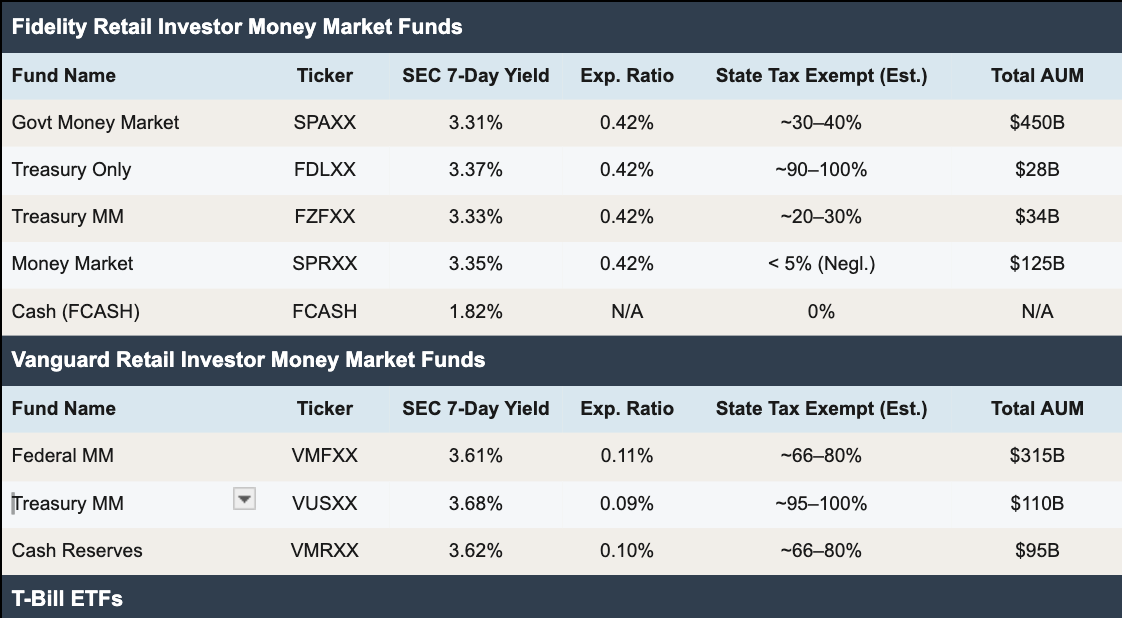
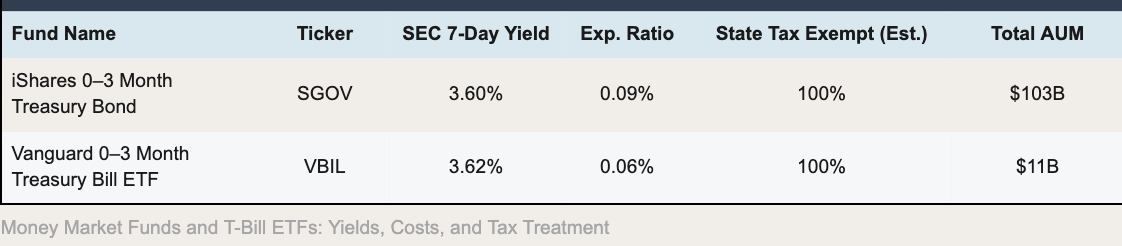
A few things jump out from this table. First, notice the difference between Vanguard’s expense ratios (9–11 bps) and Fidelity’s (42 bps) on their money market funds — that’s a meaningful drag on your return, and it shows up clearly in the yield difference. Second, look at the bottom of Fidelity’s list: their default cash sweep (FCASH) pays just 1.82%. If your cash is sitting in FCASH by default, you’re leaving a lot on the table.
A word on safety: Money market funds are not FDIC-insured. In theory, they carry some risk — e.g. the Reserve Primary Fund “breaking the buck” in 2008. In practice, money market funds that invest almost entirely in US Treasury obligations feel about as safe, credit-wise, as having FDIC insurance. The US government stands behind the Treasuries directly. That’s not a guarantee, and we don’t want to overstate it, but for most purposes, a Treasury money market fund or T-Bill ETF is an extremely low-risk place to park your float.
Our Recommendation
For most people, we’d suggest keeping the bulk of your float in a T-Bill ETF like VBIL — it’s the lowest-cost option, it’s 100% state-tax-exempt, and with T+1 settlement, you can access your money quickly. Keep just what you need for near-term expenses in a money market fund for same-day liquidity. If you have your account at Vanguard, VUSXX is an excellent choice for that purpose: low expense ratio, high yield, and nearly 100% in Treasury obligations, or at Fidelity, FDLXX if you’re subject to state income tax.
The Tax Angle: Why Treasuries Can Be Even Better Than They Look
Here’s something some people overlook: Interest on US Treasury securities is exempt from state and local income tax. This isn’t a niche benefit — roughly 80% of the US population lives in a state with an income tax, and the population-weighted average of the highest marginal state tax rates is about 6.9%. With short-term interest rates at around 3.7%, that average 6.9% tax rate translates into a roughly 0.25% per year advantage for T-Bills over otherwise equivalent short-term investments that don’t carry the exemption. If you’re in a high-tax state like New York or California, the advantage is about double that.
One important wrinkle: Some states — including California, New York, and Connecticut — require that a fund hold at least 50% of its assets in government obligations for any of its distributions to qualify for the state tax exemption. This is why the “State Tax Exempt (Est.)” column in the table above matters so much. A fund like Fidelity’s FZFXX, with only 20–30% in government obligations, won’t clear that 50% threshold and may not qualify for any state tax exemption in those states, even though a meaningful share of its income comes from Treasuries. By contrast, VUSXX and FDLXX, with 90–100% in government obligations, will easily qualify. Check your state’s rules, and pay attention to the fund’s government obligation percentage — it can make a real difference to your after-tax return.
Let’s run the numbers for a high-tax state. Say short-term Treasury rates are around 3.8%. If you’re paying a combined state and local tax rate of around 13%, the state tax you’d owe on a taxable alternative at the same rate would be roughly 0.5% per year. That’s not trivial. It means a Treasury-based option yielding 3.8% can be worth as much as a taxable deposit or money market fund yielding 4.3%.
This is why, if you have a choice between a government-obligation money market fund or T-Bill ETF and an FDIC-insured high-yield savings account at the same pre-tax rate, the Treasury option often wins after tax. And in practice, the Treasury option often wins before tax too.
The High-Yield Savings Account Illusion
Speaking of which — let’s talk about the heavily marketed “high-yield” cash accounts offered by robo-advisors like Wealthfront and Betterment. These programs have attracted over $100 billion, and they’re not bad products. But they’re not as good as they look.
Wealthfront Cash, for example, currently offers a 3.3% annual rate on deposits. They’ll give you 3.95% for the first three months as a promotional teaser, reverting to 3.3% — or as much as 3.55% if you jump through some additional hoops. These are FDIC-insured up to $250,000 per bank counterparty (Wealthfront spreads your deposits across multiple banks to extend this coverage).
Now compare that to US 1-month Treasury Bills, which are currently yielding around 3.7%. But that 3.7% is quoted as a discount yield on an Actual/360 day-count convention. Translated into the same terms that Wealthfront and banks use to quote their rates, that’s more like 3.83%.
So Wealthfront is offering you roughly 3.3% (or 3.55% with effort) on a product that’s taxable at the state level, versus approximately 3.83% from T-Bills that are state-tax-exempt. If you’re in California — where Wealthfront is headquartered and many of its customers presumably live — the after-state-tax gap is even wider.
You could, instead, simply own VBIL or SGOV in a brokerage account at Vanguard, Fidelity, or Schwab, and earn meaningfully more on your float with arguably the same credit risk.
Other 'Short’ish-Term U.S. Treasury ETFs
There are many other low-cost, well-run ETFs that give exposure to short-maturity Treasuries, but we feel that VBIL or SGOV are the best candidates for managing your float. Here are tickers for some other low-cost, less-than-0.05% expense ratio Treasury ETFs, all of which hold longer-than-three-month-maturity assets: VGSH, SCHO, SPTS, and VTIP (which owns short-term TIPS).
Riskier and/or More Complex Structures You May Encounter
Our overall investment philosophy is that you should manage your float in the safest assets possible and take your risk through owning an amount of broadly diversified equities as appropriate for your level of risk aversion and your view of their expected risk premium and risk.
Some investors are drawn to higher yielding short-term investments, such as short-term “high yield” bond funds (e.g. SHYG, SJNK and IBHF). Also, there are some short-term municipal money market funds, but again, we feel the reward is generally not worth the extra risk in this area, as to get full tax benefits you have to concentrate your investment in the credit of the state you live in. As a general rule, we caution against taking risk in your short-term investment bucket– you never want your float to sink, especially when your non-float investments are taking on water!
We also caution against the “yield illusion”. It’s easy to look at a high-yield investment and treat the offered yield as the expected return, but it’s not – the headline yield needs to be adjusted for the default risk and/or other risks being taken. Unfortunately, it’s often quite challenging to figure out an expected return which is really comparable to a treasury yield, especially given that much of the risk can be in the form of low-probability, high-consequence events which are intrinsically difficult to estimate, and play into known cognitive biases to “ignore” such low-likelihood outcomes.
But for those who enjoy financial engineering, here are two more exotic strategies we mention for completeness. For us, the complexity and risks involved outweigh the potential improvement in after-tax return.
BOXX (Alpha Architect 1–3 Month Box Rate ETF): We’ve written about BOXX before. This ETF uses options strategies (specifically, options box spreads) to produce a return close to the T-Bill rate after fees. The interesting wrinkle is that if you hold BOXX for more than a year, the return may qualify for long-term capital gains treatment rather than being taxed as ordinary income.
Long-Short Stock Portfolios as Synthetic Cash: You construct a portfolio of stocks you like, hedged with a short position in S&P 500 futures. The net exposure is roughly cash-like — you’re earning the spread between your chosen stocks and the index, plus (or minus) the return difference between your longs and the S&P 500. If your stock picks outperform, you earn more than the T-Bill rate; if they underperform, you earn less. The potential appeal is that the overall position may receive favorable tax treatment relative to straight interest income, depending on holding periods and the character of the gains and losses.
These approaches are complex, carry genuine investment risk and tax uncertainty, and we don’t recommend any of them. But we mention them for completeness, knowing you may come across them.
Conclusion: Take Fifteen Minutes and Earn What’s Yours
The difference between earning nothing on your checking account and earning the market rate on short-term Treasuries is real money — potentially hundreds or even thousands of dollars a year, depending on how much cash you typically keep on hand. Unlike so many things in investing, this isn’t about whether the return justifies the risk; it’s just about not giving away return that’s rightfully yours.
You don’t need a traditional bank checking account paying you zero, and you may not need a traditional bank at all. Fidelity offers robust banking services alongside brokerage accounts where your cash can earn a competitive return, and Vanguard and Schwab do as well with slightly more limitations. Set up the right money market fund sweep, consider parking the bulk of your float in a T-Bill ETF like VBIL or SGOV, and be skeptical of fintech “high-yield” accounts that may not be yielding as much as you think, especially after state taxes.
We practice what we preach: For the client portfolios we manage at Elm, we keep almost all short-term investments in T-Bill ETFs, with the minimum practical in the best available money market funds. If you work with a financial advisor, how they handle your float can be a useful litmus test of their alignment with your interests. If they’re not keeping your float afloat, it might be time to let them sink.
Endnotes
1With about $3 trillion of that from retail investors. See latest ICI report.
2JP Morgan, Citi, and Wells Fargo all have zero-commission offerings too, but when it comes to managing your float, take a careful look at their terms.
3Schwab’s money market fund offerings are similar to Fidelity’s, with slightly lower expense ratios, but at Schwab we understand they do not offer an automatic sweep into their higher-yielding funds. There are other T-bill ETFs which we didn’t list, such as State Street’s BIL ETF, which is currently larger than Vanguard’s but has a 0.14%
Victor Haghani is founder & CIO of Elm Wealth, a Philadelphia-based asset manager. James White is Elm Wealth’s CEO.
This not is not an offer or solicitation to invest, nor should this be construed in any way as tax advice. Past returns are not indicative of future performance.
We thank our partner Jerry Bell and Steven Schneider for helpful comments. Of course, there is only so much he can do to help us, and all remaining shortcomings are solely our own.
A message from Advisor Perspectives and VettaFi: Discover something new! Click here to register for our upcoming webcasts.
Membership required
Membership is now required to use this feature. To learn more:
View Membership Benefits