For the first time in his three months on the job, Federal Reserve Chair Kevin Warsh said the right things. In his keynote speech Friday at the Federal Reserve Bank of Kansas City’s annual central banking event in Jackson Hole, Warsh acknowledged that inflation was elevated and widespread, and had been been so for “far too long.” He also said he would be “hard pressed” to describe financial conditions in the economy as “restrictive,” meaning he didn’t think the central bank’s current interest-rate settings were helping contain inflation.
Here’s how he described what it would imply for monetary policy (emphasis mine):
We must be confident that underlying inflation is moving to our objective, clearly and at sufficient speed. Otherwise, we have work to do. That’s our job... that’s our mandate... and that’s our charge to keep.
Now, Warsh just needs to follow through and raise the Fed’s target federal funds rate when policymakers next meet in mid-September. If this is his standard, then there’s almost no excuse for delaying action, with the Fed’s preferred measure of inflation — the personal consumption expenditures index — at 3.7%, above its 2% target for around five-and-a-half years. That’s far too long for struggling American households, who have seen their wage growth flatline after subtracting inflation — or worse.
Warsh has faced an awkward balancing act since becoming Fed chair. President Donald Trump, the biggest monetary interventionist to sit in the Oval Office in recent memory, ostensibly gave Warsh the job as part of a campaign for lower policy rates. Initially, Warsh paid lip service to the president’s desires despite some clear signals from the bond market that higher rates were needed.
But the US and Israeli attacks on Iran have sent global energy prices soaring and kept inflation from slowing. Goods and services sensitive to the artificial intelligence boom have also kept prices elevated. At the same time, Warsh has faced a growing cohort of hawkish leaning voters on the rate-setting Federal Open Market Committee, including three who dissented at the July meeting and wanted to see rates raised then — this at an institution where such disagreement has become somewhat rare. Although the optics of a rate hike may be hard before the November midterm elections, which would surely raise the ire of the White House, Warsh would bolster his credibility in the financial markets by doing the right thing and putting American households above politics.
See more: Today’s Interest Rates: Not the New Normal, Just Normal
Besides price stability, the other side of the Fed’s dual mandate — to promote maximum employment — provides little cover for Warsh to keep rates on hold. As he put it, companies are investing at an extraordinary rate (driven by AI-related spending); corporate profits are strong (supporting a booming stock market); and banks’ commercial and industrial lending standards are relatively easy (supporting a smooth flow of money to businesses.) At the household level, Warsh noted that real consumer spending was up 2% in the past year and the unemployment rate, at 4.1%, was relatively low and stable.
Warsh himself would caution against interpreting these observations as an implicit pledge to take action. He has sworn off “forward guidance” about policy, arguing that such public commitments can make the Fed less nimble in reacting to changing economic conditions. On Friday, he also expressed a disinclination to share a precise “reaction function,” or how the Fed would react to specific economic conditions (emphasis mine):
So, if forward guidance is ill-suited to normal times, then how about the new Fed chief commits—at the very least—to an explicit reaction function? Surely, he should tell us his interest rate path—if, say, the data were to come in hot or cold.
I wish our understanding of the economy were so precise as to provide a mechanical, tried-and-true answer—that some simple function like a Taylor rule could be rigorously relied upon. But our knowledge just doesn’t extend that far—at least not yet—and the factors most relevant to the proper conduct of monetary policy change over time.
(The Taylor rule he describes is essentially a math formula that prescribes a policy rate for given rate of inflation and unemployment, subject to various other assumptions.)
Warsh is right that the economy is too complex to capture with a simple model. But he is tying himself in knots to maintain the appearance of a zero-guidance policy, and the Taylor rule argument is a strawman. No one was asking for something as specific as an equation, but he ironically gave the market the reaction function that it coveted anyway when he said the Fed would take action if inflation fails to converge on the 2% target “clearly and at sufficient speed” — which is objectively the case.
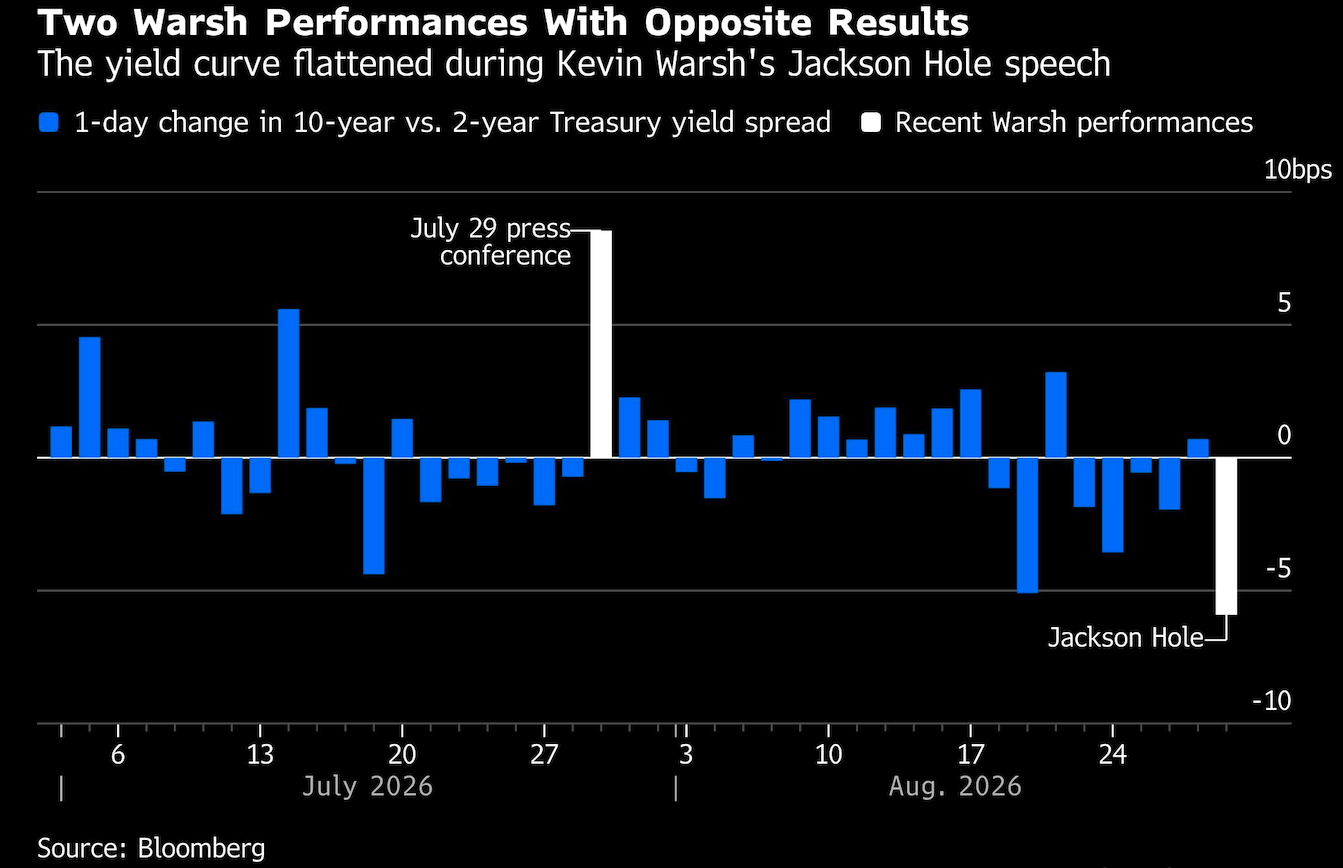
As a result of this glimmer of forthrightness, the derivatives market suggests about 62% odds that the Fed will raise its fed funds target from 3.75% by a quarter of a percentage point in September, with a total of a half-percentage-point of tightening by March. The yield on the benchmark two-year US Treasury note surged as much as 0.11 percentage point to 4.34%, while the yield on the 10-year note gained 0.05 percentage point to 4.72%. This caused the closely-watched spread between the two yields to narrow by6 basis points, the biggest drop since June and a sign the market is gaining confidence Warsh will do what it takes to get inflation under control.
Compare today’s performance with what happened after the Fed’s July monetary policy meeting, when Warsh was seen as being evasive about his commitment to containing inflation during a press conference. That caused the spread to widen in one of the biggest such moves in years, as two-year yields fell on speculation Warsh was dovish on inflation and 10-year yields rose on speculation such dovishness would spur faster inflation as the Fed moved further “behind the curve.”

In the world of central banking, the bond market is the report card that really matters, and the reactions show that although Warsh failed his July exam, he got an A at Jackson Hole. And he did it by providing a form of forward guidance, whether he wants to call it that or not. So unless he follows through, this newfound credibility will prove fleeting.
A message from Advisor Perspectives and VettaFi: Discover something new! Click here to register for our upcoming webcasts.
Bloomberg News provided this article. For more articles like this please visit
bloomberg.com.
Read more articles by Jonathan Levin