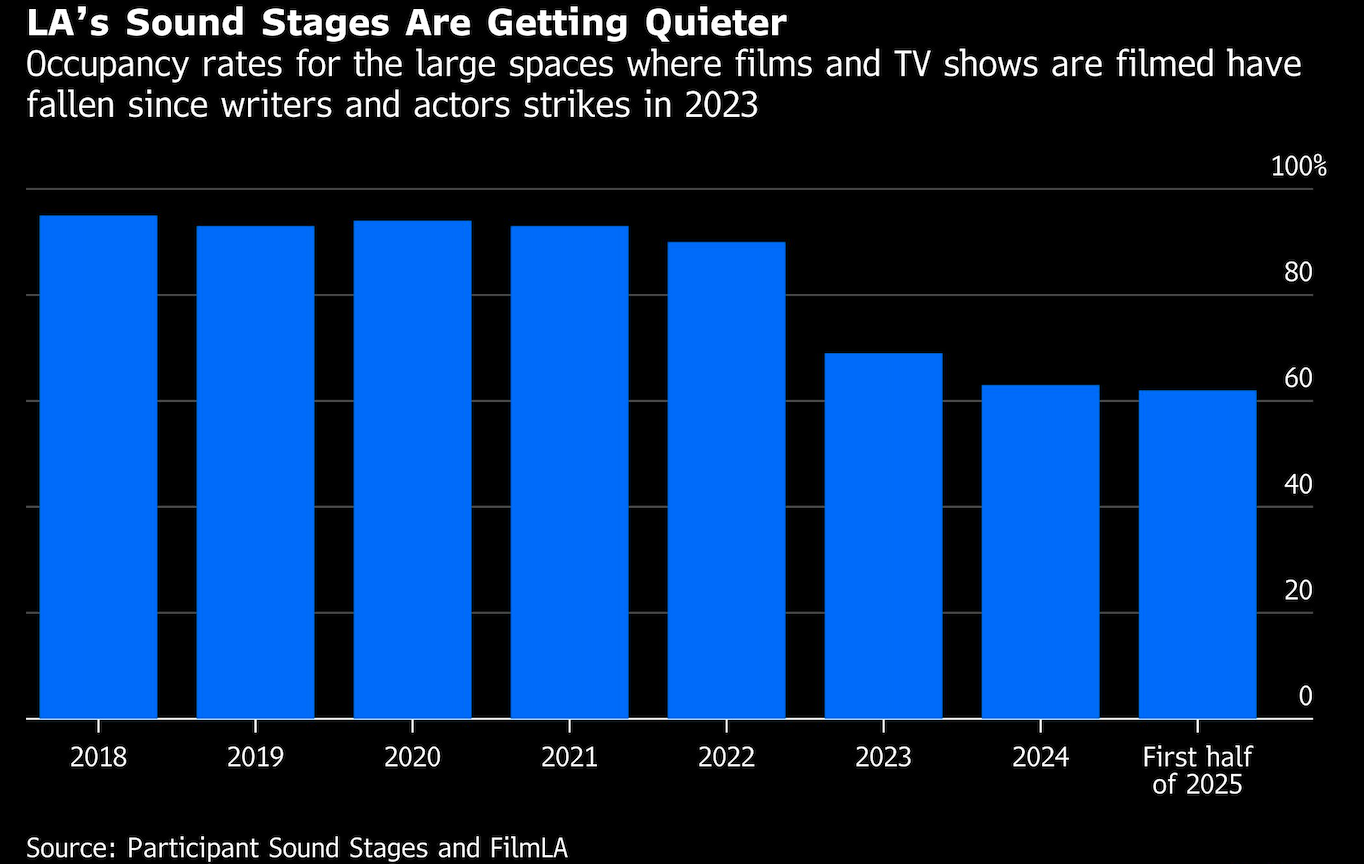
Even more so than usual, Hollywood’s future is uncertain. For decades the Los Angeles economy revolved around the film industry, but now more movies and shows are filmed elsewhere, driven or lured away by high expenses or tax incentives. The prospect of Paramount leaving California over the state’s antitrust lawsuit may not be serious, but the very idea that it can be entertained shows how much the economics of the industry have changed.
Los Angeles isn’t the only US city being forced to consider a future without the industry that has defined its identity. Over the last half century, if you worked in tech, the Bay Area was the place to be, with access to top talent and financing. If you wanted to become a finance master-of-the-universe, you needed to at least start your career in New York. Now all of this is changing — with implications not only for these cities but also for the US economy.
Success did not necessarily require living in one of these cities — but it made success more likely, so the best talent clustered in them. These clusters created an ecosystem that generated well-paid jobs and job growth. There was spillover into other industries and more innovation.
Clusters also made US films, tech and finance the best in the world. When an industry is mostly located in one place, people can more easily build networks, compare notes and develop skills. They can job hop and share know-how. Talent from all over the world comes to that one place, creating positive externalities.

See more: Gilligan’s Island and the Limit of Economic Innovation
A big part of the technology industry’s success — and America’s lead in innovation — is due to the fact that it is located in Silicon Valley. That conferred benefits to the larger economy, because it has fostered innovation in all industries, not to mention greater tax revenue and a booming stock market. Other cities tried to start their own tech clusters, but none could match Silicon Valley; once a cluster gets that critical mass of top talent, it is very difficult to displace.
The pandemic challenged that stickiness. First, it became more acceptable to work from home, and once Zoom meetings became normalized, people could work from anywhere. Second, for a while cities were unpleasant places to live, with a spike in crime and a decline in quality of life. Since the pandemic, affordability has become a bigger issue, with rising inflation and home prices. Then, among the very wealthy, there were a few notable moves to Florida and Texas.
But the cluster cities have endured. Citadel is still making a major investment in New York because the benefits of being in the world’s financial capital still outweigh the costs. The Bay Area, meanwhile, remains the place where the big AI firms are headquartered and deals are done. Relocating a major studio from Los Angeles might be possible, but it wouldn’t be easy because so much the film industry is still there.
On an individual level, if you are established in your career, maybe you can move out of a cluster. But if you are just beginning or want to start a new business, living in a cluster is still important.
Politicians in cluster cities seem to be counting on their continued stickiness. California may pass a wealth tax that will hit tech founders especially hard. LA remains an expensive place to do business. The mayor of New York has not exactly fostered a business-friendly environment (and seems to realize it). Underperforming schools and quality of life around homelessness and petty crime remain unaddressed in cluster cities. Local politicians talk a lot about affordability, but their actual policies will not solve the problems making things more expensive.
A central lesson from economics is that behavior on the margins is often revealing about what’s happening in an economy. There is still value to living in a cluster city — but if the costs rise and the benefits diminish, that calculation changes. (For some people, it already has.) Smaller clusters in other cities are becoming more viable, especially for anyone somewhat established who is raising a family. You can work in film in Atlanta or finance in Texas because there is a critical mass of talent there, too.
Cluster cities won’t necessarily become “the next Detroit,” because their industries will still generate jobs and money. They may even still dominate — just not as much as they used to. That will mean less tax revenue, worse public services, and more economic populism.
A de-clustering would also slow the rate of innovation, making the entire US economy less competitive. There is a magic that comes from having a lot of talented people in one place, and that magic remains critical to the modern American economy.
A message from Advisor Perspectives and VettaFi: Discover something new! Click here to register for our upcoming webcasts.
Bloomberg News provided this article. For more articles like this please visit
bloomberg.com.
Read more articles by Allison Schrager