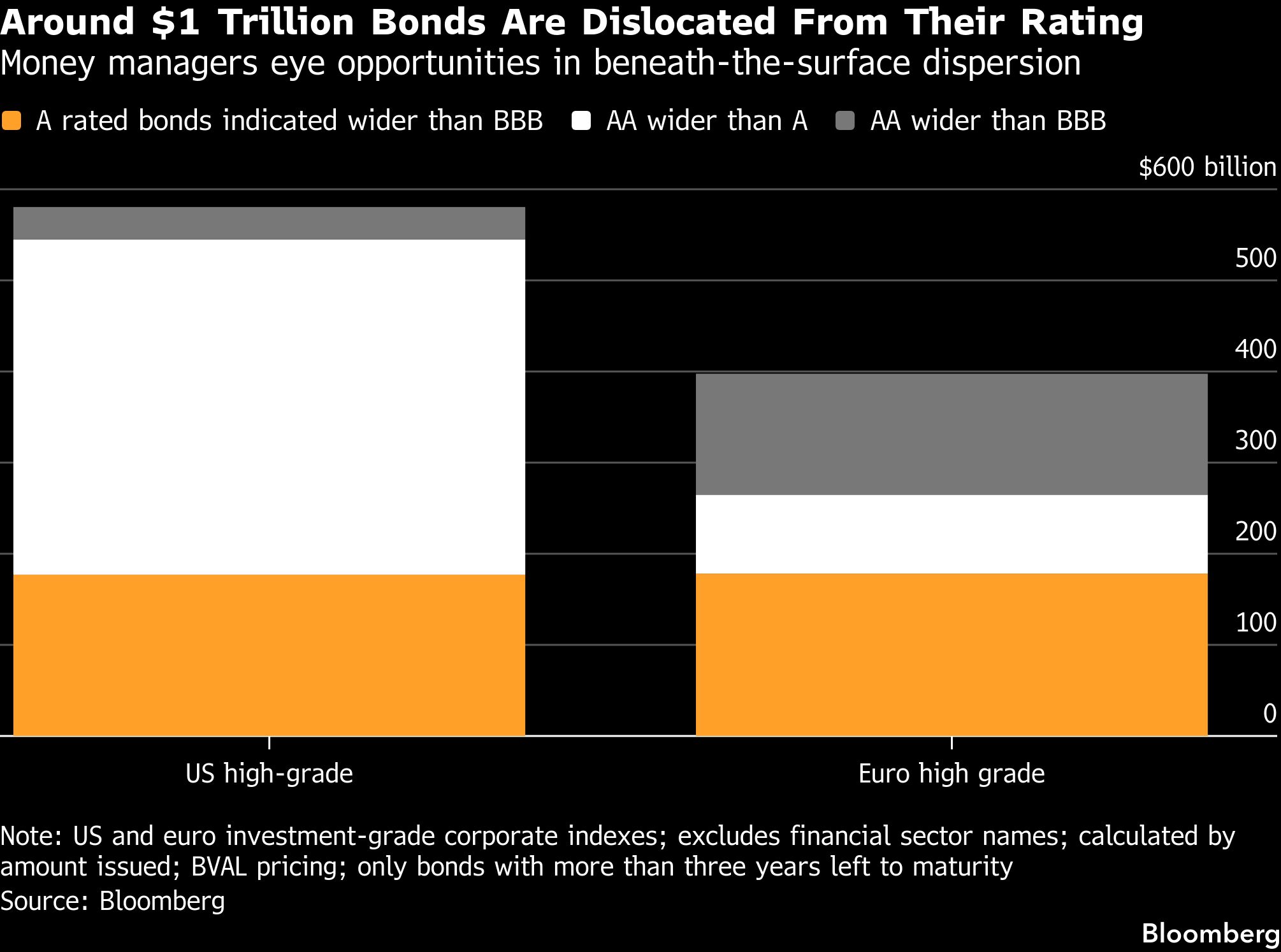
As government bond yields across the world erupt, corporate credit has rarely looked calmer. Yet even in that market, about $1 trillion of bonds are telling a much different story.
That’s the amount of company bonds trading at spreads that are unusually wide relative to their credit rating, based on a Bloomberg News analysis of non-financial high-grade securities with more than three years left to maturity. The tally includes about $580 billion of US bonds and almost $400 billion in Europe, when examining non-financial high-grade securities.
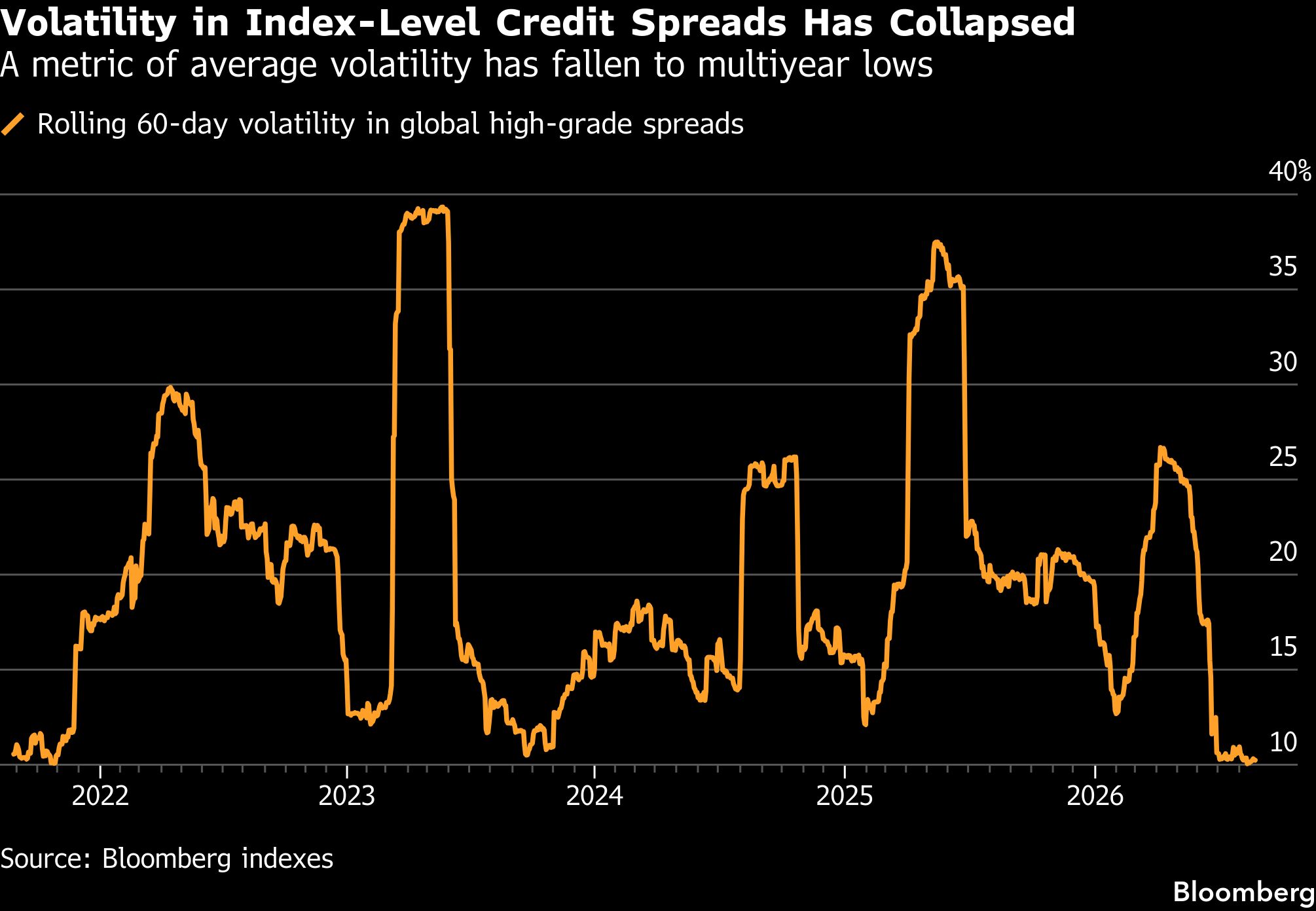
The divergence is striking because it comes as the broader investment-grade market has barely moved. Credit spreads have been stuck in tight ranges for months, while 60-day volatility in global high-grade spreads is around its lowest in five years.
For active managers, that makes the action beneath the index increasingly important. Bonds trading wider than similarly rated — and in some cases lower-rated — peers can offer elevated income and potentially large price gains if those gaps eventually close.
“Headline spreads are boring and probably going to stay that way, but under the surface, on a more sectoral, sub-sectoral, name-specific basis, there’s lots for us to get stuck into,” said Matthew Jackson, global investment grade portfolio manager at Robeco.
As markets constantly move, even small changes in spreads can throw a large amount of debt in and out of line with its rating band.
There are multiple drivers for the phenomenon. The share of hyperscalers in credit indexes keeps increasing, prompting investors to reshuffle their holdings just to stay neutral. The bonds of carmakers reflect stiff competition from Chinese firms, while those of software companies underscore the threat from AI. Insurers are being penalized for their exposure to riskier private credit.
If it turns out the market is too pessimistic, buyers of the exiled debt can profit, so long as they bought after a bond’s spreads widened and prices dropped. The bet also assumes the bond is mispriced — as opposed to poised for an eventual downgrade that the market has forecast before ratings firms.
Broad measures of risk in the credit market show few signs of concern. The average spread on the US high-grade index stands at 0.78 percentage point, still within a few basis points off its lowest level in the past quarter-century. In Europe high-grade corporate debt pays an average spread of 0.79 percentage point, within touching distance of their post-financial crisis lows.
Even as a selloff is sending government bond yields to their highest level in almost two decades, high-grade corporate credit spreads are widening by just under 1 basis point in the euro area and 0.3 basis point in the US on Tuesday, based on data compiled by Bloomberg.
Still, under the surface, the market is in flux. With trillions of dollars needed in pursuit of AI supremacy, so-called hyperscalers have been binging on debt across the world, boosting their presence in debt indexes.
The six hyperscalers now make up about 5% of the US high-grade index, double their share compared to two years ago, based on data compiled by Bloomberg, prompting some managers to rebalance their portfolios to avoid concentration, leading to distortions in names beyond the AI leaders.
They have risen to top spots in foreign markets, in many cases after just one large deal. And by some metrics, the risk they have brought to investors already exceeds that of the big six Wall Street banks.
“You need to be compensated for that much debt going on to the issuers, but also coming into the market,” said Nick Elfner, co-head of research at Breckinridge Capital Advisors. “That’s why you’re seeing spreads that are wide” against peers.
Wider spreads reflect both the risk of deteriorating credit quality and a technical overhang from heavier issuance by increasingly dominant borrowers, Elfner said.
It goes further than this. For example, bonds of 25 different single-A rated borrowers in the US across five sectors are indicated wider than the triple-B spread curve as of late August. The amount of high-grade debt that is trading wider than junk equivalents also rose this summer.
French Wildcard
To be sure, dislocations within high-grade rating bands won’t trigger forced sales and can vanish as quickly as they appeared if too many investors rush to the trade.
Different parts of the credit market are driven by unconnected drivers. What is linked to the hyperscaler buildup may not be affected by the impact of the Iran War in energy products or competition from China.
In Europe, a potential risk comes in the form of the French presidential election next April. Soren Willemann, a credit strategist at Barclays Plc, flags French assets as “an area to monitor closely” with “limited upside in adopting a constructive stance towards the broader French risk complex.”
The credit cycle “doesn’t seem quite so simple,” said Robeco’s Jackson. “There’s no one-size-fits-all cycle anymore.”