The list of challenges confronting Wall Street piled up this week. Oil firmly above $100. Inflation refusing to disappear. A defiant bond market that all but dared Scott Bessent to bring more policy firepower.
Unbowed, Wall Street stuck with the 2026 playbook: betting that an AI-fueled earnings boom and a still-growing economy can take the hit from expensive energy and higher interest rates. Stocks rallied Friday even after hotter-than-expected inflation strengthened expectations of a Federal Reserve hike next week.
Yet the factories, data centers and power infrastructure behind the tech boom require enormous amounts of capital — and the price of that capital is only rising.
ETF flows offer a window into how investors are living with it. Money is still pouring into artificial intelligence, infrastructure and other beneficiaries of the spending boom. Investors are also adding Treasuries, commodities and related exposures that can potentially provide a hedge in the event that inflation and rates stay elevated.
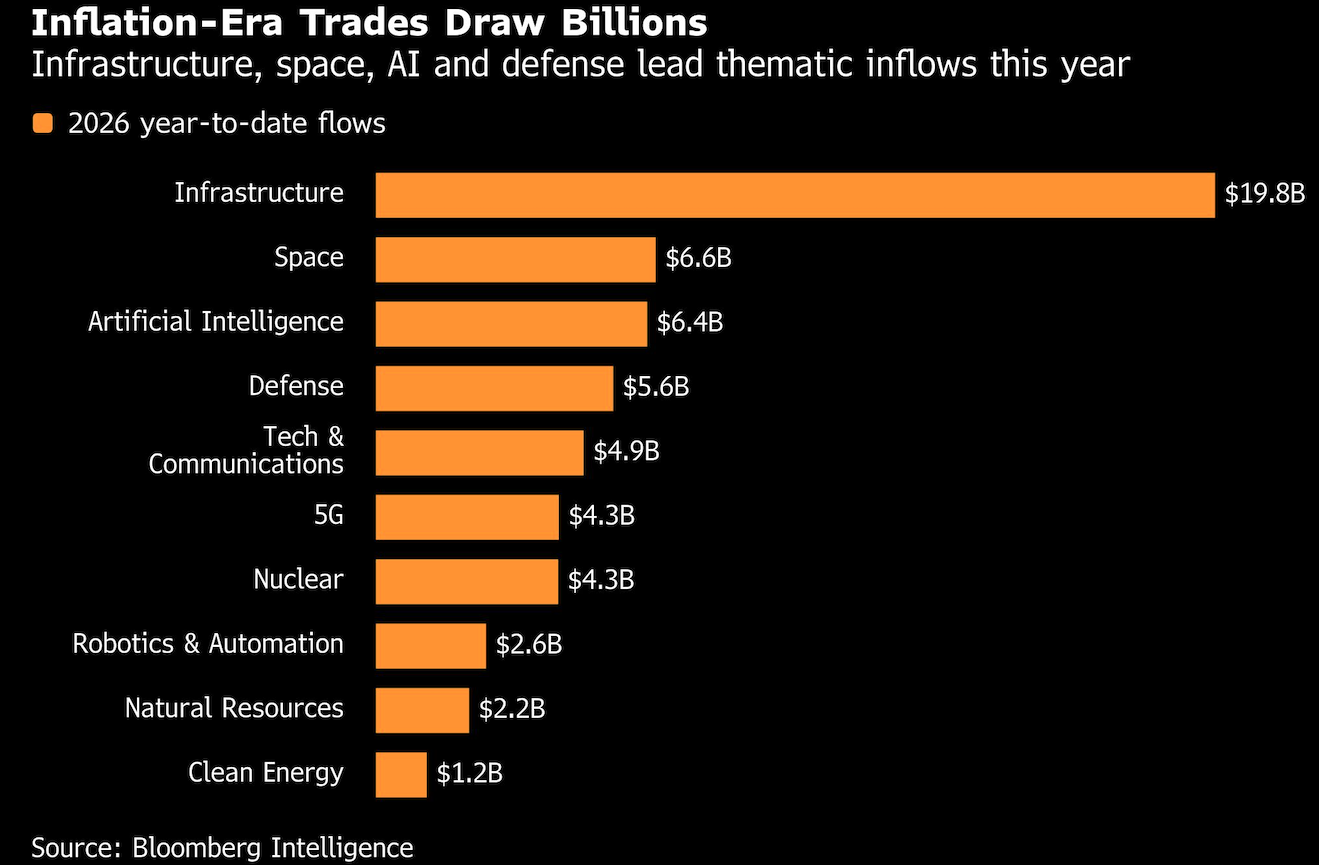
Thematic ETFs alone have attracted about $56 billion this year, according to Bloomberg Intelligence. So far this month, infrastructure funds have taken in more than $600 million, AI nearly $300 million and agriculture another $250 million.
It comes as the bond market is in rebellion. Treasury tripled the maximum size of its long-dated bond buyback to $6 billion. Yields climbed anyway, with the 10-year coming within a whisker of 5%.
Then came hotter inflation on Friday. Core consumer prices rose 0.3% in August, more than economists expected, strengthening expectations for a Fed hike next week and raising the odds of another by year-end. This time, long-term yields fell as investors took some comfort from the prospect that the Fed would act to contain inflation.
“The double headwinds of rising bond yields and oil prices are now testing the market’s resilience, but stocks have not lost their key pillar of support, which is fast-rising earnings,” said Angelo Kourkafas, senior global strategist, Investment Strategy at Edward Jones. “The lesson is that higher yields alone are not a reliable signal to abandon growth exposure.”
Recent history offers limited guidance for this particular mix. Steven DeSanctis at Jefferies says oil and yields have only been as high as they are now one other time during his three-decade career. Yet his calculations show that even when both have weighed on the macro backdrop, equities have tended to fare reasonably well over the following several months, with small-cap stocks at times outperforming.
Investors haven’t been waiting around for the answer. US ETFs alone have already taken in more than $1.3 trillion this year and, with roughly three months still to go, are on course for a record annual haul thanks to the continued equity bull market.
Some of the biggest bets remain squarely on the investment boom. AI-themed ETFs have attracted about $6 billion this year, while infrastructure has pulled in more than $19 billion, the most among the roughly three dozen thematic categories tracked by Bloomberg Intelligence.
Jessica Lin, a BI analyst who tracks the trends, says the AI buildout and infrastructure spending are becoming powerful enough drivers that thematic investing is starting to look less like a side bet and more like a core portfolio allocation.
BlackRock Investment Institute is leaning into much the same idea. Strategists led by Wei Li recommend staying overweight equities as the AI buildout accelerates, with a focus on bottlenecks including power, chips and data centers. They also favor real-asset-linked exposures as protection against inflation.
None of that means stocks escaped the week untouched. The S&P 500 finished lower despite Friday’s rally, while the Nasdaq 100 slipped 0.6% for its first weekly decline in nearly a month.
For now, earnings are giving investors reason to tolerate headwinds from the bond market and geopolitics. More analysts have been raising rather than cutting US profit estimates in recent weeks, the longest run of upgrades in five years.
“For now, we just have this warm blanket of earnings that’s keeping us nice and cozy,” said Marta Norton, chief investment strategist at Empower. “But I think longer term, anytime there’s any sort of issue on that front, all of these other risks are going to start to matter more.”