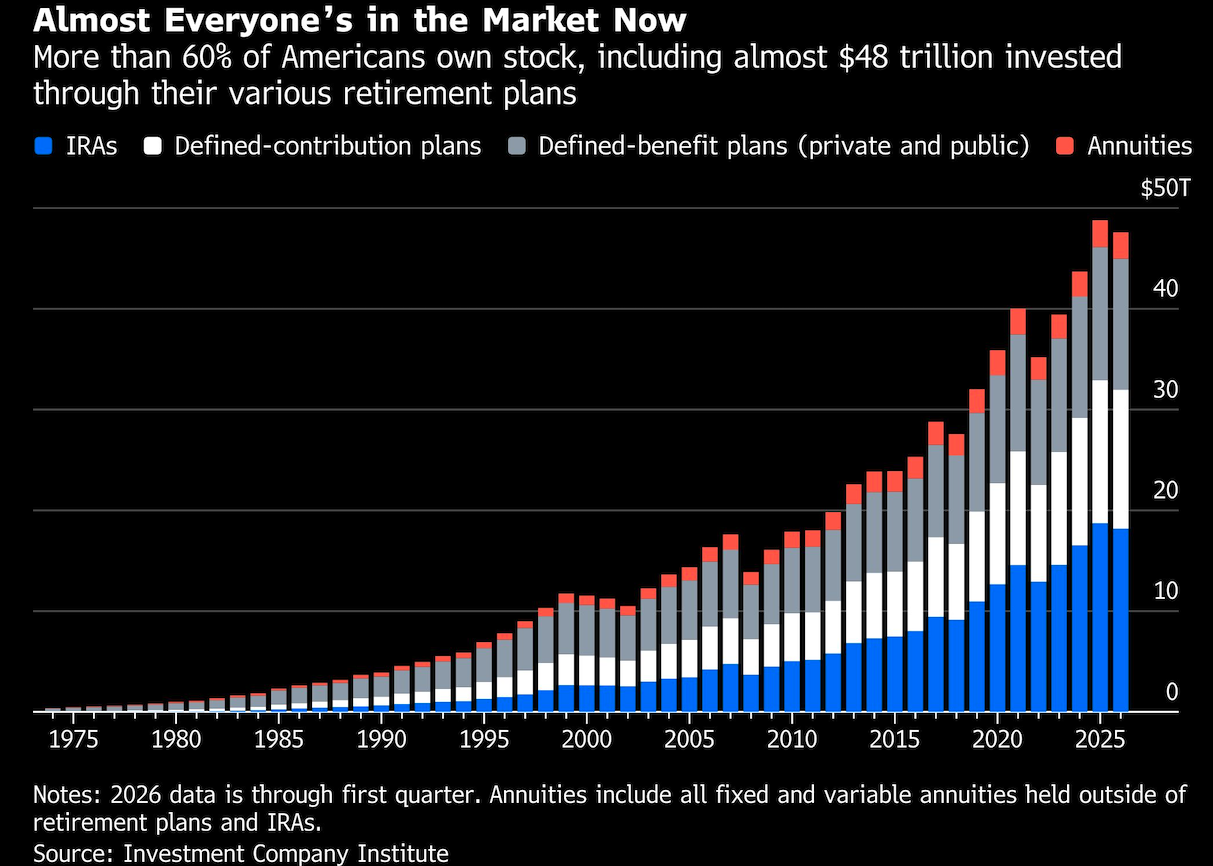
Like it or not, we are all betting on AI taking over the economy. In the last 40 years, the US has become a nation of stock investors. On the whole, it has made Americans rich. Now the stock market is soaring on the hopes that AI will make everyone more productive — and if that doesn’t work out, we all may learn the definition of a bad tail risk.
More than 60% of Americans own stock. For most of the middle class and lower earners, it is through workplace retirement accounts, which have boomed since the 1980s. In 1989, only about 30% of Americans owned stock. In 2007, employers started automatically enrolling plan participants in the market, often in target-date funds that put younger workers almost entirely in stock and move them slowly into bonds as they age. (By the time they retire, they are about 50% stocks.) Some 84% of participants in Vanguard’s defined-contribution plans, representing about half of all covered workers in the US, are invested this way.
These retirement accounts were in many ways a triumph, mainly because they became popular right before one of the best stock runs in history. About 20% of Americans are now millionaires — at least on paper.
But stocks, even well-diversified index funds, are still risky assets. Index funds are less risky than individual stocks or sports betting. But the mere fact that they pay off is proof that they involve risk. In general, stocks go up as the economy grows; they are a bet on the future of the US economy, which is increasingly dominated by technology.
Yet even a growing economy has bear markets. And the question is how the changing nature of stock ownership will change the nature of bear markets.
The US now has a large, captive population of investors who not only own lots of stock no matter what happens, but they also buy more each month through their regular contributions to their retirement plans. These investors are becoming a large share of the market. In the first quarter of 2026, some $32 trillion was invested in IRAs or defined-contribution plans.
The average equity allocation in a Vanguard defined-contribution plan was 75% in 2025. Some of that is probably in foreign stocks, though Americans tend to invest domestically. Thus it is safe to assume about one-third of the $75 trillion US stock market is owned by retirement investors. If Trump accounts take off, the population of passive long-term stock owners can be expected to grow. This changes the market dynamics.
There are still enough active traders to incorporate information into prices and keep the market efficient. But retirement money is often in passive funds, which may increase volatility and concentration in the stock market. This could be one reason that tech stocks went up so much.
But retirement investors also want to temper risk. In a bear market, people usually sell or at least stop buying, which pushes prices down further. Retirement savers, who are more passive, put something of a floor on how low stocks might go. They do not entirely eliminate market risk; there are still enough active traders, or people who get easily spooked, to bring the market down 30% to 40%. But the growth of retirement investing since the Great Financial Crisis of 2008 has changed the composition of stock ownership, and this new dynamic remains untested.
There are two forces that are not quite at odds, but in tension: On the one hand, the growth of retirement investors means more Americans own a piece of the economy, which brings them both more wealth and more stability, since they are more diversified compared to when they owned just their home or government bonds. On the other hand, this growth in retirement investors means more systemic risk, because if the stock market drops there is an economy-wide wealth shock that affects more than 60% of households. If markets don’t recover, it leaves some poorer in retirement. It also makes people feel poorer today because of the wealth effect. This could further depress demand and worsen a potential recession.
Then there are the policy effects: With so many of their constituents exposed to the market, politicians and other policy makers have an enormous incentive to do all they can to prop it up. Keeping markets up requires lower interest rates even when the market is hot. Count me as skeptical on an AI pause, or frontier pacing.
Passive and patient retirement investors deepen financial markets, increase wealth, and may even make markets a little less prone to corrections. But they also leave the economy more exposed to stock risk, and create incentives for the government to make the economy riskier. When big events happen, they can lead to even bigger fallout.