The Dollar Is Older Than Shakespeare
Membership required
Membership is now required to use this feature. To learn more:
View Membership BenefitsThe views presented here do not necessarily represent those of Advisor Perspectives.
Brendan Greeley’s “The Almighty Dollar” is unlike any other book on the U.S. dollar ever written. Greeley starts his story of the dollar in 1518; the United States would not exist for another 258 years. Halfway through the book, he’s up to 1781. If you want to take a really deep dive into financial history and — more specifically — the history of currency, this is the book for you.
Otherwise, it’s a diversion, in the best sense of something off the beaten track that is fun. It’s an intellectual journey that may not help with your investment decisions unless you’re curious about root causes of inflation and price stability. Consider the book to be part of a liberal education, a practice that becomes more valuable the less we do it.
Greeley warns us:
If you are already familiar with financial history, you will open this book looking for things that aren't there. I won't spend a lot of time on Alexander Hamilton's financial plan, or the Civil War paper greenbacks, or the creation of the Federal Reserve, or even the way Richard Nixon ended gold convertibility in 1971.
Instead, Greeley describes the dollar as an idea, older and more powerful than the United States itself, that “moves across borders and oceans.” He continues,
It follows a path that kings and presidents found difficult to bend. No country, no kingdom, has ever held complete sovereignty over the dollar, not even the United States, not even today . . . America didn’t invent the dollar. America succumbed to the dollar.
Weird stuff, you may say — but it’s a point of view well worth understanding.
Source
I’ll focus on how Greeley uses the history of the dollar to illuminate a long-standing debate over what money is — incredibly, economists still don’t agree on that question — and how a given type of money comes to be accepted as a unit of account, medium of exchange, and store of value.
The Dollar Begins
What happened in 1518? Silver miners in Sankt Joachimsthal (St. Joachim’s Valley),1 a village in German-speaking Bohemia, began minting silver coins called “Joachimsthaler,” eventually shortened to “thaler” (pronounced, roughly, “tahler”). English speakers spelled it “dollar.” That’s the origin of the modern word. Its use as the U.S. currency evolved over the ensuing centuries.
The thaler produced in Bohemia in the 1500s had advantages over other currencies of the time. The silver was relatively pure; some copper was added for hardness, as is done with most silver coins. The coins were of standard weight and appearance, so they could be trusted as a medium of exchange. The issuer of the 1525 coin shown in Exhibit 1, Louis II, King of Hungary, Croatia, and Bohemia (“Ludovicus” on the coin), ruled as stable a monarchy as existed in Renaissance central Europe.2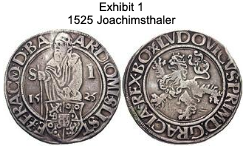
Source: Wikimedia Commons
It’s a long road from the coins mined in Sankt Joachimsthal to the world’s dominant currency a half-millennium later. (The road includes a mention by Shakespeare, writing “Macbeth” in 1606, of “ten thousand dollars.”3) Greeley takes us on that journey in a scholarly yet accessible style, the scholarly tone being attributable to his status as a Princeton PhD student, albeit one with two decades of journalistic experience behind him.
How the Dollar Conquered the United States
That the U.S. “succumbed” to the dollar, rather than creating it or (more likely) choosing it as the best preexisting alternative, is an interesting claim. What does Greeley mean by this?
It’s hyperbole. Greeley demonstrates thoroughly that the dollar, principally in the form of the Spanish milled silver dollar coin, was in widespread use in the American colonies well before the prospect of independence. The colonies typically had their own currencies, based on — but not equal in value to — the British pound and not equal in value to each other.
The resulting chaos created demand for more standardized money, and the Spanish dollar coin fulfilled the requirements. Following the principle (which I discuss in detail later) that money is whatever a group of people agrees to use as money, the Spanish dollar became an unofficial currency in what would become the United States for most of the colonial period.4
It was only natural that the United States, having failed during the Continental Congress period to establish a fiat currency (the unbacked Continental quickly fell in value almost to zero), adopted the Spanish dollar as a national currency in 1792 by specifying that “Dollars or Units—[are] each to be of the value of a Spanish milled dollar, as the same is now current.”5
Thus, the U.S. adoption of the dollar as its currency was a conscious choice, based on the market “telling” it to. It only “succumbed” figuratively.6
Silver Dollars & Bank Dollars
Greeley divides his book into two sections, the first on “silver” dollars and the second on “bank” dollars. This distinction is reminiscent of the familiar division between commodity and fiat money, but it’s not the same. Bank dollars existed before the fiat-money era as deposits, lines of credit, and units of account.
The American colonists presciently called bank dollars “imaginary money,” even though they could be redeemed for gold or silver. As the country gradually entered the fiat money era — first with the establishment of the Federal Reserve in 1913 and conclusively with President Nixon “closing the gold window” (suspending the convertibility of deposits to gold for foreign depositors) — the dollar became truly imaginary. An idea.
Bank dollars, Greeley writes, are not created by the Federal Reserve, or by the U.S. Treasury, or by an act of Congress. “If I achieve anything with this book at all,” he continues, “it will be to explain, in plain English, one uncomfortable thing I know to be true: Commercial banks make our dollars.” Greeley goes on to explain the mechanism, which is related to but different from the mechanism you probably learned about in Money and Banking or Macroeconomics 101.
Here’s Greeley’s bottom line:
. . . [T]here is no such thing as a fiat dollar. There are all kinds of financial assets denominated in dollars, and there are deposit dollars. Commercial banks hold most of the deposit dollars, but the Fed holds some, too . . . [a]nd so the story of the dollar doesn’t start with a coin and then end in a country . . .
That is, it doesn’t start with the Joachimsthaler and end with the United States’ adoption of the already popular dollar during the Revolutionary era. Instead, Greeley writes — provocatively for anyone who thinks they understand the fiat-money system — “. . . [i]t starts with a coin and then ends in a bank.”
This explanation sounds a little mysterious because it is. Commercial banks “manufacture” money when they make loans and simultaneously create deposits; this is standard stuff. To understand the differences between Greeley’s view and what is typically taught in school requires reading the book; I’m unable to provide the denouement in a review. It suffices to say that Greeley believes the proverbial “license to print money” is held by commercial banks in the form of a bank charter — not by the Fed.
I welcome comments from macroeconomists and monetary economists on this claim, which is backed by a recent paper from the Bank of England (McLeay et al. [2014]). According to Greeley, the paper “circulates as samizdat” among admiring economists and central bankers.7 My contact information is at the end of this article.
After a brief digression into modern monetary economics and the operations of the Fed and other central banks, Greeley’s voice as a historian quickly returns. Like the “Silver Dollar” section of “The Almighty Dollar,” the “Bank Dollar” section is more a history book than an economics book. His long section on the Great Depression and various people’s attempts to publicly and privately inject newly created dollars into a system that was experiencing a desperate shortage of them is especially worth reading.
Electronic Dollars
Missing, but needed, is a separate section on the “Electronic Dollar.” While Greeley discusses issues related to the proliferation of new kinds of money, such as Apple Pay, Venmo, PayPal, AliPay, Visa, and Mastercard, the difference between electronic dollars and traditional bank dollars is profound enough to merit a fuller treatment. Maybe he will take up this challenge in future work.
In this new Electronic Dollar era, the functions of money as both a store of value and a means of payment are less tied to bank deposits. This presents problems in defining money and the money supply, and in understanding how the quantity of money relates to the price level. How do we even think about inflation — which is a change in the price of money — when we no longer know what money is?8
This question is one of the underlying reasons Leeper (1993) and Cochrane (2021) developed the Fiscal Theory of the Price Level (FTPL). It also explains the theory’s power: The value or “price” of a dollar is being determined by the balance between current government debt and expected future primary government budget surpluses.9
What Is Money? How Does a Commodity or Object Become “Money”?
One of the major themes of “The Almighty Dollar” is that the U.S. government didn’t create the dollar — it couldn’t have, since the dollar had existed for almost three centuries before the U.S. Constitution was ratified. Instead, the dollar had already insinuated itself into American trade and finance in a way that made its adoption by the newly created U.S. almost inevitable.
This observation leads Greeley into a discussion, threaded throughout the book, of the economic questions I raised at the outset: What is money? Where does it come from? Why do we use one kind of money and not another?
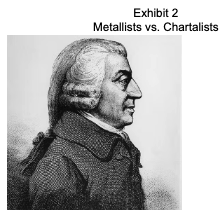
These questions, often asked by schoolchildren, don’t have easy answers — and economists, ancient and modern, have spent whole careers arguing for their particular takes on the matter. It’s amusing that economists can’t agree on an answer to the very basic question “what is money?”, but it’s true. Monetary historians divide into two camps: metallists and chartalists (see Exhibit 2). Both terms sound antiquated and are far from self-explanatory. Let’s dig deeper.
Adam Smith (1723–1790)
Source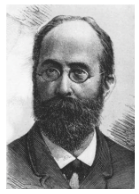
Georg Friedrich Knapp (1842–1926)
Source
The metallist view holds that money first arose to avoid the very high frictional costs of barter, which relied on a coincidence of (material) wants for a transaction to take place. In a barter economy, if I have a goat and want a bushel of wheat, I have to find someone who has a bushel of wheat and wants a goat.
It’s possible to imagine a population of intermediaries that will facilitate the transaction by storing both goats and wheat (and every other commodity that a trader might want), but the storage costs and the fees charged by the intermediary would make for a wildly inefficient economy. It’s easier to bring in some kind of money, which then acts as the intermediary without the costs. It’s no wonder money appeared at the dawn of civilization — or that civilization began to flourish as soon as humans had the contrivance of money!10
Aristotle was the first philosopher to say that a commodity must have value in use to be accepted as money. Most classical economists, notably Adam Smith and David Ricardo, also held this view. A variation is that, instead of using the commodity itself as money, one can use tokens that represent ownership of it — thus, gold and silver certificates, German rentenmark (issued in 1923 and backed by real estate), and some cryptocurrencies all are or were money.
Chartalism: Money is whatever the government says it is
Chartalism, another awkward word with no particular intuition behind it, is the view that a particular currency — even a fiat currency with no intrinsic worth, no value in use — has value because “the prince” (Adam Smith’s term — we would now say “the government”) demands that people pay taxes in that currency. Another, better term for chartalism is the state theory of money.
Both terms, chartalism and state theory, were coined by the German economist Georg Friedrich Knapp in a 1905 book,11 but the concept goes back past Adam Smith to ancient times — in particular Imperial China, where state power reached a climax. Chartalism was widely criticized at the time and later blamed for having morphed into the ridiculous Modern Monetary Theory._ However, it retains a place in the ongoing discourse about why seemingly worthless fiat money is so eagerly sought in every economy in the world.
Metallism is more fundamentally correct than chartalism in the sense that if there were no government, money would arise anyway as a workaround for barter. But if you think chartalism is completely wrong, try paying the IRS with cows, Yap Island rai stones (Exhibit 3), or bitcoin. The requirement to hold dollars with which to pay taxes adds to the demand for dollars, and thus to their value.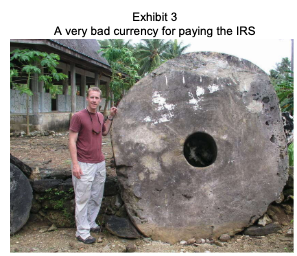
Note: The object pictured is a rai stone, traditionally used as currency on Yap Island, Federated States of Micronesia.
Greeley’s Take on the Two Theories of Money
Greeley clearly leans toward the metallist or free-market explanation, a conclusion that follows naturally from his observation that the dollar existed long before the U.S. was a country, had popular appeal without being the official currency of any country, and also existed in German-speaking Central Europe for centuries before Germany (or Czechia) was a country! But he does not take a hard line on any economic doctrine. He is a historian and empiricist whose conclusions are drawn from observation, not the application of theory.
I’m a little less open-minded, because I’m a University of Chicago graduate (twice). If I see an economic phenomenon that I don’t understand, I first ask how markets could have produced that phenomenon. If that doesn’t produce a satisfactory answer, I look for other explanations such as state authority. So, I guess I’m a metallist; I'm aware of many situations where a type of money has arisen out of the human desire to trade, independent of any state mandate or approval. But I won’t try to pay my taxes in cows, Yap Island rai stones, or bitcoin.
Thoughts for Investors
I said earlier that the subject matter of “The Almighty Dollar” doesn’t easily translate to investment advice. But I can offer some ideas:
- Based on the Lindy effect, the dollar is going to be around for a very long time — possibly longer than the United States. The Lindy effect, as described by Nassim Taleb, is the idea that the future life expectancy of an idea, practice, or institution is proportional to the amount of time that it has already existed. The name of the effect comes from Lindy’s Delicatessen, in Times Square, New York, where comedians working in the area’s theaters joked that the best forecast of how long a Broadway show would continue to run was the amount of time it had already been running. Thus, Taleb surmises, Judaism still has a long “run” ahead of it, while Scientology does not.
- Inflation will continue to erode the value of the dollar — it has already washed away 97% of the dollar’s value since the Federal Reserve was established in 1913 — but that is likely to be true of any fiat currency. There’s a natural tendency for governments to spend more than they receive in taxes, and the resultant increase in the money supply causes inflation (defined as a decline in the real value of a currency), which transfers resources to the government through a decrease in the real value of government debt and by other means.13
- Some currencies may appear stronger than the dollar. The Swiss franc is an example, having risen relative to the dollar because Switzerland doesn’t have much inflation. However, there aren’t many Swiss francs in circulation. If too many investors tried to own them, their value in terms of other currencies would rise too high for the Swiss franc to remain attractive in the future. It would be a classic example of the fallacy of composition. And if Switzerland tried to issue enough of its currency to meet this hypothetical demand, it would experience a lot of inflation and the Swiss franc would no longer be a strong currency. We’re stuck with the dollar.
- That said, U.S.-based investors should try to diversify away from the dollar (but only a little). Because most of the liabilities of U.S.-based investors are denominated in dollars, they should have a bias toward holding dollars. But there is risk in that position, as our country’s fiscal problems make obvious. Because currency exposure, including exposure to one’s own currency, involves risk but no additional expected return, currency risk is uncompensated risk. To partially diversify away this risk, investors should hold at least some of their non-U.S. assets (typically equities) in a portfolio that is not currency-hedged or that is only partially currency-hedged, so there is some foreign currency exposure in the portfolio.
Should I Read This Book?
I'm reluctant to recommend “The Almighty Dollar” to investors pursuing a self-education strategy that doesn’t take up all of their time. If you are a scholar of economic history or wish to become one, you should read it. Otherwise, I’d caution that the book takes you on such a deep dive into the history of the dollar — which is only one of many topics about which investors need to learn! — that you may never come up. However, a great deal of scholarship and care went into writing “The Almighty Dollar,” and many readers will benefit from reading at least parts of it.
If you want to take the royal road, or easy path, to acquiring the knowledge in “The Almighty Dollar,” listen to the Mercatus Center’s David Beckworth’s excellent interview of Greeley, or read the transcript at the same location.
Endnotes
1 Now called Jáchymov, Czechia. It is located close to the current German border, near Karlovy Vary (Carlsbad).
2 There were earlier and later issuers, the first being Count Stefan von Schlick.
3 “Macbeth,” Act 1, Scene 2. (This is not in Greeley’s book.) Shakespeare also mentions “a dollar” in “The Tempest."
4 An excellent discussion by the University of Virginia economic historian Ron Michener is at https://eh.net/encyclopedia/money-in-the-american-colonies/.
5 From Section 9 of the Coinage Act of 1792.
6 The 1792 action did not put an end to uncertainty about the value of the dollar. In the late eighteenth century and much of the nineteenth, paper dollars were issued by state banks and commercial banks, and these dollars often sold at a discount to silver and gold coinage. Smithsonian Magazine claims that, before the Civil War, 8,000 different kinds of money circulated in the U.S. This nonsense came to an end, relatively late in U.S. history when compared with the country’s other achievements in its first 87 years, with the National Banking Act of 1863. Interestingly, this change is outside the scope of Greeley’s story.
7 McLeay, Michael, Amar Radia, and Ryland Thomas. 2014. “Money Creation in the Modern Economy.” Bank of England Quarterly Bulletin (2014 Q1). Greeley refers to this as a 2011 paper because unpublished versions were circulating as of that earlier date.
8 “Price of money”: Although we usually talk in terms of the dollar price of a good or service, we can look through the other end of the telescope and define the “price of a dollar” as the quantity of goods and services that one would have to give up in order to obtain or “buy” a dollar.
9 Leeper, Eric M. 1991. “Equilibria under ‘Active’ and ‘Passive’ Monetary and Fiscal Policies.” Journal of Monetary Economics 27 (1): 129–47. Cochrane, John H. 2021. “The Fiscal Theory of the Price Level: An Introduction and Overview.” Working paper. See also Coleman, Thomas S., Bryan Oliver, and Laurence B. Siegel. 2021. "Puzzles of Inflation, Money, and Debt: Applying the Fiscal Theory of the Price Level.” Charlottesville, VA: CFA Institute Research Foundation.
10 One of the best books addressing this topic is Goetzmann, William N. 2016. “Money Changes Everything: How Finance Made Civilization Possible.” Princeton, NJ: Princeton University Press. The book covers the entire history of finance up to the present day, not just in ancient times.
11 Knapp, Georg Friedrich. 1905. "Staatliche Theorie des Geldes.” Leipzig: Duncker & Humblot. Translated into English and published as “The State Theory of Money” in 1924 by Macmillan & Co., London.
12 See my unpublished 2021 note, co-authored with Thomas Coleman and Bryan Oliver, at https://larrysiegeldotorg.wordpress.com/wp-content/uploads/2026/09/coleman-oliver-siegel-mmt.pdf for an explanation of why my co-authors and I think that Modern Monetary Theory is ridiculous (moreover, not modern, not monetary, and not a theory).
13 John Maynard Keynes, in his 1923 book, “A Tract on Monetary Reform,” noted that the mere act of printing money creates a seigniorage profit for the government, which is extracted from the people by requiring them to replenish their (zero-interest) cash balances by acquiring new cash by giving up something of real value (goods or services).
Laurence B. Siegel is the Gary P. Brinson director of research, emeritus, at the CFA Institute Research Foundation, senior advisor at Quent Capital, economist and futurist at Vintage Quants LLC, and an independent consultant, writer, and speaker. His books, which include Fewer, Richer, Greener and On Progress and Prosperity, explore ideas in economics, investing, the environment, technology, and human progress. His website is http://www.larrysiegel.org. He may be reached at [email protected].
The author thanks Thomas S. Coleman, Senior Lecturer and Executive Director of the Center for Economic Policy, Harris School of Public Policy, University of Chicago, for his substantial intellectual and editorial contributions to this article.
A message from Advisor Perspectives and VettaFi: Discover something new! Click here to register for our upcoming webcasts.
Membership required
Membership is now required to use this feature. To learn more:
View Membership BenefitsSponsored Content
Upcoming Virtual Events View All