Don’t Be Fooled. Treasuries Aren’t Cheap Yet
Membership required
Membership is now required to use this feature. To learn more:
View Membership BenefitsTreasuries might look cheap against stocks, GDP and the global cycle, but on their own historical terms they have more to fall before they become oversold and ready for a durable bounce.
The counter-rally in Treasuries has yet to come, with 10-year yields as high as 5.34% so far failing to get buyers’ salivary glands going. That is surprising as Treasuries are starting to look good value from several perspectives. Yet holding off might turn out to be a wise move because, as we’ll see, an Occam’s razor approach shows that they could fall even more before they become oversold. Nonetheless, shorting is not a good idea when there is the looming prospect of government intervention.
Here’s a chart I love. It shows the US 10-year yield versus the average of US nominal GDP and 10-year bund yields. Aside from the pandemic and the Lehman crisis, it has hugged fairly closely to the US yield, which has just risen above it.
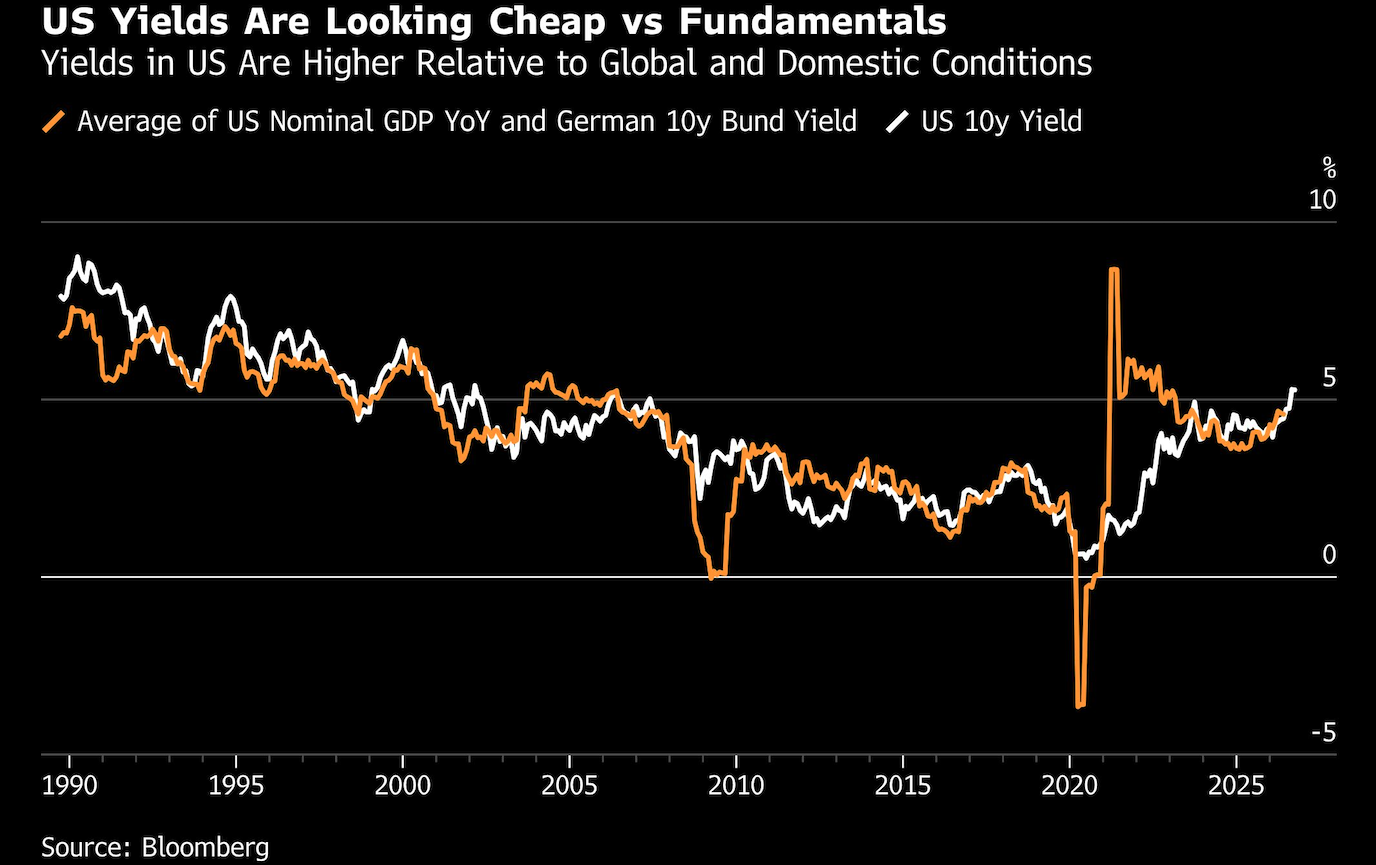
Nominal GDP captures domestic economic and inflation conditions, and typically you’d want longer-term yields to be below it (as they are today). The bund yield captures the global interest-rate regime and business cycle. Treasuries are now therefore cheap compared with this benchmark, yet foreign or domestic buyers have yet to emerge in a declamatory fashion.
See more: TIPS Yields at 3% Are Awesome! But Fundamental Principles Don’t Change
Buyers have been unstirred despite the clear rise in yields versus fundamentals. The 10-year yield is over 60 bps higher than its fair value, implied by global central bank rate hikes, the yield curve, oil and the policy rate.
Treasuries are also cheap relative to stocks. The equity risk premium, ie the trailing earnings yield versus the 10-year yield, is negative and is as low as it’s been for over 20 years. (On a forward earnings basis, the equity risk premium is not quite as low as it was in 2025, but it’s very close.)
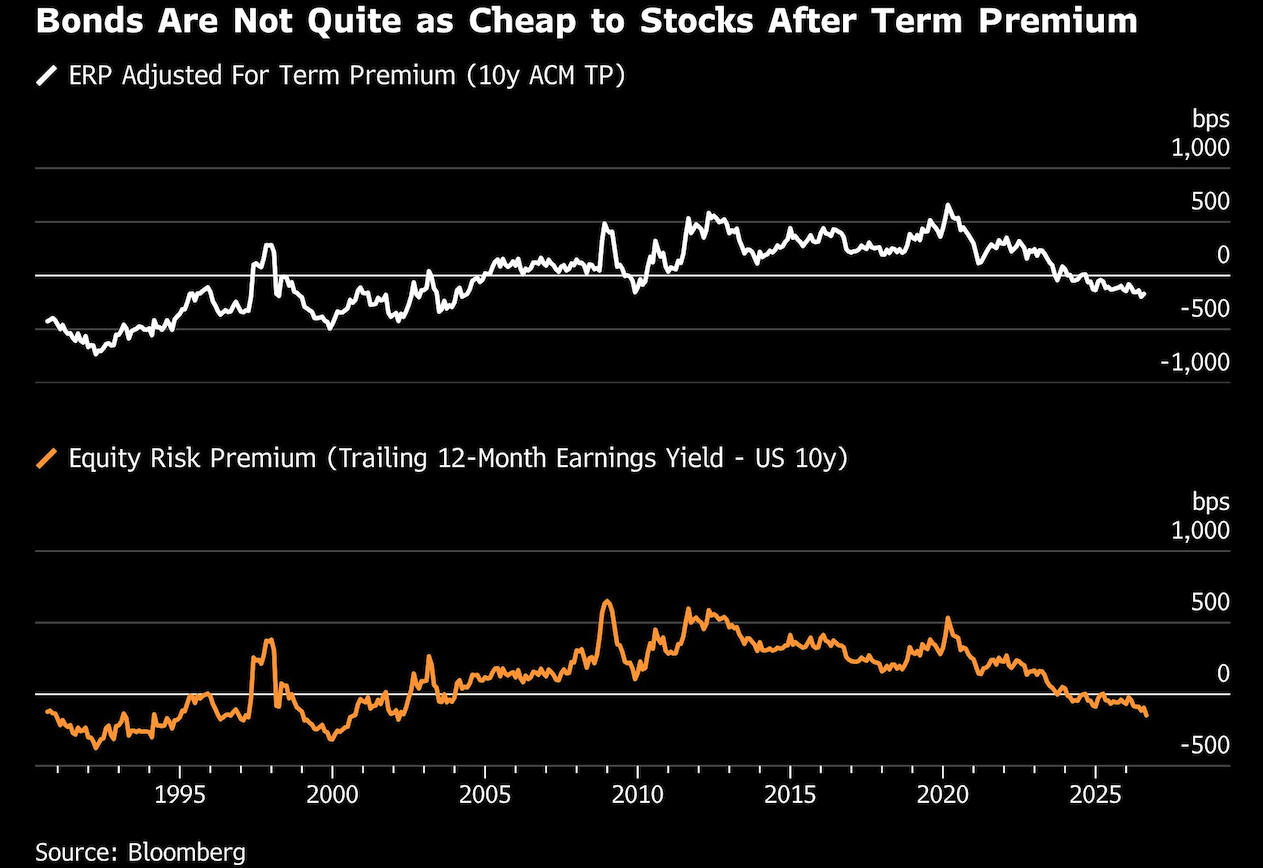
Adjusting yields for term premium gives a fairer comparison. After all, one likely wouldn’t jump into bonds from stocks if the rise in yields was entirely driven by compensation for worsening Treasury risks. On this basis USTs are not quite as cheap, but still attractive (bottom panel of chart above).
On a price basis too, Treasuries look cheap against stocks. The stock-bond ratio has declined slightly as Treasuries have sold off, but it still remains approximately one standard-deviation rich. As we can see, the series tends to oscillate around its mean, overshooting to the upside and downside.
Compared to global government markets in the aggregate, Treasuries do not look particularly undervalued, as bonds around the world have also been selling off. But they do not look overvalued either. US yields have risen at about the same pace as the global developed-market average in recent months.
Nevertheless, buyer beware. There are reasons why yields can keep rising, even if there is a retrenchment in the shorter term.
Simple ideas are often the best. With fewer inputs, they are less prone to overfitting. That is why I prefer to gauge the longer-term path for Treasuries by looking simply at their annual return. As the chart shows, this reverts to the mean over the longer term.
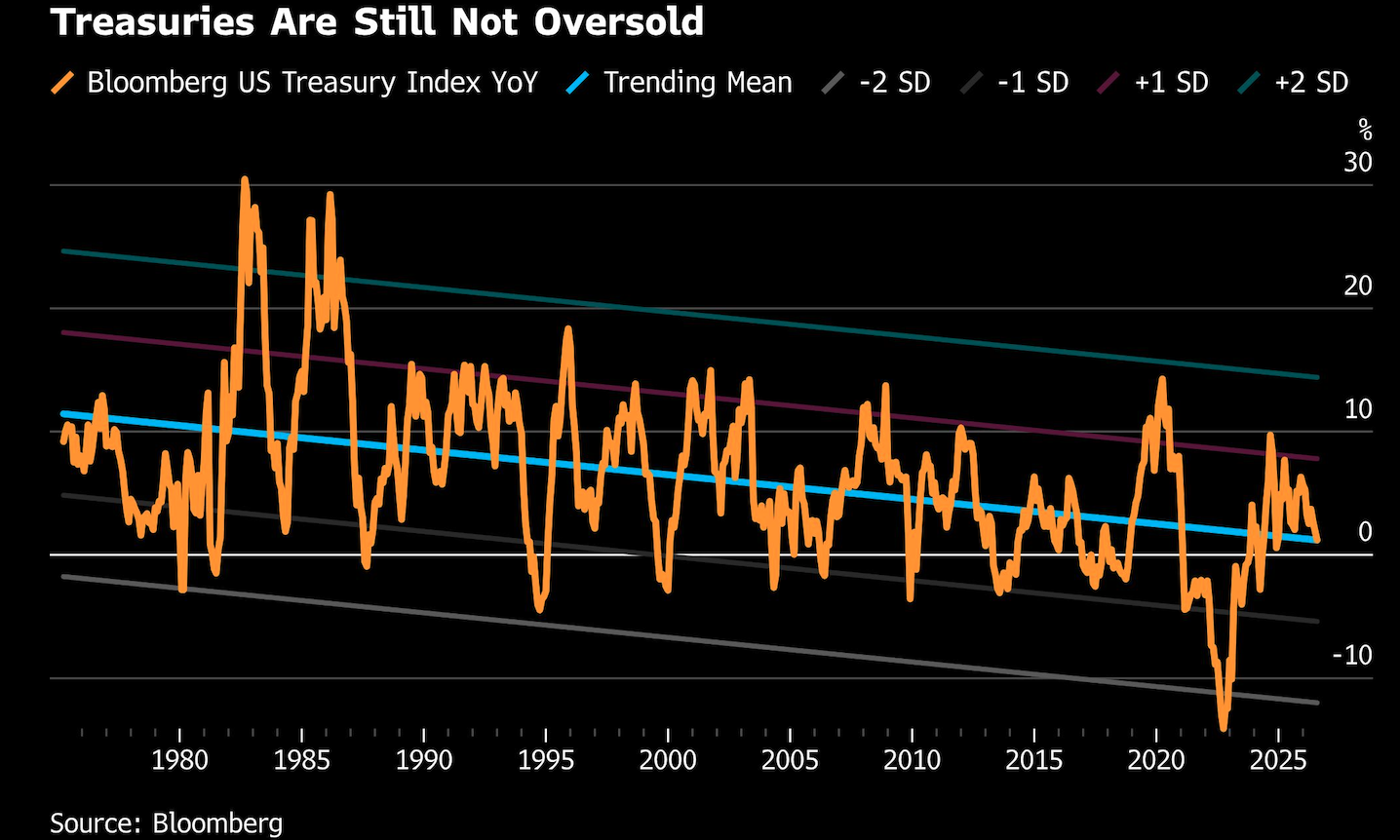
Yet, as with a pendulum, it rarely stays in the middle. It typically overshoots to the downside when falling, and to the upside when rising. As we can see, the annual return of the Treasury index is back to its trending mean.
Treasuries are not yet oversold on this basis. But there’s a good chance they will become so though if history is a guide. In three-quarters of the prior occasions when the annual return has been falling over the previous six months and is back at its mean (as is the case today), the return was yet lower three months later (based on over 50 years of data).
That’s certainly feasible when we look at real yields. The bulk of the rise in nominal yields has been driven by reals, with inflation breakevens remaining relatively contained (although don’t fall into the trap of thinking this is telling us much of import about where inflation will actually end up).
Real yields are set to keep rising. My leading indicator for 10-year reals is rising, based on excess liquidity, global central bank rate hikes and the Federal Reserve’s policy rate, and it has done a good job of leading the 10-year real yield by three to four months.
Any buyer of Treasuries should also be cognizant of the fiscal dynamics they are opening themselves up to. The US has one of the largest budget deficits in the world, with only Brazil, Poland, Hungary and Colombia having a higher one in GDP terms among major emerging and developed market countries.
That is no doubt in part because the US has one of the highest interest bills in the world relative to GDP (and the highest in dollar terms), beaten only by Italy. But even stripping that out, the US is left with the largest global primary budget deficit, bar the UK’s which is a fraction wider (and not really fiscal company that one wants to be keeping).
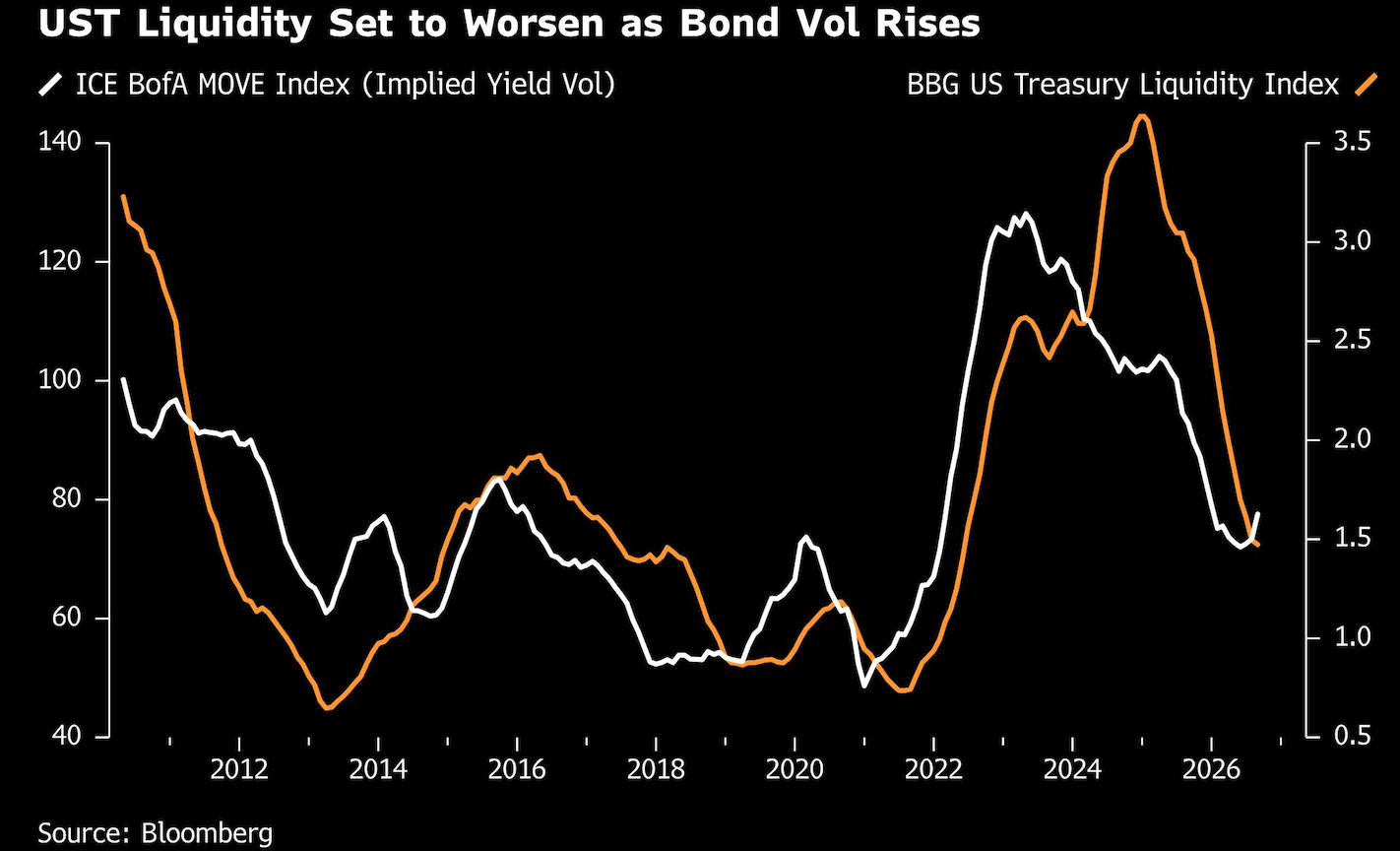
Perhaps most importantly, a buyer of Treasuries here should be aware that risks could become reflexive if yields keep rising. As they do so, so does volatility, which then impacts margining and Treasury risk limits. Higher volatility typically goes hand in hand with worsening liquidity in the Treasury market.
Further, historically Treasuries have become persistently positively correlated with stocks when yields stay much above 5.25% to 5.50% in the 10-year, winnowing away demand for them as portfolio hedge.
It’s not looking good for the government bond market, which is why further intervention is on the cards. It’s likely no coincidence the Treasury this week hired Jefferies’ Chief Market Strategist David Zervos as an adviser. In an interview yesterday, Zervos stated the Treasury is taking back control of the maturity of the debt, adding “you want to watch very closely how that gets managed.”
Markets that become subject to a government put are hard to short, but that doesn’t mean it’s a good reason to buy them either.
Simon White is a macro strategist who writes for Bloomberg. The observations he makes are his own and not intended as investment advice. The MacroScope column is a wide-angled take on the most important macro and market topics, rising above the short-term noise to get the big picture.
A message from Advisor Perspectives and VettaFi: Discover something new! Click here to register for our upcoming webcasts.
Bloomberg News provided this article. For more articles like this please visit bloomberg.com.
Membership required
Membership is now required to use this feature. To learn more:
View Membership BenefitsSponsored Content
Upcoming Virtual Events View All