Municipal bond asset managers are finding opportunities in the rout that tore through markets this month, with cheaper valuations and the highest yields in years drawing investors.
The selloff across the fixed-income space saw yields on benchmark munis climb to the highest levels since at least 2011. Those elevated yields have lured the retail market, with investors plowing over $3 billion into one of the largest muni exchange-traded funds, Vanguard’s VTEB fund, in the last month, marking the best month of inflows since 2022, according to data compiled by Bloomberg.
“We’ve seen just in the last two weeks alone some of the heaviest inflows into our strategies ever in our firm’s history,” Andrew Clinton, chief executive officer for Clinton Investment Management, said. “There’s definitely folks out there who are saying, ‘Oh, I can get an equity-like return from my munis. I need to own more of those.’”
Ten-year benchmark munis offered about 81% of the yield on comparable Treasuries as of Tuesday, the highest since April 2025, according to data compiled by Bloomberg. The 30-year muni-Treasury ratio climbed to about 95%. The higher the ratio, the cheaper munis appear relative to Treasuries.
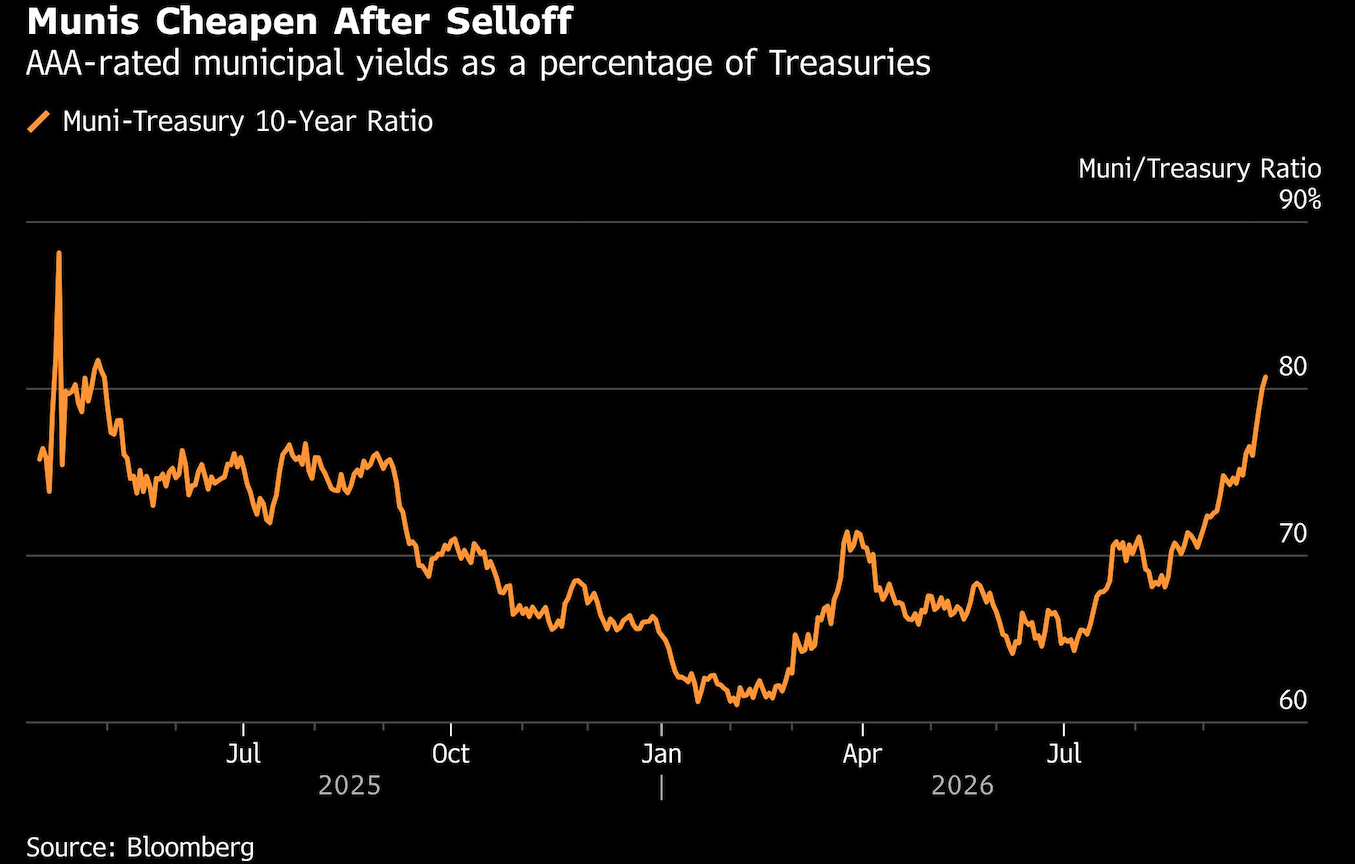
Recent moves in the muni market have been driven largely by inflation fears, rate volatility and heavy selling, rather than a deterioration in credit quality, creating “a more attractive risk-adjusted entry point,” Sam Weitzman, product manager at Western Asset Management, wrote in a Tuesday note.
Investors can use the dislocation in the market to harvest tax losses, rebalance duration and improve portfolio income, he said. Higher starting yields allow investors to take advantage of better returns without taking a bet on riskier credits or extending duration.
The muni selloff eased Wednesday, with benchmark yields falling as much as 12 basis points as of mid-afternoon New York time.
The selloff has made munis more competitive compared to other fixed-income assets. A 30-year bond sold by a New Jersey state agency this month has cheapened in secondary trading, trading at an average yield of about 5.4% on Wednesday.
For a married household in New Jersey — known for high state taxes — making $500,000, Treasuries would need to offer a yield of about 8.4% to compete with the muni, based on Eaton Vance’s tax-equivalent yield calculator.
“From the separately managed accounts perspective, when high-quality munis are providing 7%-plus tax-equivalent yields, investors don’t need to make a big bet on rates,” said Leslie Martin, a portfolio manager at Cavanal Hill Investment Management. “Buy-and-hold investors are happy to lock in some of the most attractive tax-exempt yields we’ve seen in years and hold the bonds to maturity.”
Miguel Laranjeiro, investment director at Aberdeen Investments, also touted the buying opportunity in US state and local debt.
“We haven’t seen these yields in a long time, decades really, so this is a good time to really be able to take advantage of the tax efficiency in the market,” he said.
A message from Advisor Perspectives and VettaFi: Discover something new! Click here to register for our upcoming webcasts.
Bloomberg News provided this article. For more articles like this please visit bloomberg.com.