You can barely take a step on the New York subway lately without seeing the face of Meta Platforms Inc.’s furry Muse AI assistant. I’ve written already about how impressed I’ve been with the form and function of the breakthrough bot. Now, attention must move to assessing whether Muse has long-term staying power — or whether its launch will be just a flash in the pan.
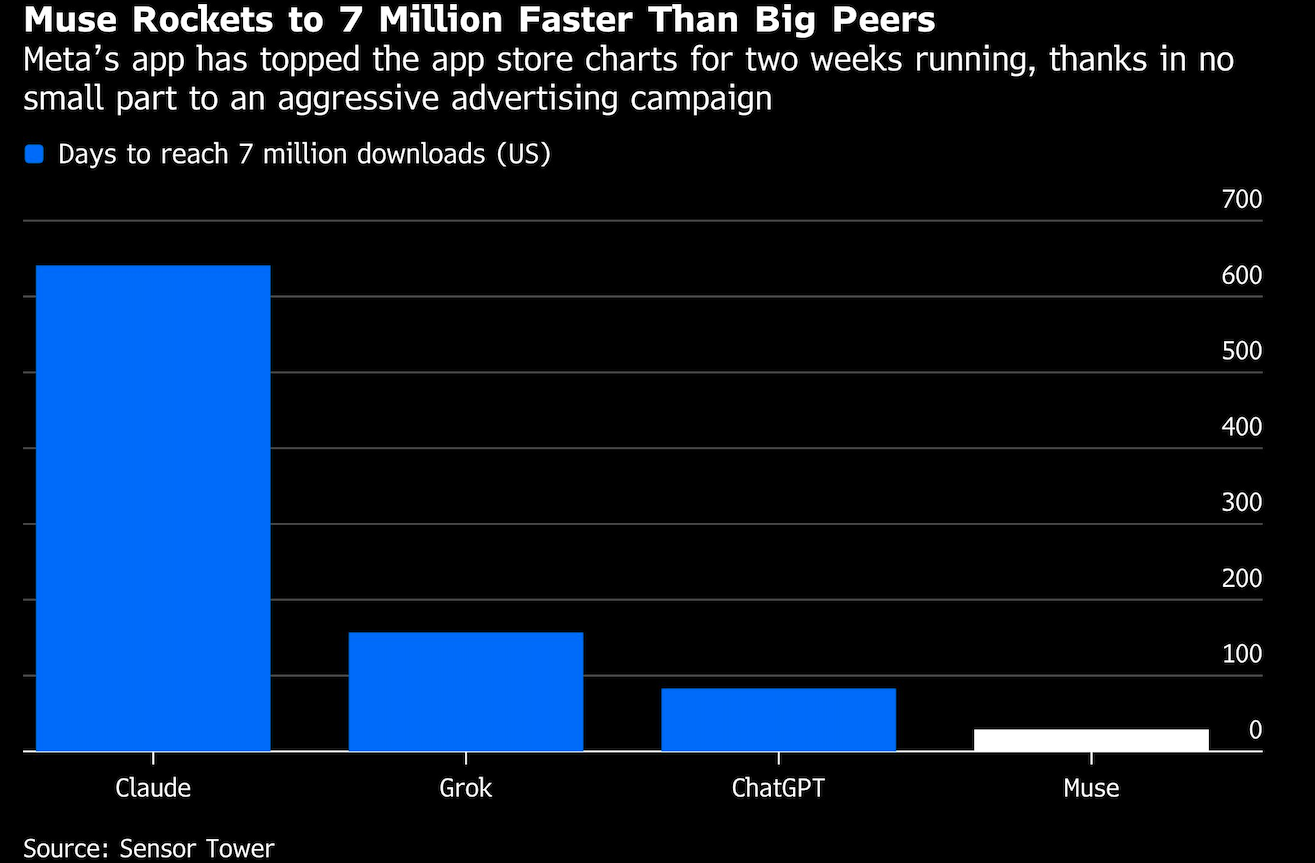
Much of the coverage surrounding the launch of Muse pointed out that it had soared to the top of the app store charts and stayed there, 7 million downloads and counting. That’s one measure of a breakout success but offers only the slightest insight into an app’s long-term prospects. The observation that more people are currently downloading the Muse app than, say, ChatGPT doesn’t tell us all that much: A lot of people already had ChatGPT.

Historical comparisons can offer useful context. A beaming report from analysts at Citi, which cited Muse as a potential source of more than $27 billion in annual revenue for Meta by 2030, noted that Muse’s downloads have outpaced ChatGPT, Google’s Gemini and Meta’s own earlier AI chatbot app at the same point in their life cycle. Muse could become the new “front door to the internet,” the report said.
Still, two weeks as the most downloaded app on both Apple Inc.’s and Google’s app stores, according to market intelligence firm Sensor Tower, isn’t nothing. But this is merely Muse’s honeymoon period — data from Apptopia now points to plateauing downloads of Muse over the past few days. What Meta investors need to see now is proof that those who bought into the Muse idea are actually finding it useful. Users are fickle and will gladly abandon apps after mere minutes unless given a compelling reason to stick around.
See more: Future Schlock: A Guide to the Singularity
On this front, Meta is seeing positive trends. Daily active users now surpass 2 million, Sensor Tower said, growing 4% a day on average over the past week. For context, that represents less than 1% of the total daily user base for Meta apps. But in the nascent world of consumer AI agents, it’s a striking start, particularly because it looks as if Muse users are indeed using the product as intended — as an agent that can handle tasks on their behalf. Human Security, a firm that tracks bot activity for security purposes, said that Muse accounts for 72% of all AI agent requests to the websites it monitors, more than five times the amount of requests coming from ChatGPT’s agent function. “To put that in context,” the company wrote, “Muse reached a request volume that took ChatGPT 11 months to achieve — in just two days.”
Muse is also 25% more likely than any other AI agent, Human Security observed, to navigate a user all the way to the checkout. This performance is crucial if Muse’s business model, outlined by Chief Executive Officer Mark Zuckerberg at an event last month, is to take a cut of transactions orchestrated through the agent. Citi believes that by 2030 transaction cuts could drive $23 billion a year in revenue. It sees an additional $4.5 billion from subscriptions — heavy users who pay for extended use of Muse’s computing power.
Competitors to Meta’s cuddly bot have arrived. They can turn Zuckerberg’s own tried-and-tested playbook against him: Copying the best features and then implementing them within their own apps. OpenAI’s colorful “Dots,” announced last week, has a visual aesthetic similar to Muse’s. SpaceXAI’s Grok Bot has gone with cutesy faces on blobs also. Buzzy upstart Instinct just secured a $1 billion funding round and offers an agent experience right within Apple’s iMessage or regular texts instead of requiring a separate app.
Google on Thursday launched its agent for Work, but its more consumer-friendly AI agent, Gemini Spark, has received such little promotion you wonder whether Google is ashamed of it. I’ve long seen Google as a sleeping giant of consumer AI given the breadth of useful data it has — think of Google Maps alone — as well as a wide device footprint with the Android operating system. Apple’s upper hand with its control of the iPhone will be obvious once the company finally begins to act on it. If these two platform giants can sort their act out, Meta’s failure to get its own smartphone aspirations off the ground may come back to haunt it more than a decade after the fact.
To make Muse a lasting habit for users, Meta must keep adding partnerships to connect the bot with more of the existing services its users expect to interact with. Already, that list includes Walmart, Shopify, Expedia, Ticketmaster and OpenTable. It needs to find a way to make friends with Amazon.com Inc., which continues to block Muse from using its store, and prepare for similar interoperability battles with other top services and platforms. It needs to execute well when introducing Muse into the physical world, building on a promising start with its Tamagotchi-like device and the open sourcing of its hobbyist “gadgets” platform. Still unknown is whether there is a trust ceiling — an upper limit of how many people are prepared to trust Meta at all — and how high that might be.
Ultimately, Meta’s enormously profitable legacy business — almost $60 billion in advertising revenue in the last quarter alone, up 27% from a year ago — performs strongly enough to subsidize Muse for as long as it takes to drive adoption to a tipping point. Then Zuckerberg can turn the screw on monetization. Compare that luxury with what some of his competitors must navigate. From day one, for instance, OpenAI’s Dots is only on offer to users willing to pay $100 a month. The Instinct agent is free but still available by invitation only, limiting adoption to keep costs under control. With deep pockets and a renewed sense of mojo, Meta has taken a strong position at the start of the personal AI race and is well positioned to stay ahead, whether it’s a marathon or a sprint.
A message from Advisor Perspectives and VettaFi: Discover something new! Click here to register for our upcoming webcasts.
Bloomberg News provided this article. For more articles like this please visit
bloomberg.com.
Read more articles by Dave Lee