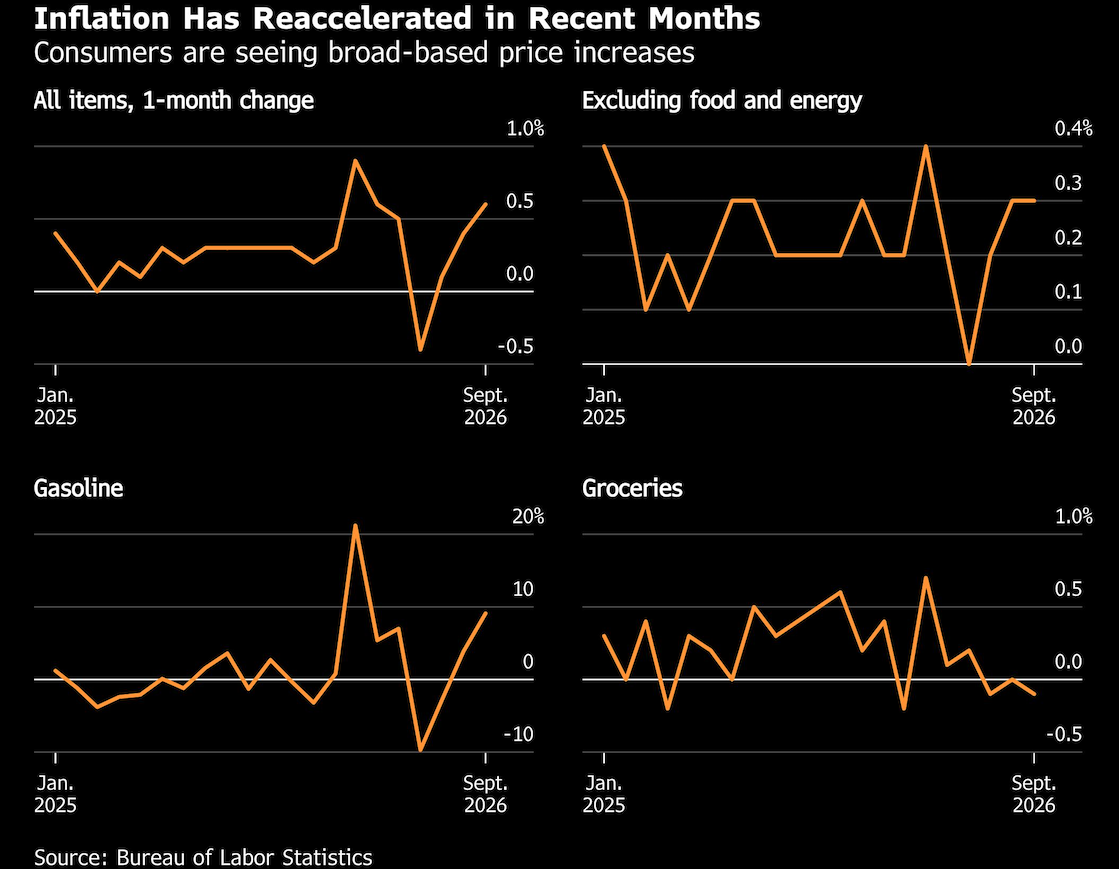
US consumer prices advanced in September at the fastest pace in five months and a gauge of underlying price pressures rose by more than expected, keeping the squeeze on household budgets ahead of November’s midterm elections.
The consumer price index rose 0.6% from a month earlier, driven by a surge in fuel costs, according to Bureau of Labor Statistics data out Wednesday. A key measure of underlying price pressures, which excludes food and energy, was up 0.3%.
The report suggests the economy — and in particular, price increases that are eroding paychecks — will remain front and center for voters in the final stretch of midterm campaigns. The broad upswing in prices also helps reinforce expectations for additional Federal Reserve interest-rate increases in the months ahead, even if the central bank elects to take a pause at its upcoming policy meeting.
“Americans are seeing their pay totally wiped out by inflation,” Heather Long, the chief economist at Navy Federal Credit Union, said in a note. “Meanwhile, the Federal Reserve isn’t seeing progress on inflation,” and rising fuel prices are “starting to spill into other areas.”
US Treasury yields rose and the S&P 500 opened lower after the release as investors upped bets on an October rate hike to about 50%.
The Fed in September responded to renewed price pressures by raising interest rates for the first time since 2023. Since then, top officials have signaled they have time to weigh incoming data before acting again, though the median forecast of officials lined up with one more increase this year, according to their latest projections.
Wednesday’s report, which showed the CPI advanced 3.7% from a year earlier and core CPI rose 2.6%, is the last reading on consumer prices before the central bank’s Oct. 27-28 policy meeting. Fed Chairman Kevin Warsh is due to speak late Thursday New York time from the International Monetary Fund meetings in Bangkok.
Read More: Fed’s Williams Currently Sees No Need for Rate Hike in 2027
Surveys show US households have become increasingly frustrated with worsening affordability problems as price increases have outpaced wage growth. A separate report on Wednesday showed that average hourly earnings, adjusted for inflation, fell in September from a year earlier for a sixth consecutive month.
The CPI data showed gasoline, a daily price gauge for many, climbed 9.1% in September from the prior month — the most since the outbreak of the Iran war sent fuel prices surging in March. Medical care services prices, meanwhile, rose 0.3%. Healthcare costs and gas prices tied as voters’ top economic concern ahead of the midterm elections, according to a KFF poll released this month.
Owners’ equivalent rent, a gauge of housing costs which is the largest component of the CPI, continued to climb, advancing 0.3% from the prior month. Grocery prices, however, edged lower, and prescription drug prices also fell.
Broader services prices excluding energy and rents registered a steep advance for a second month. Core goods prices rose by the most since January 2025, reflecting solid increases for used cars and apparel as well as a record jump for toys.
“Obviously we knew there was going to be a spike in energy and fuel prices, but the firm readings for core CPI — which follows up a firmer reading on core CPI in August — those give us concerns that maybe we are seeing more pass-through from fuel prices into other goods and services,” said Ben Ayers, a senior economist at Nationwide.
The report also highlighted ongoing pressures from the data center buildout: Computer software and accessories prices rose a record 28.4% from a year earlier, while prices of computers, peripherals and smart home assistants rose a record 9.7%.
What Bloomberg Economics Says...
“The surprising acceleration in September core CPI may appear to cement another Federal Reserve interest-rate hike this year, but the source of the pressure pushes against such certainty. The owners’ equivalent rent component printed hot despite a cool housing market most of the year, suggesting a potential aberration.”
— Anna Wong and Troy Durie
The economy is a key topic of debate for candidates in upcoming midterm elections. The unemployment rate is low, consumer spending remains strong and business investment is adding fuel to economic growth. But many voters blame President Donald Trump’s tariffs and the Iran conflict for the rising cost of living.
At the beginning of the year, inflation had settled back toward its lowest levels since early 2021. But the war sent gasoline, diesel and other prices soaring, boosting inflation and ultimately borrowing costs.
Diesel prices can be hard to isolate in the CPI. Higher fuel costs tend to first affect transportation services and later move through to food, durable goods such as furniture, and other products that have higher freight costs, though the effect can be lagged.
Separately, the Social Security Administration said Wednesday that beneficiaries would receive a 3.6% cost-of-living adjustment in 2027, the most in four years. The adjustment is calculated using CPI data from the third quarter.