An AI rendering of a 19th-century Jon Gray, complete with pitchfork, waistcoat and straw hat, flashed up behind the Blackstone Inc. president at a recent meeting with investors.
The image, placing the financier on the cusp of an earlier technological revolution, appeared as he argued that artificial intelligence is giving birth to a new era of equally profound change.
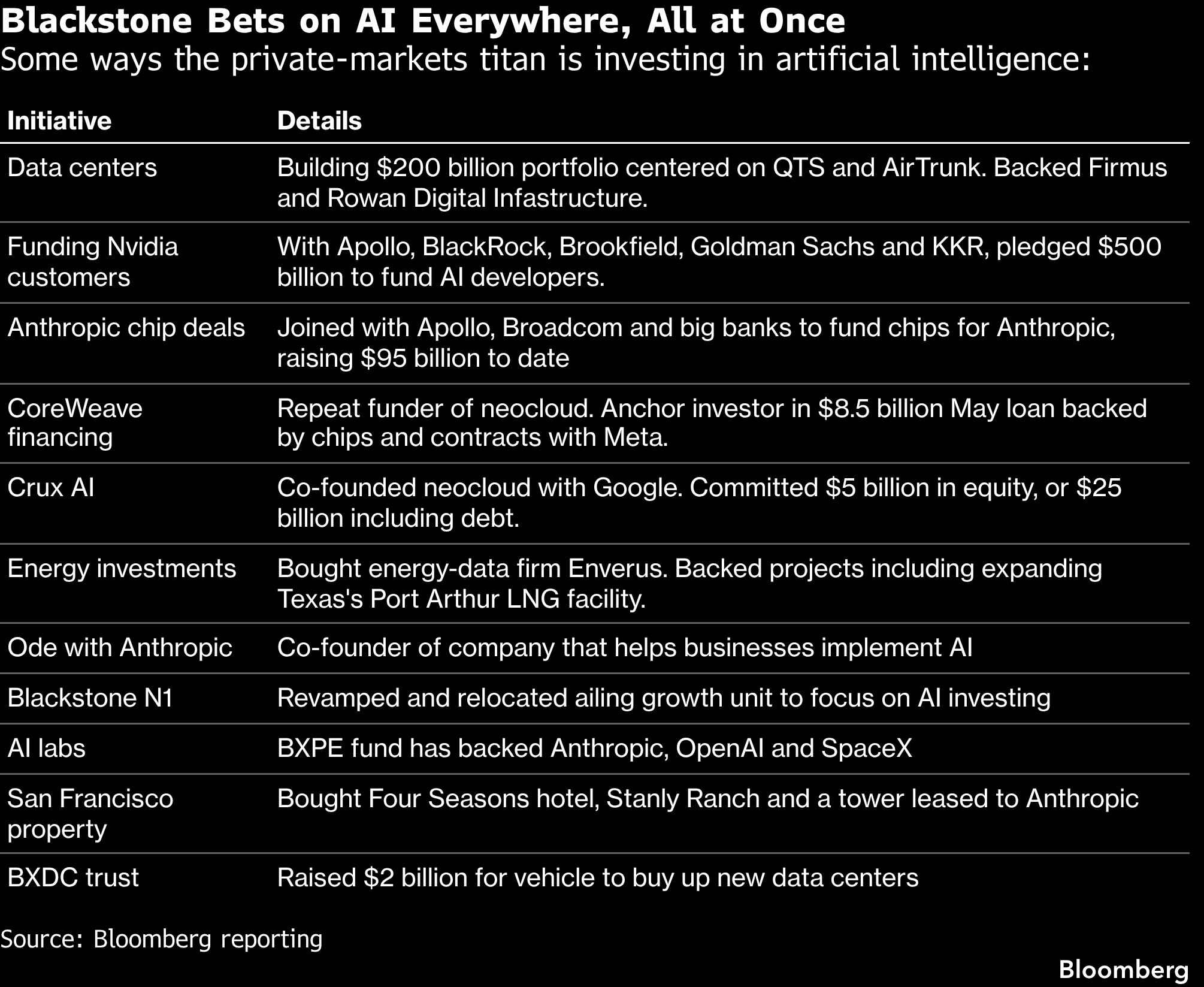
Gray, who’s long been the lead candidate to one day replace Chief Executive Officer Steve Schwarzman, is now making AI the biggest bet of his career. Already, he’s amassed a $200 billion data-center empire and is building a cloud venture with Google. Blackstone has taken stakes in labs like OpenAI and lent against Broadcom Inc. and Nvidia Corp. chips. And it’s committing capital to power plants and data-center cooling equipment. It all shows that the world’s largest alternative investment manager is leaning into AI every way it can.
See more: Inside IG Bond ETFs: The Hidden AI Bet
Even in property, where Gray cut his teeth, AI is now a driver of many deals, such as leasing offices to Anthropic or launching a data-center real estate investment trust. Blackstone is also embedding AI into the hundreds of real-economy businesses the private equity giant controls. And the technology is slowly reshaping the firm’s own operations: a model now weighs in on proposed investments.
Every private markets firm is investing in some piece of the AI boom. But while others have shied away from certain corners of the market, Blackstone has been unequivocal about the opportunity the technology represents, with Gray calling the investments "the single most important thing" underway at the firm.
“As an investor these are interesting times, because there’s just an enormous amount of transformation underway,” Gray said in an interview — warming to the same theme that he hit in his AI-enabled address to chief investment officers in September. “In the 1880s you would have lived in a world of wood, horses and candles,” he said. “And then, by the 1900s, you were in a world of steel and railroads and electricity.”
“We are in one of those moments.”
Still, the headlong rush into AI hasn't come without bumps along the way.
Earlier this year, Blackstone folded its growth business into a new division that focuses solely on AI after the previous unit suffered from uneven results. The real estate business got two new leaders following Nadeem Meghji’s surprise exit. And being a huge data-center landlord has thrust the firm into sensitive political territory as unease about job losses and the dangers of runaway AI are building. The growing backlash against vast, power-hungry data centers has already derailed some Blackstone projects.
Meanwhile, some large investors are concerned the boom in capital spending could turn to bust. Asset allocators also worry about how their exposure to a single dominant theme is soaring across both public and private markets — a challenge that is intensifying as Blackstone and rivals such as Apollo Global Management Inc., Brookfield Asset Management Ltd. and KKR & Co. push deeper into AI.
Read More: AI Risk Is Everywhere and It's Making Billion Dollar Funds Nervous
“This is a new world,” said Jeffrey Hooke, adjunct instructor at Johns Hopkins Carey Business School and author of The Myth of Private Equity.
“The dependence of data centers on hyperscalers and contracts is as yet untested,” Hooke said. “Sticking these into retail and other special funds could prove to be a challenge if things don’t go according to plan.”
‘Front-Row Seat’
Blackstone’s AI journey began about a decade ago when it started investing in data centers. What was first a bet on the growing digitization of the world economy sped up in 2021 after it bought QTS Realty Trust, a leading builder and operator of these facilities, for $10 billion.
The firm’s investment case was that demand for data and storage was rising, and would continue to grow on that same path. So Blackstone initially reckoned QTS’s large land holdings, with power supplies already lined up, would last a decade.
Then, in November 2022, OpenAI released ChatGPT. Demand exploded and the QTS land bank ran out, just 18 months after Blackstone had concluded the takeover. That “gave us a front row seat to what was happening,” Gray said.
Blackstone began snapping up more data centers. QTS pushed deeper into Europe and Blackstone bought AirTrunk, a peer in the Asia-Pacific region.
As QTS grew, Blackstone’s AI bets started to spread. In 2023, Gray initially balked at a pitch by dealmaker Jas Khaira, then part of the freewheeling “tactical opportunities” team. Khaira wanted to lend to a former cryptocurrency miner that was now using fast chips, known as graphics processing units, to crunch data for AI models.
“He said, we want to do this multibillion-dollar financing on these GPUs, with an offtake contract from Microsoft. And these guys were ex-crypto,” Gray recalled. “I was like, ‘What?’ But it turned out to be a great opportunity.”
The customer was CoreWeave, a nascent “neocloud” company, and the deal helped kickstart asset-backed financing based on AI chips.

Starting in early 2025, as the wider implications of the boom came into focus, AI also became a key driver of Blackstone’s investments in areas like power generation.
There are few precedents for the enormous upsurge in energy demand that is taking shape. Data centers will account for about 20% of US electricity consumption in 2035, up from 5.9% today, BloombergNEF estimated earlier this year.
Blackstone is investing accordingly, according to Sean Klimczak, the firm’s global head of infrastructure, across areas such as wind and solar power, battery storage and gas-fired power plants.
The momentum has only built this year. In April, Blackstone named Khaira to oversee AI investing as head of the new Blackstone N1 unit. It folded the struggling growth business into BXN1 and moved Khaira west to San Francisco.
Blackstone has since partnered with Google to create Crux AI, a cloud business built on the Alphabet Inc. unit’s homegrown chips. The firm and five other financial giants have also pledged $500 billion to fund Nvidia customers, and the wider chip financing market has grown rapidly.
Khaira says computing capacity is becoming an asset class in its own right. Pricing is becoming more visible, Khaira said, as neoclouds sell services to hyperscalers — or AI giants such as Alphabet, Microsoft and Oracle Corp.
Read More: Nvidia’s $500 Billion Plan Envelops Wall Street in Its AI Frenzy
A mismatch between AI’s capital needs and available funding is a good opportunity for Blackstone, according to Gilles Dellaert, the global head of the firm’s credit and insurance business.
“We finance power, we finance chips, we’ve done transmission — we've done all the various components of the whole ecosystem,” Dellaert said.
Risk of Obsolescence
The rush into AI was a mindset shift for a New York-based financial firm with roots in bricks-and-mortar businesses. Gray is best known for the mega-buyout of Hilton Hotels, a rollercoaster real-estate bet that nearly blew up during the financial crisis but later paid off handsomely.
The company grasped AI’s potential faster than its peers in the buyout industry, even if not as quickly as West Coast venture capitalists, according to Molly Murphy, chief investment officer of the Orange County Employees Retirement System. OCERS, a California pension, has invested in Blackstone funds, according to data compiled by Bloomberg.
“Blackstone saw the need for the AI infra build before others either saw it, or at least believed in it,” Murphy said.
Schwarzman, the firm’s billionaire co-founder, has also been thinking about the technology for years. He made a large AI-related donation to the Massachusetts Institute of Technology in 2018 and another to the University of Oxford the following year.
For help, Gray has leaned on one of the biggest names in venture capital, Doug Leone of Sequoia Capital. Leone started advising Blackstone on AI after the two men met at the Milken Institute’s global conference in May 2025.
“Blackstone had the fortitude to lean in, counter to their culture up to that point, and take full advantage of this AI wave,” Leone recalled in an interview.
With Leone’s encouragement, Blackstone has invested in later-stage tech companies such as Anthropic, Elon Musk’s SpaceX and OpenAI. The investments have largely been made through Blackstone Private Equity Strategies, a private equity fund for wealthy individuals that is also known by the ticker BXPE.
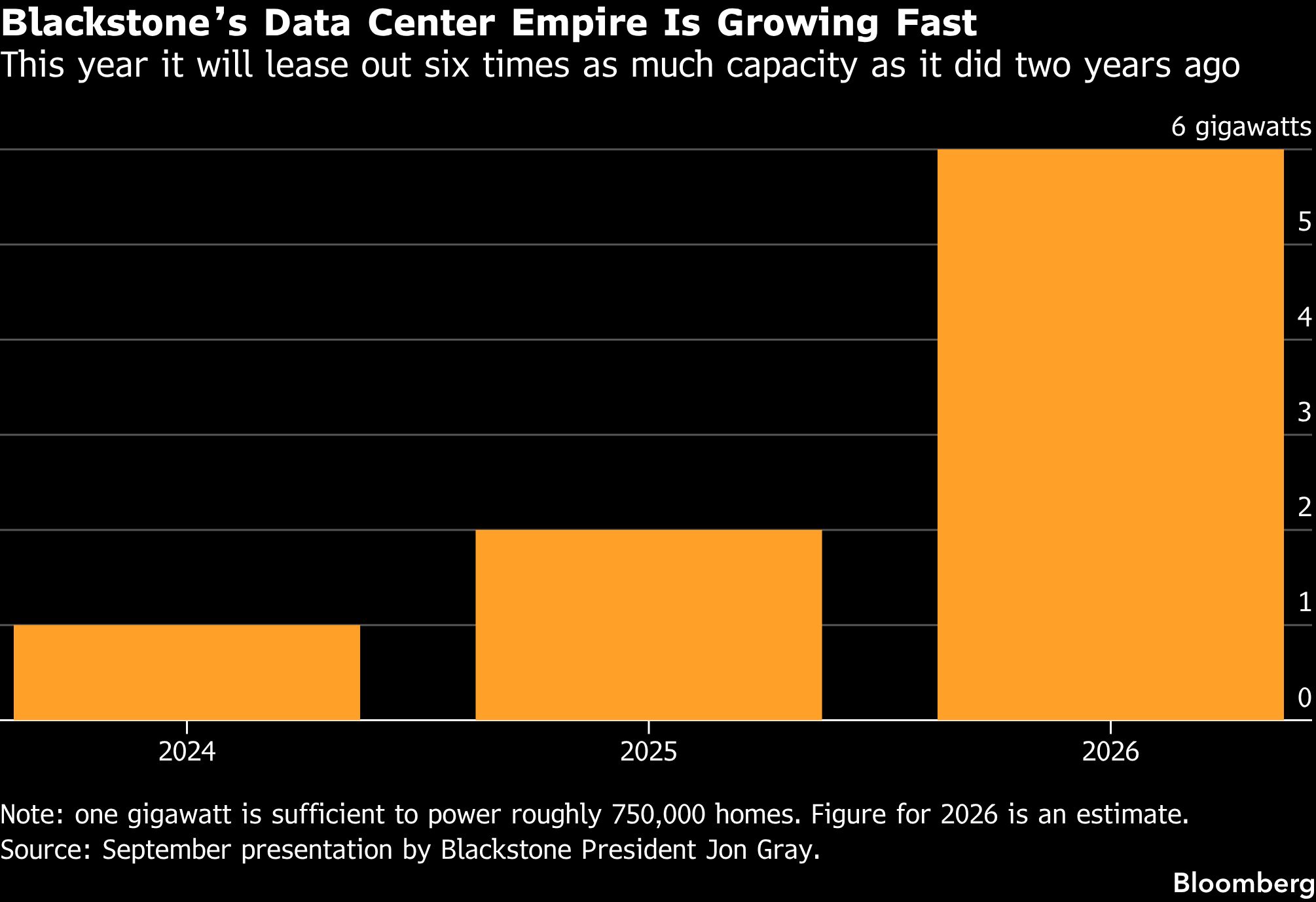
Data centers remain at the forefront of Blackstone’s bet. Including debt and projects under construction, the firm’s data-center investments have soared to $200 billion as of July, up from $55 billion in June 2024.
To get a rough sense of just how large that is, consider the most recent available values for Blackstone’s entire real estate and infrastructure portfolios: $608 billion, and $218 billion including debt, respectively.
And there could be plenty of future growth ahead. Global capital spending on data centers, including the chips they house, will total $31.6 trillion by 2050, with the US accounting for nearly half of that, according to PricewaterhouseCoopers LLP.
There are also numerous risks and unknowns. Among them: tenants could fail to renew lease contracts if demand for AI services falters, and estimates of how well data centers hold their value could prove too optimistic.
The opportunity for Blackstone is enormous, said Sunaina Sinha Haldea, global head of private capital advisory at Raymond James Financial Inc. But investors considering its new infrastructure bets “will need to price technology obsolescence and contract quality far more carefully than in conventional infrastructure,” she said.
“While Blackstone has taken leadership, it has to ensure it deploys capital and cashes out at right times to maximize returns, else the strategy can unravel,” Sinha Haldea said.
The sheer size of Blackstone’s data-center gambit could also make it harder to eventually cash out through sales or public listings — always a key consideration for private equity. The list of potential buyers for such huge businesses is short. The world’s largest sovereign wealth fund, for one, has said it is steering clear of unlisted data center investments.
This month, two Blackstone-backed data center companies pulled large planned listings in the Asia-Pacific region. Firmus Grid Ltd. scrapped plans to go public in Australia after failing to lure global investors who’ve grown more wary about frothy AI valuations, while AirTrunk delayed a Singapore offering.
Skilled Trades
Another challenge is the growing opposition in many communities to data centers, over issues such as noise, air pollution and potential strain on power and water supplies. A March poll by Gallup found seven in 10 Americans oppose local AI data centers. Politicians such as Texas Governor Greg Abbott have joined the backlash.
This summer, the pushback claimed its biggest casualty yet in Virginia, where QTS and a Brookfield-backed competitor, Compass Datacenters, had planned to build a $100 billion campus roughly double the size of New York’s Central Park. Local hostility threatens QTS’s plans to build another center in Clinton, Iowa.
Read More: A Data Center Revolt By Historic Battlefield Is Now a Blueprint for Backlash
It’s no longer enough for Blackstone to pledge it will do no harm, said Klimczak, the infrastructure head. Instead, he said it needs to show “net additionality” in areas such as cutting power bills and creating jobs.
In Iowa, for example, QTS is providing $5 million for a “skilled trades” program to help prepare residents for careers in construction, advanced manufacturing and related trades. Blackstone expects there will be 40,000 jobs tied to QTS, including staff, suppliers and contractors, by year-end, up from 10,000 a year earlier.
The investment community needs to do a better job in communicating the benefits of data centers, Klimczak said, but be prepared to move on if communities remain opposed.
The rapid buildout is throwing up other problems. As well as permits and power, data center projects can fall behind because of equipment bottlenecks. Blackstone’s Crux AI venture with Google has already run into delays.
‘Where’s the Beef?’
The final piece of the puzzle is deploying AI to overhaul Blackstone itself.
Gray — who personally uses AI to find running routes, restaurants and Netflix shows — has given it a voice at the Monday investment committee meeting, a crucial fixture for the firm’s top brass.
Nearly every investment up for review now comes with two memos: one from the deal team and one from the AI chief investment officer, a model trained on data including more than 14 years of internal deal memos and debates. The AI CIO doesn’t have a vote.
Rodney Zemmel, Blackstone’s head of portfolio operations, said he spends nearly 60% of his time on AI. Zemmel, who joined last year after nearly three decades at McKinsey & Co., has one team of data scientists working on investment-intelligence for Blackstone, and a second, applied AI team that works with portfolio companies.
Early this year, Gray met with Krishna Rao, Anthropic’s chief financial officer and a Blackstone alumnus, who had worked in the firm’s private equity business for four years through 2015. The two discussed collaboration. Anthropic wanted to foster use of Claude, while Blackstone’s corporate empire, which today spans more than 280 companies, was eyeing productivity boosts through AI.
Those discussions helped lead to the creation of Ode with Anthropic, an AI consulting firm set up in partnership between the duo, fellow buyout firm Hellman & Friedman, and a wider investor consortium. Business Insider dubbed Ode the “McKinsey of AI.”
Ode is now working with Zemmel and with Blackstone’s head of data science to help portfolio companies with their AI transformation, sending in software specialists known as forward-deployed engineers.
Some AI-driven change is already bearing fruit. Cell-tower company Phoenix Tower International is processing leases five times faster, while Indian diamond certifier International Gemological Institute is grading more lab-grown stones. Chamberlain Group, which makes garage-door openers, has gone from being an analog business to a vendor of AI-powered smart lock systems that can identify an owner’s car, children coming home from school or a parcel delivery.
“Who knew that the world of garage-door opening would be such an exciting AI spot?” Zemmel said.
At Gray’s September address to more than 100 CIOs, he drew on these and other examples from Blackstone’s vast portfolio. The image of the pitchfork-wielding Gray of 1870 was followed by a suit-wearing alter ego in 1900, reflecting a society transformed by the so-called second industrial revolution.
He also harked back to the 1980s, and the famous “Where’s the Beef?” commercials for the burger chain Wendy’s Co.
“Is there beef? Is it just a bunch of circular financing — people are going to lose all this money?” he asked the crowd. He argued no. If the bun is the trillions being plowed into chips, data centers and power, there is a meaty filling, too: the return on investment from surging AI uptake. A huge patty labeled “ROI from AI” appeared inside a cartoon bun.
“We’re gonna continue to see demand grow,” Gray said, “and that is justifying this enormous investment.”
For more news, information, and strategy, visit the Fixed Income Content Hub.
Bloomberg News provided this article. For more articles like this please visit
bloomberg.com.
More Innovative ETFs Topics >