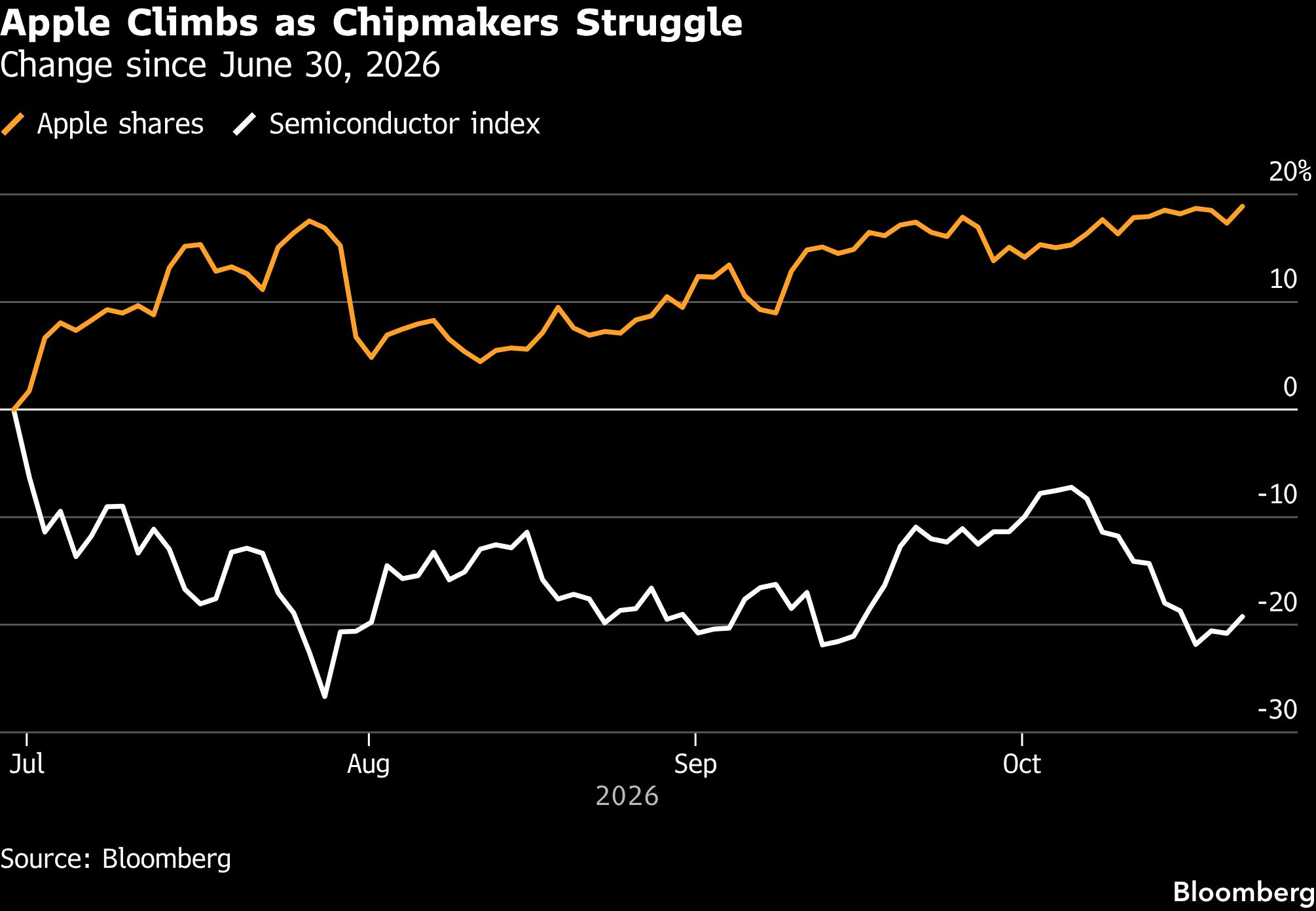
It’s become one of the most reliable trades in the stock market as sentiment toward artificial intelligence swings wildly: Whatever AI stocks do, Apple Inc. does the opposite.
The iPhone maker’s stock is up 28% in 2026, making it the biggest contributor to the S&P 500 Index’s 12% climb. It’s also by far the best performer among the Magnificent Seven technology giants this year, a stark reversal from 2025, when its 8% gain put it near the bottom of the group.
The reason for the divergence is fairly simple. While most mega-cap tech companies are spending wildly on AI infrastructure, Apple is largely sitting it out and instead focusing on what it historically does best, creating products that get consumers buzzing, like its new foldable iPhone Duo. With Wall Street’s view toward AI capital expenditures seemingly in constant flux, the company’s shares have become investors’ preferred method for staying in Big Tech while avoiding some of the group’s ups and downs.
See more: The Hidden Costs of AI: Are You Paying Attention?
“Apple is a very liquid hedge against AI volatility, and it’s a great position to have if you’re starting to get worried about AI but still want tech exposure,” said Jordan McCall, senior portfolio manager at Russell Investments, which has $418 billion in assets and owns the company’s shares in multiple portfolios. “Apple is a flight to safety when the market gets nervous.”
The divergence was clear on Thursday, when Apple rose 0.5% and was the only Magnificent Seven stock in the green, while the broader market fell with chip stocks leading the way down, after results from Lam Research Corp. and Meta Platforms Inc. raised questions about AI spending.

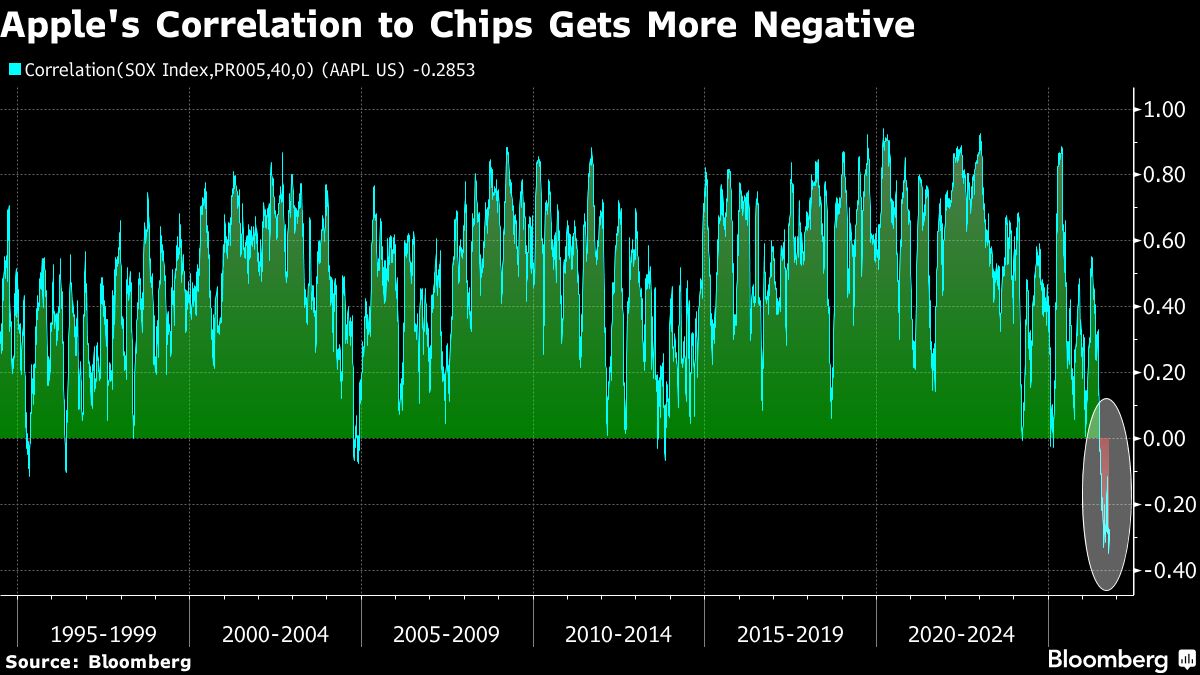
Investors are searching for safety because sentiment around AI is shifting so quickly. Shares of the big spenders like Microsoft Corp., Amazon.com Inc., Alphabet Inc. and Meta Platforms Inc., and the chipmakers at the heart of AI infrastructure, rise and fall as Wall Street debates when and if the hundreds of billions in capital expenditures will pay off in a big way. Apple has an increasingly negative correlation to semiconductor stocks and often moves in the opposite direction of its mega-cap peers.
The dynamic was apparent last week, when concerns about cloud computing provider CoreWeave Inc.’s debt spurred widespread selling of AI stocks. The SOX tumbled more than 11%, marking its worst week since April 2025, while an index of Magnificent Seven stocks sank 3.1%. Apple, meanwhile, rose 2% as the company said demand for the Duo was “nothing short of extraordinary.”
“If hyperscalers get more bad news, it would make sense to sell the SOX and use the money as a source of funds to buy Apple,” said Michael Matousek, head trader at U.S. Global Investors Inc. “Apple is more of a defensive play because it lacks exposure to the themes moving chips, and given how pronounced this kind of pair trade has become, it is so much easier to just go with the momentum. I wouldn’t fight it.”
Apple’s 40-day correlation to the chip index has been negative since early July and is at its most extreme in data going back to 1994. On a 10-day basis, Apple has a negative 90% correlation with the chip index, according to Jonathan Krinsky, chief market technician at BTIG.
Apple’s strong free cash flow and durable earnings growth are helping it stand out, McCall said. Microsoft, Amazon, Alphabet and Meta have seen their free cash flow plummet or even turn negative as they invest in AI infrastructure. And while chipmakers are seeing huge growth for the time being, the fear is their earnings will nosedive if that spending slows.
The primary concerns for Apple shareholders are that it’s growing more slowly than its Big Tech peers but carries a soaring stock market valuation. The company is scheduled to report earnings for its fiscal fourth quarter in a few weeks, and revenue is expected to rise about 15% for the year, well below the overall tech sector, according to Bloomberg Intelligence data. What’s more, the pace is expected to slow to 9.7% in fiscal 2027 and to 5.5% in fiscal 2028.
Meanwhile, the shares trade at 36 times earnings estimated over the past 12 months, their highest multiple since January 2008. That’s twice Nvidia Corp.’s valuation and well above where the tech-heavy Nasdaq 100 Index and S&P 500 trade.
This combination could make it difficult for Apple to continue outperforming, especially if investors’ perceptions of big AI spenders and chipmakers improves again.
“With SOX having just seen a -16% pullback, and AAPL at all-time highs, we think a bounce in SOX is likely to coincide with AAPL pulling back, at a minimum, toward its 50 DMA,” BTIG’s Krinsky wrote on Oct. 19, referring to Apple’s 50-day moving average, which is 4.7% below the stock’s most recent closing price.
There’s certainly a precedent for this kind of reversal. As recently as August, strengthening sentiment toward AI plays lifted shares of Microsoft, Amazon and Alphabet, while Apple struggled.
“I would be shocked if we didn’t see another period of AI enthusiasm that leads to chipmakers coming back, and it is very reasonable and plausible to think the pattern would repeat itself again,” McCall said. “Risk on for AI would mean risk off for Apple.”
Tech Chart of the Day
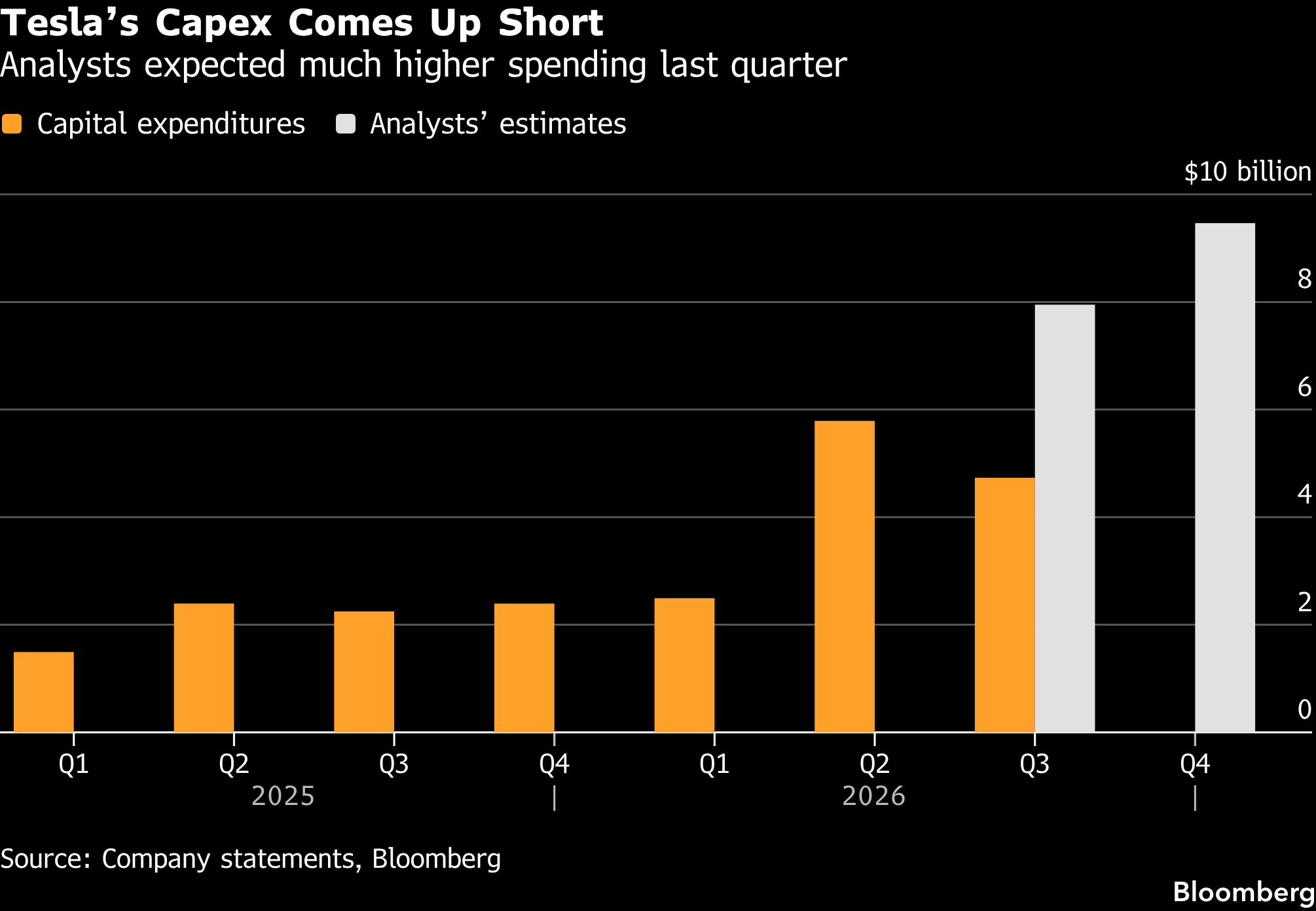
Tesla Inc. pulled back its spending plans after investment last quarter trailed expectations, clouding Elon Musk’s effort to transform the electric vehicle maker into an AI and robotics company.
A message from Advisor Perspectives and VettaFi: Discover something new! Click here to register for our upcoming webcasts.
Bloomberg News provided this article. For more articles like this please visit
bloomberg.com.
More ETF Topics >