Kalshi Inc. is opening up a new frontier in its rivalry with traditional financial exchanges by pitching the world’s largest banks and hedge funds on a futures market tied to US inflation.
The New York-based firm, best known for its prediction markets, is targeting a December launch for exchange-traded futures contracts tracking both the consumer price index and the closely watched core gauge of inflation, which excludes food and energy, according to people familiar with the matter. The firm has tapped Michael Ashton, a former Barclays Plc trader known as the “Inflation Guy,” to design the contracts and drum up interest with big investment firms.
The contracts would be the only futures tied directly to CPI, giving Kalshi a unique way to court macro investors active in the multi-trillion-dollar markets for interest-rate and bond futures that are currently offered by CME Group Inc. and Intercontinental Exchange Inc. CME tried to roll out CPI futures in the past but does not currently offer them.
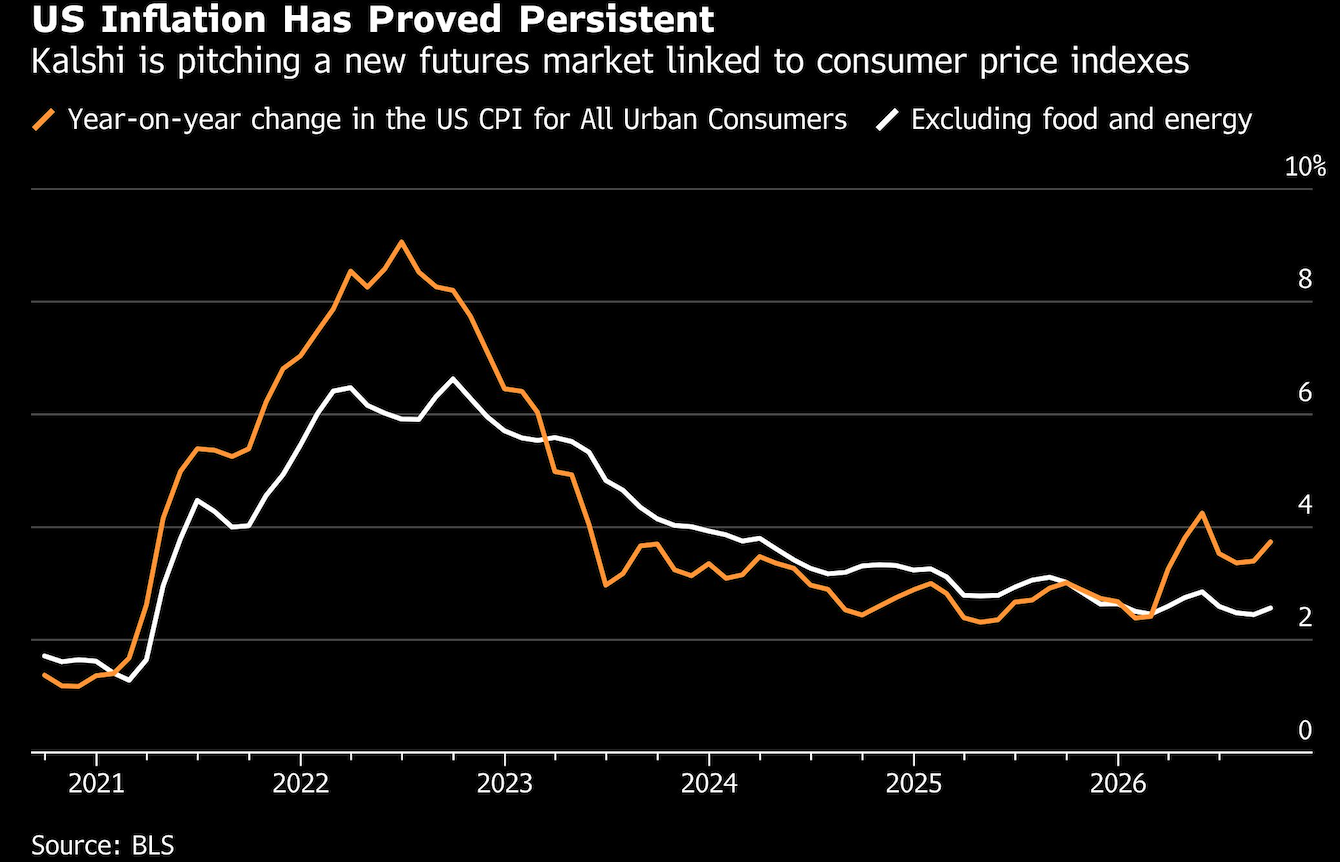
Kalshi is looking to roll out the product at a time when inflation has become a central preoccupation for trading desks trying to get ahead of potential rate hikes from the Federal Reserve.
“There’s no exchange that trades this and they want to be the inflation exchange,” said Ashton, the managing principal of Enduring Investments LLC.
A Kalshi spokesperson confirmed they were working on CPI futures, but declined to provide details on the rollout.

See more: Fed Hiking Cycle May Run Longer Than Markets Expect
The CPI futures are the latest in a dizzying array of new financial products rolled out by Kalshi and a handful of other startup exchanges.
Kalshi’s prediction market exchange is dominated by sports betting, but it already offers event contracts that allow customers to bet on whether CPI comes in above or below a certain level each month. Those binary contracts, though, have primarily been attractive to retail investors because they don’t offer the kind of smooth payout outcomes that institutional investors and traders are typically seeking.
Kalshi also has a growing business in so-called perpetual contracts, or perps, tracking the likes of crypto tokens and commodities. Unlike the new CPI futures, though, perps do not have any expiration date, which make it hard for them to slot into the existing Wall Street financial infrastructure. The CPI futures give Kalshi a new kind of product and a way to test expanding into traditional futures markets.
“This is a push they want to make and to some extent the success of their dated-futures ecosystem is going to depend on how this does,” Ashton said of Kalshi.
The documents Kalshi is using to pitch clients, which were reviewed by Bloomberg, show the CPI futures would be available for the next 12 reference months, and then for May and November for the four years after that. They would trade 24 hours a day from Sunday to Friday, with Kalshi Klear LLC acting as the clearinghouse.
Perpetual Debate
Kalshi’s expansion into derivatives markets has not been without controversy. The firm has filed with the Commodity Futures Trading Commission to create perps linked to oil and US Treasuries in recent months. That’s a direct challenge to CME, which currently lists the most popular futures markets for such assets.
Terry Duffy, the CEO of CME, has been critical of Kalshi and has said his institutional clients have little interest in the product.
“People can’t manage risk with no expiration date,” Duffy said on an Odd Lots podcast earlier this week. “Institutions go, ‘this is impossible for us to trade.’”
The CPI futures, with a defined expiration date, offer Kalshi a way to address that criticism while also bringing it into greater competition with CME, the dominant player in the US listed interest-rate derivatives market, where traders hedge and speculate on changes in US monetary policy. It also diversifies Kalshi away from its sports-related event contracts business, which many US states argue is skirting gambling rules and taxes.
Previous Efforts
The US inflation market is focused primarily on the $2.2 trillion in Treasury Inflation-Protected Securities, or TIPS, as well as over $5.4 trillion in inflation swaps, which are over-the-counter derivatives that don’t trade on an exchange. Unlike traders focused on Treasuries or stocks, inflation traders currently lack futures products, like Kalshi’s new CPI contracts, which can improve liquidity by bringing together varied market participants to trade standardized instruments on a single exchange.
There have been previous efforts to create inflation futures, including a product that CME launched in 2004.
Kalshi’s consultant, Ashton, said that earlier products didn’t match the needs of the broader TIPS market. For the new contracts, Ashton said he has consulted with a range of hedge funds, long-only asset managers and banks active in the US inflation-linked bond and swap markets.
“We are having some conversations with very large firms at very high levels across the board,” Ashton said.
Mark Spindel, chief investment officer at Potomac River Capital LLC, is among those to have been in talks with Ashton regarding the Kalshi contracts. He said the primary current method of making trades linked to inflation — using over-the-counter swaps — requires extensive documentation which limits potential participation, whereas a futures exchange could attract new players.
A deep futures market would be “a valuable addition to the toolkit at my disposal, as well as other speculators and hedgers,” Spindel said. “We’ve all been stung by surprising developments in inflation.”
A message from Advisor Perspectives and VettaFi: Discover something new! Click here to register for our upcoming webcasts.
Bloomberg News provided this article. For more articles like this please visit
bloomberg.com.
Read more articles by Greg Ritchie