Our higher education system is broken. Families pay a fortune for degrees that do not pay off like they used to. However you feel about the future of advanced degrees, they’re certainly a mispriced asset — a mispricing that started in the market for student loans.
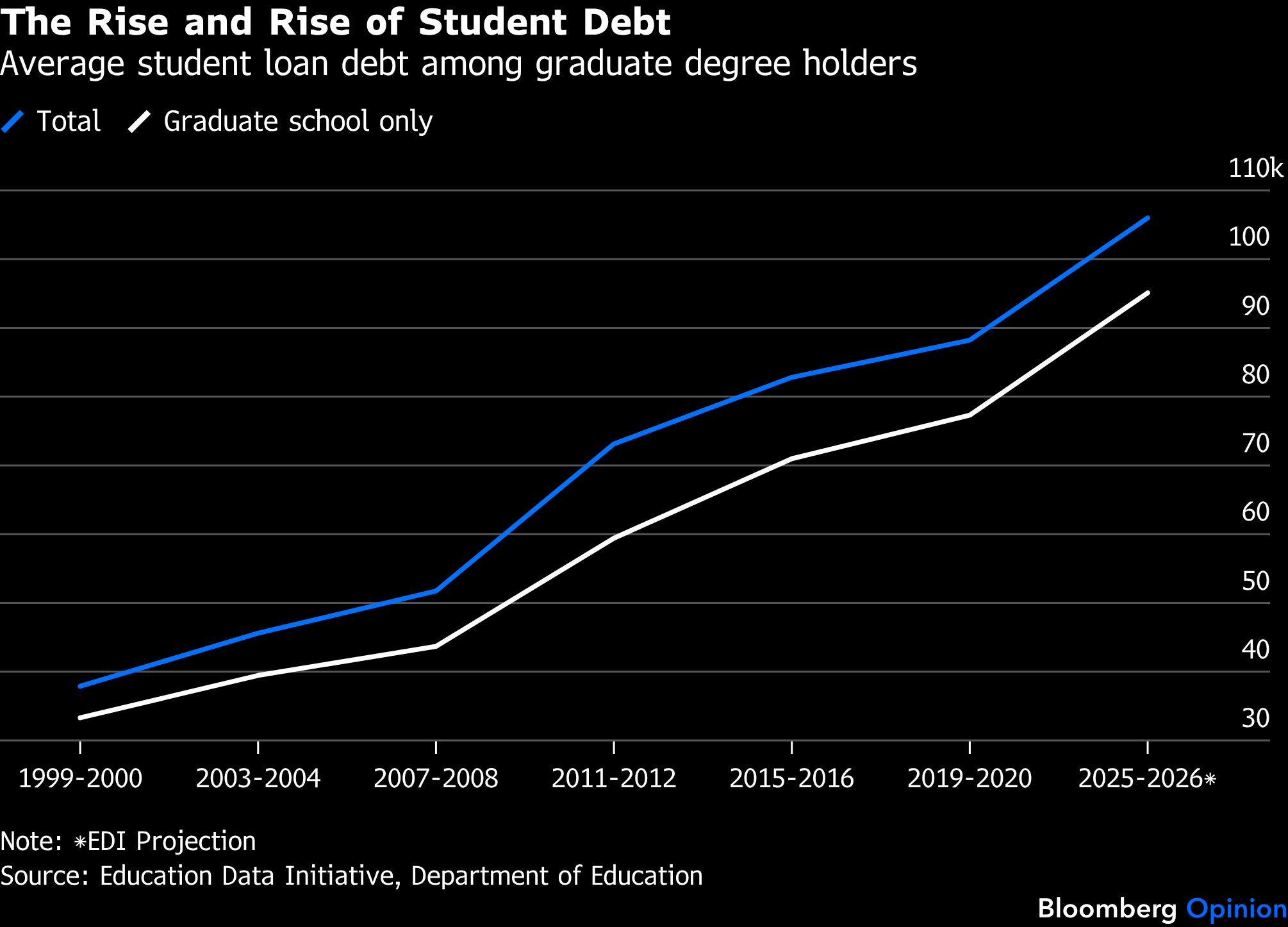
The biggest distortions are in graduate degrees, where students have the largest debt burdens. They represent 25% of borrowers, but account for half of all loans. The government has been the dominant lender here, but the Trump administration is scaling back significantly and creating an opening for private players. This will make graduate education more expensive as students are forced to turn to more costly loans, but that may be a healthy development.
Some graduate degrees are dicey undertakings, yet federal loans offer the same interest rates no matter the area of study. Education can be an important investment, but people can’t make smart choices without accurate price signals. If Alphabet Inc. and GameStop Corp. paid the same interest rate for a loan, the bond market wouldn’t allocate capital efficiently. Why would we expect more from university education?
It’s also true, however, that market rates alone shouldn’t dictate loan pricing. Degrees that lead to teaching roles, for example, have smaller payoffs than MBAs, but they benefit the entire economy. I am not one to advocate for government intervention, but one of the few exceptions is when externalities can’t be priced in. That’s true of programs such as teaching and public health, and it’s one big reason we subsidize educational loans as much as we do.
But there can be too much of a good thing.
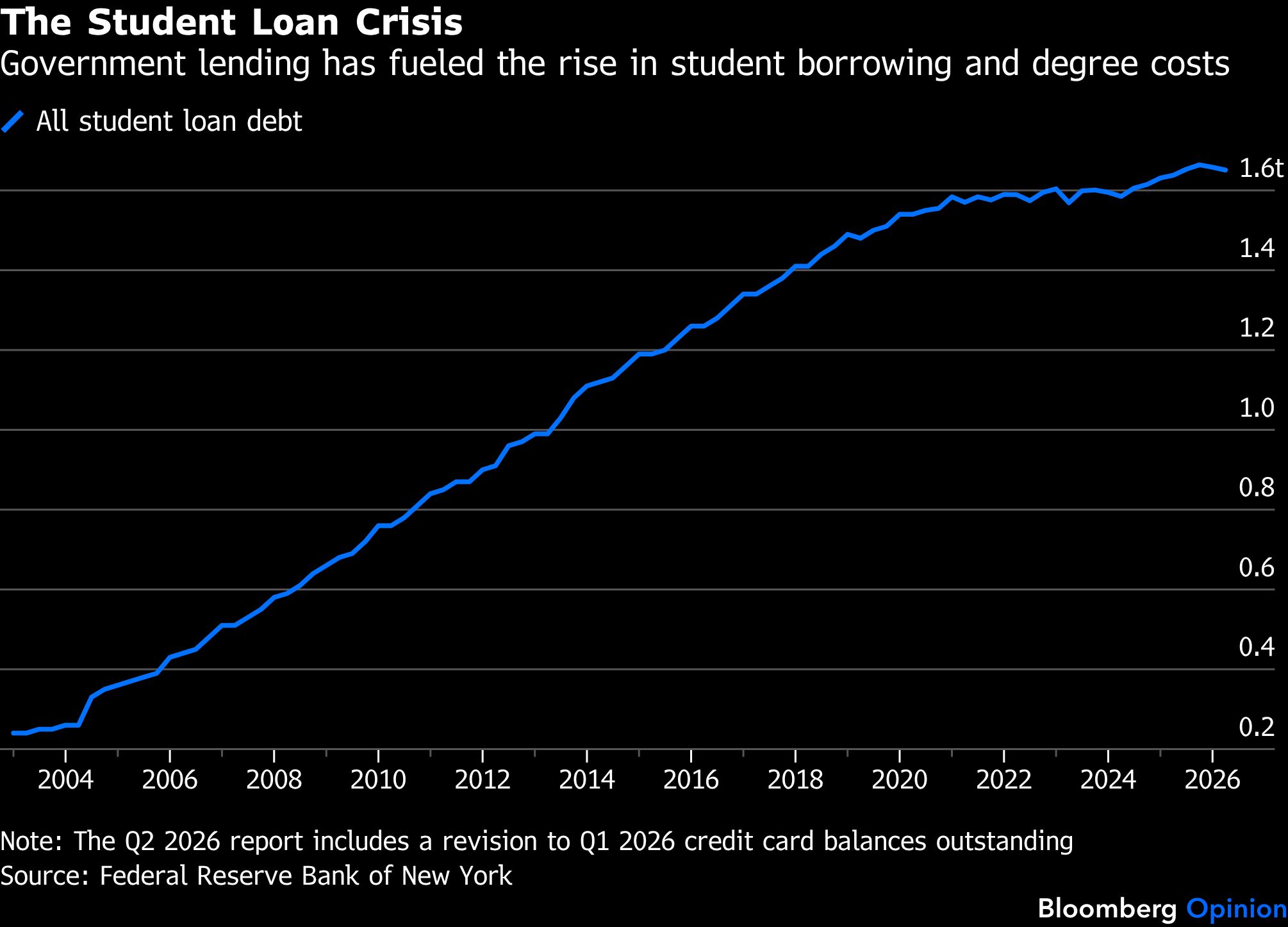
Government loans effectively subsidized all graduate degrees until this year — some benefited the wider economy, some paid off for the borrower, but others did neither. We still treated them the same from a risk and pricing perspective, resulting in an explosion in student debt and rising degree costs. The private market has the potential to reintroduce risk pricing that compels student borrowers to weigh the merits of the debt they’re considering. But preserving the best of government subsidies while introducing a market nudge will require a number of changes to how we fund education.
The first is already afoot. The One Big Beautiful Bill (OBBB) capped federal student loans for graduate degrees at $20,500 annually, starting in July, with a $100,000 aggregate limit on most programs. The caps are $50,000 and $200,000 for what the government considers professional degrees, including in clinical psychology, dentistry, law, medicine and theology — though why theology makes the cut but not a nurse practitioner program is up for debate (and lawsuits).
This could be a game changer because government loans will no longer fully cover tuition and expenses at most private universities — that will be true even for some degrees subject to the higher cap. The funding gap is estimated at $8 billion each year.
Assigning different loan limits for different degrees is a good idea in theory because it forces borrowers on to the private market. Those pursuing the lower-cap degrees now have two hurdles to consider: They are more exposed to higher private-sector rates, and they have no scope to enter the government’s income-based repayment plans, which can lead to some loan forgiveness, for that portion of the loan.
This should give students some pause on the value of the degree they are considering. If that consequently dents demand for certain degrees, universities may be forced to charge less for those programs. There is some evidence this is already beginning to happen.
Still, the OBBB changes have weaknesses that need to be addressed.
The degrees that qualify for the higher “professional” cap are currently arbitrary and could be subject to politics. The government has already decided not to lend to programs that don’t increase a student’s earnings; it could use similar data to determine objective loan limits for other graduate degrees, too.
A more thoughtful approach is also necessary for degrees such as teaching or social work, which have positive externalities. The government could extend forgiveness to private loans in these instances once borrowers have worked in public service for 10 years or more, as is already the case for federal loans.
Another big challenge is reviving the private sector, which worked well at aligning incentives and pricing risk before the 2006 introduction of the Grad PLUS program. PLUS allowed students to borrow as much as they needed under better terms, crowding out private lenders. It also disconnected borrowers from prices and contributed to today’s student loan crisis.
Restarting the private market won’t be easy. Student loan debt receives a high risk-weighting on bank balance sheets. Private student loans were securitized to offset that risk before 2006. Reviving securitization will take time because it requires more detailed data than currently exists on credit risks for different degrees and schools. The government may need to step in and offer early-stage credit enhancements to grow the market and data enough to start securitization.
Economists Beth Ackers and Sarah Turner point to several other hurdles. Private lenders used the credit scores of borrowers (or their guarantors) to set loan terms before 2006. This data is readily available, but it is not sufficient. It penalizes lower-income families and is backward-looking. Some lenders in the pre-PLUS era considered projections of future earnings for specific degrees and fields. This is critical for functional risk pricing that students can afford. But once again, it will take time to collect sufficiently granular data.
Jump-starting the private sector in this regulatory and limited-data environment may require universities to step in, too. They could partner with private lenders to subsidize loans or offer them themselves. They have done this in the past, though universities will probably need some guarantee from the government.
Incorporating risk into loan pricing for higher education could transform graduate programs by better aligning incentives at all levels, so long as government subsidies remain in place for degrees that serve the wider public. What happens with graduate education may also offer a model for how to better price education overall and force universities to take a bigger stake in the success of their students. Education involves risk like any other asset, and if you distort its price, poor choices follow.