Anybody who has lived through the past quarter century or so is familiar with the concept of a debt doom loop. Big government deficits, say, cause higher interest rates, making the government pay more to borrow and also bail out the banks that own its sinking bonds, driving it even deeper into debt. Rinse, repeat.
The next quarter century will feature a new kind of debt doom loop, one driven by a heating planet. Say a sovereign government, or a Texas town, has a tight budget and vulnerability to climate-driven disasters. Most of the money it would have spent shoring up against catastrophe goes to debt payments instead. When trouble inevitably arrives, it has to borrow more money to recover, probably at higher rates, giving it even less to spend on resilience for the next disaster. Flood, repeat.
You might call this a climate-doom loop, and a paper published last week in the journal Science explores a recent example: Jamaica. Over a decade, its government diligently worked its debt load down from 144% of gross domestic product in 2013 to 65% in 2024. This cost the island nation $3.1 billion every year, or six times its annual spending on roads, bridges and other infrastructure vulnerable to disasters. But that paid off in repeated credit-rating upgrades, including an all-time-high BB rating with a “positive” outlook from Standard & Poor’s in September 2025.
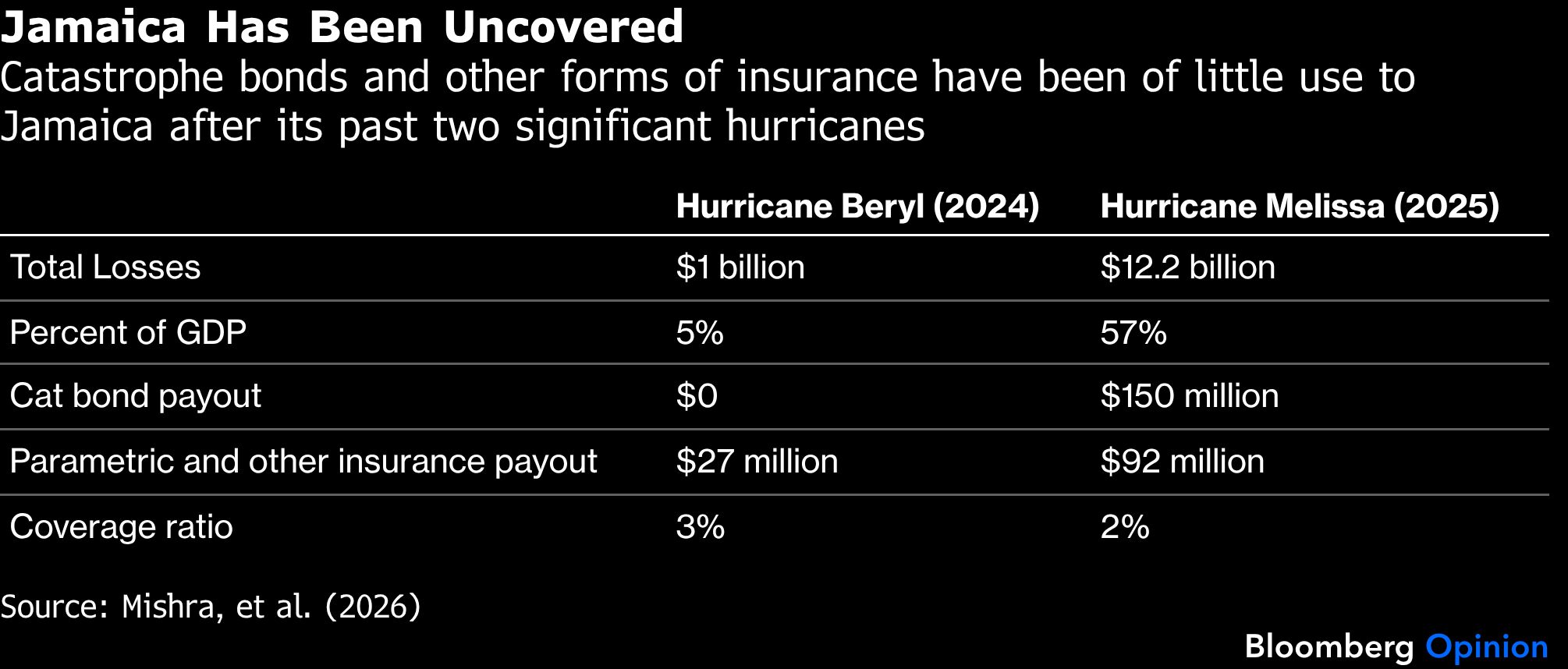
Too bad credit ratings don’t stop hurricanes. Just a month after the upgrade, Hurricane Melissa smashed into Jamaica as a Category 5 monster, one of the strongest in Atlantic history, undoing much of the country’s hard fiscal work. The storm inflicted $12.2 billion in losses, or 57% of Jamaica’s GDP.
In an increasingly familiar story, Jamaica’s disaster insurance was essentially useless. Yes, the island nation had catastrophe bonds and parametric insurance, which pays out when certain storm measurements such as wind speed are met. But the cat bond was worth only $150 million, and the insurance paid only $92 million. Together they covered less than 2% of Jamaica’s damage.
Borrowing would have to handle the rest. As a result, Jamaica’s annual debt service has gone from $3.1 billion to upward of $3.7 billion, widening the huge gap between debt payments and spending to protect itself from future storms. Kicking the country when it was down, two months after Melissa, S&P trimmed Jamaica’s outlook from “positive” to “stable.”
“The current system is rewarding countries for paying down debt but nothing for the very protections that would reduce those losses,” Aayushi Mishra, an environmental scientist at Northeastern University and an author of the Science paper, told me. “Countries shouldn’t have to choose between what is seen as fiscally responsible and protecting themselves.”
Jamaica isn’t the first country to enter one of these doom loops, and it won’t be the last. Mishra and her co-authors have identified about 35 heavily indebted island nations that are vulnerable now, but that cohort will expand as the planet becomes hotter and climate disasters get more damaging.
And there’s an even more crowded universe of potential doom-loopers in the US: the roughly 55,000 borrowers that make up the $4.2 trillion municipal-bond market. In a paper published in January in the journal Nature Cities, Mishra and her co-authors found that, as with sovereign debt, one big risk for muni borrowers is a sudden bond repricing after a disaster that triggers a debt doom loop.
On average, heat and sea-level rise raise muni interest rates, the researchers found, but just barely. When a catastrophe strikes and munis use debt to cover the damage, that trashes their finances. The default by California’s Paradise Redevelopment Agency after the Camp Fire in 2018 is one example. The surge in Corpus Christi’s borrowing costs as investors plumb the depths of its water crisis is shaping up to be another, as my Bloomberg Opinion colleague Matthew Winkler has noted.
A hotter, more chaotic future will bring more of these financial crises. So will the Trump administration’s demand that state and local governments bear more of the burden of preparing for and recovering from disasters. Relying on private creditors won’t solve anything; it certainly hasn’t stopped this country’s dangerous underinvestment in critical infrastructure from yawning to $9.1 trillion, according to the American Society of Civil Engineers.
Like the insurance industry, the sovereign and muni debt systems are built for a different era, one before multibillion-dollar climate disasters became routine. Even when everybody plays by the rules, as happened in Jamaica’s case, that system buckles.
In this era, vulnerable borrowers need bigger, public financial backstops. Mishra and her co-authors have called for a federal institution for buying or backing resilient-infrastructure loans issued by munis and bundling them into asset-backed securities. If the feds keep refusing to help, another possible solution is statewide grants and pools for investment and disaster recovery.
Muni and sovereign borrowers need clauses that let them postpone debt payments after a natural disaster. The International Monetary Fund, multilateral development banks and other creditors should retire debt as a reward for resilience spending because debt payment and loss avoidance aren’t mutually exclusive. Sovereigns could pool their money regionally and globally to help one another pay the bills.
Preventing climate-debt doom loops will take political will and imagination that seem to be in short supply. But if we’ve learned anything after decades of both financial and climate disasters, it’s that a little pain now will avoid a lot in the future.