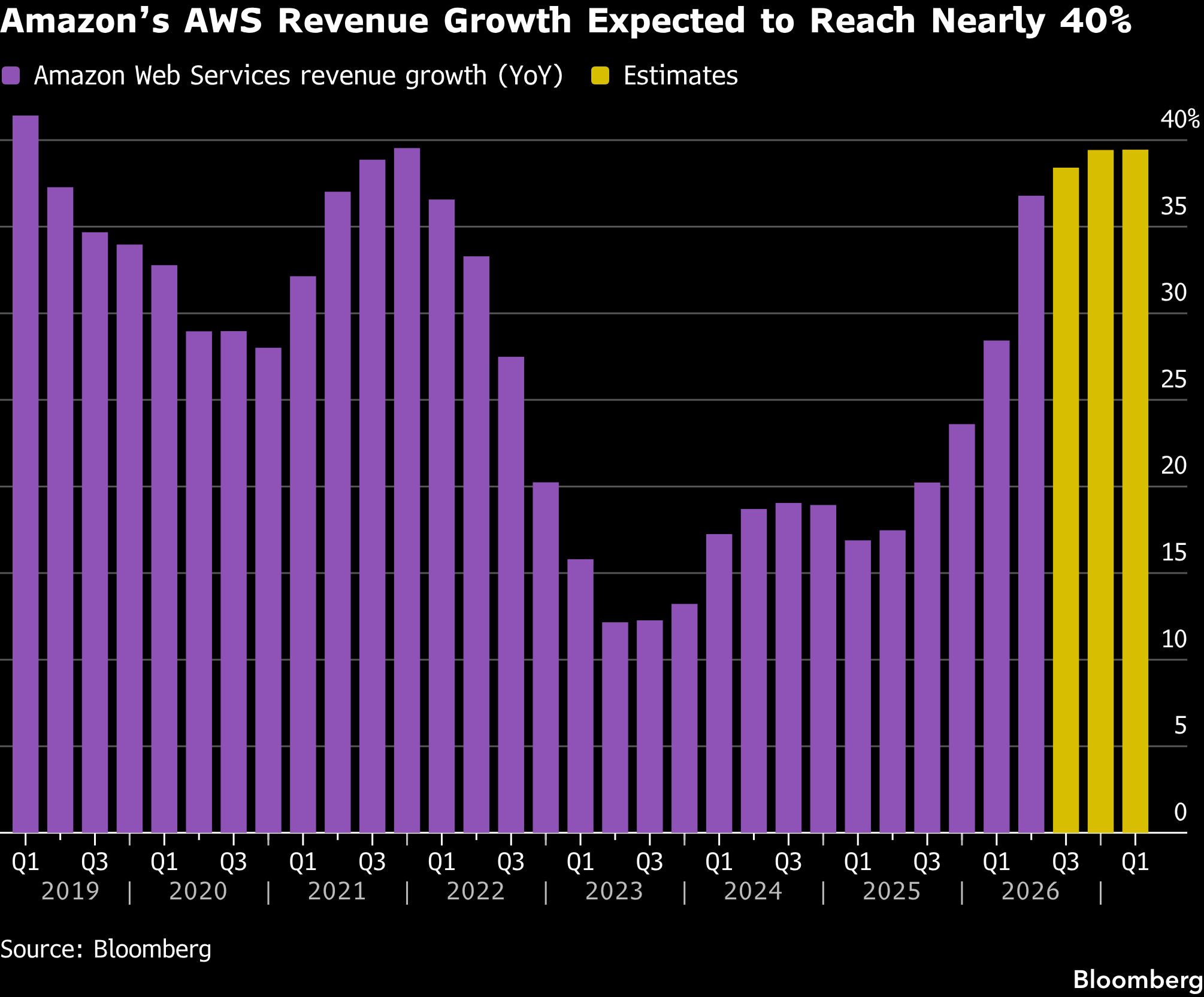
Blistering cloud growth sent Amazon.com Inc. shares soaring after its last earnings report. Now with more than half those gains gone, the firm needs to deliver a repeat performance in order to reignite its faltering stock.
The stock had its best day since 2012 on July 31 after the e-commerce and cloud giant’s second-quarter results showed that revenue at Amazon Web Services, its cloud business, was accelerating faster than Wall Street expected. But the shares have struggled since then, down 10% from an early August record, as jitters about the AI trade, pressure from higher interest rates and competition from AI services such as Meta Platforms Inc.’s Muse cut into market sentiment.
See more: Consumer Confidence Recovers Significantly in October
So shareholders are looking for AWS to perform the same trick it did last quarter when Amazon reports its earnings after the bell on Thursday. Analysts expect the segment to post an almost 40% jump in quarterly revenue from last year to $45.7 billion, according to data compiled by Bloomberg.
“A year ago, investors would’ve doubted that they could do that,” said Jed Ellerbroek, a portfolio manager at Argent Capital Management, which holds Amazon shares. “I think we’re going to see excellent results from AWS.”

Amazon’s report comes during a packed week for hyperscaler results, with investors increasingly focused on seeing tangible payoffs from heavy spending to build the infrastructure for artificial intelligence. Anthropic PBC’s filing for an initial public offering on Monday helped assuage some fears about the health of the AI trade and the amount of debt being raised to finance it, which has weighed on technology shares in recent weeks.
Microsoft Corp. and Alphabet Inc. reported lower-than-expected capital expenditures in their earnings reports late Wednesday. Microsoft’s stock jumped in Thursday premarket trading on the company’s better-than-anticipated cloud revenue, while Alphabet tumbled as Google’s parent posted third-quarter profits and sales that missed analysts’ estimates.
Wall Street is expecting a solid quarter from Amazon, with revenue climbing 12% to $202 billion and net income rising 2% to almost $22 billion. Beyond AWS’s performance, investors will be closely watching the company’s capital expenditures. Amazon raised its capex forecast last quarter, mostly due to high memory prices, and investors likely won’t be surprised if it increases its spending outlook again. Analysts’ capex estimates have risen to about $222 billion for 2026 and nearly $290 billion for 2027.
“We have to understand where the spending plateaus and how durable it is,” said Jake Behan, head of capital markets at Direxion, adding that it needs to happen while AWS’s revenue expansion is accelerating “from high to higher.”
How Amazon gets to that AI spending figure may matter more to the stock price than the actual quarterly results, according to Evercore ISI analyst Mark Mahaney. Meta’s strong earnings last week were overshadowed by its funding needs because investors are becoming increasingly concerned about capex hurting free cash flow and whether companies are using equity or debt to fund their AI build-outs. Amazon is expected to have negative free cash flow this year and next.
“Intensifying competition for AI capital is also raising the odds of equity issuance at scale,” Mahaney wrote in an Oct. 23 note. “We would not draw a straight line from Meta to Amazon, as we view Amazon as better positioned than most to fund its AI buildout (relying on debt rather than equity.)”
The rosy reaction to Anthropic’s IPO filing also could benefit Amazon, as the company’s stake in the AI lab has boosted profits in recent quarters. The offering could value Anthropic at as much as $1.75 trillion, and according to calculations by Oppenheimer & Co. analyst Jason Helfstein, each $1 trillion of market capitalization will add about 7% to Amazon’s market value, which currently stands at about $2.7 trillion.
Anthropic’s IPO “would provide more disclosure around compute demand for cloud providers, such as the estimated $111 billion committed to AWS,” he wrote in a research note last week.
What Amazon says about its remaining performance obligations and how close it is to collecting on those contracts is also important. Amazon had a backlog of nearly $500 billion in the second quarter.
“We have to understand if Amazon is supply constrained on that backlog, we’ve seen that elsewhere,” Direxion’s Behan said. “How monetizable is that backlog?”
A message from Advisor Perspectives and VettaFi: Discover something new! Click here to register for our upcoming webcasts.
Bloomberg News provided this article. For more articles like this please visit
bloomberg.com.
Read more articles by Carmen Reinicke