Technology took us out of our homes. It gave us a boss, office politics and an alarm clock — and it was awful. We got used to it; we made it work. Now technology might take those jobs away. But perhaps it will also restore the autonomy and flexibility that once defined work.
From when we were hunter gatherers, farmers, small scale artisans and then factory workers and office drones, technological innovation has altered the optimal work arrangement. Artificial intelligence may be changing work again. We tend to assume change is bad, and transitions undoubtedly can be hard. Change is also often inevitable, challenging our imagination on what work can look like. The AI optimists believe that machines will take all our jobs, but bots can create modern jobs, too, jobs that resemble a pre-industrial notion of work.
Today we take for granted what a job should be. You show up at a certain time and have a boss. They tell you what to do, and in exchange, you are paid in both cash and benefits. They offer security and a lifestyle. We spend most of our waking hours at work, with our coworkers and bosses. Our employers bear lots of the risk we face. They pay us when we are sick, offer health and disability insurance and don’t cut our wages in disappointing years (unless things go badly for a long time. Then, they might lay us off.)
This arrangement works pretty well, though it had a rocky start. The early days of industrialization featured displacement and terrible, dangerous working conditions. As much as we complain today, work has become better, more secure and safer thanks to a confluence of factors: a rising middle class, pressure from unions, the quirks of the tax code and more infrastructure to support activities, such as commuting to work.
It wasn’t always this way. For most of human history, we worked at or near home, often alone or with a few people we knew well, on our own time. That changed with the industrial economy, which required large numbers of workers in one place at the same time. The first hundred years of industrialization were rough. People were used to the autonomy of working for themselves. Being forced to go somewhere else, be there all day and take orders was considered demeaning. It is one reason why factories initially hired women and children. It is also why we have universal school, to condition workers to take orders and show up on time.
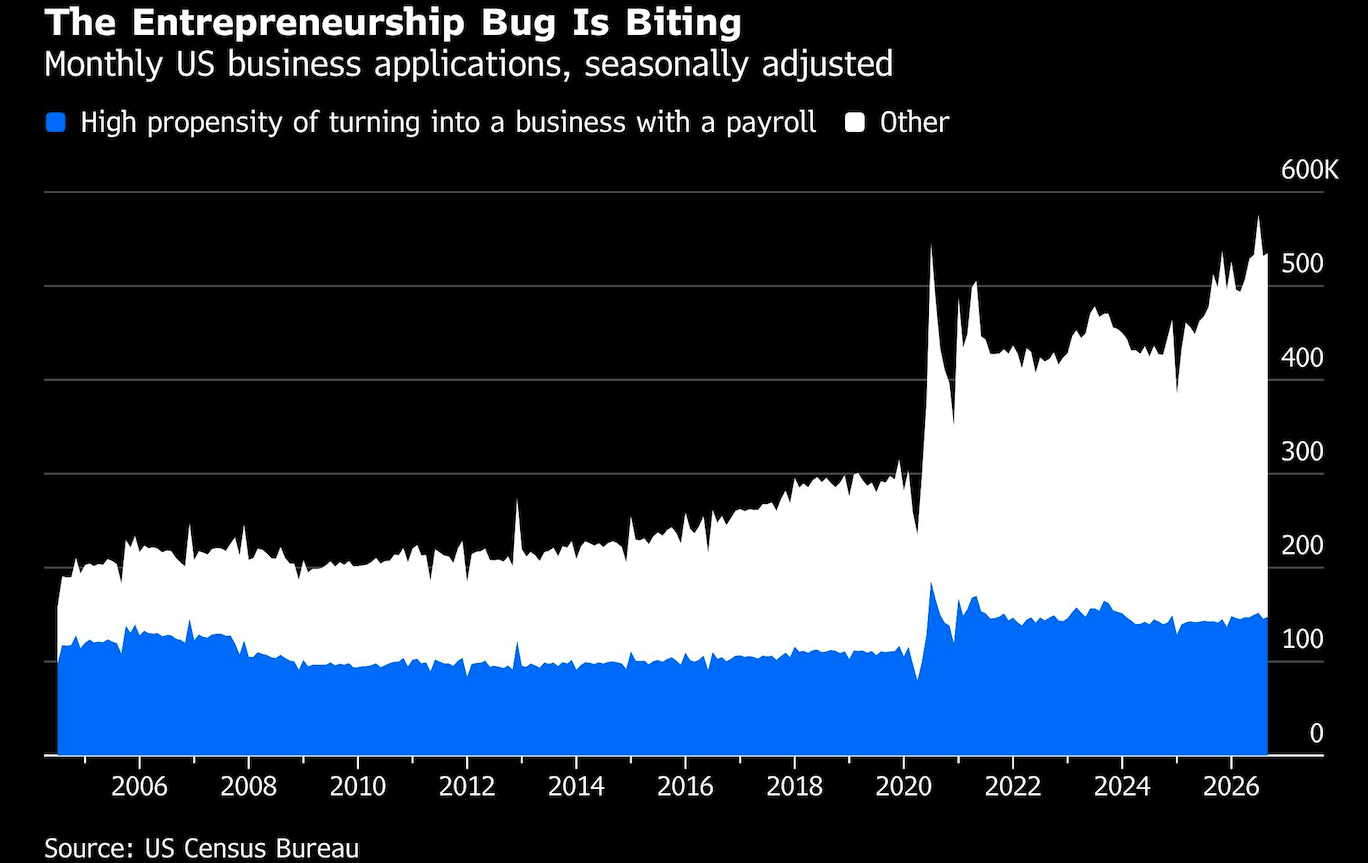
A boss became the norm. Self-employment and entrepreneurship became less common — until recently. Things started to change in the years before the pandemic, and they changed a lot during the early 2020s.
See more: Why RIAs Are Booming in the Era of AI Advice

My Bloomberg Opinion colleague Justin Fox has pointed out that much of the increase in new business formation has been single-person entities that won’t hire anyone or make their founders rich. Many of these are side hustles, and many new founders are older, perhaps seeking a gradual exit from the labor force as they approach retirement.
This does not mean we should devalue what’s happening since it could signify a throwback to an earlier form of work. Bank of America Corp. data for June showing Gen Z surpassing all other generations in business application growth may signal a material shift in how young people are responding to the age of AI. If technology took away our autonomy in the 18th and 19th centuries, now it may be bringing it back.
Amazon.com Inc. is not perfect, but it allows entrepreneurs to sell goods on a small scale, and it can offer logistics and a bigger sales network. Apps today make it easy to find consulting and gig work at all parts of the skill and wage distribution. Technology makes it possible to start a side hustle without the fixed costs of a brick-and-mortar store — and if it works out, that can become a full-time gig. Surveys show people like flexibility and being their own boss. As they should, it is a more natural way to work.
AI may take this trend to a new level because it further lowers the costs of starting and running a business. It can offer basic legal advice, be a virtual assistant, edit documents or short form videos for influencers. Maybe it will reduce jobs at big employers, but it also enables us to start new businesses on our own terms.
Transitions take time and can be messy. We still have an economy and culture built for in-person work. It is how most people get training, healthcare and unemployment benefits or sick leave. It also plays an important role in socialization, since work is where we frequently make friends and meet spouses. More single proprietor work may offer more flexibility and be more creatively satisfying, but it could add to our existing loneliness epidemic. People had other social outlets in the pre-industrial age that we lack now, whether that was offering apprenticeships or building community through shared interests and religion.
The transition to an industrial economy was longer and more painful than it needed to be because people were attached to a notion of what work was, and it took time for institutions to adjust. If we want things to go better this time, we need to be less tied to the past and find more creative ways to support this new way of work.
A message from Advisor Perspectives and VettaFi: Discover something new! Click here to register for our upcoming webcasts.
Bloomberg News provided this article. For more articles like this please visit
bloomberg.com.
More Fixed Income Topics >