Advisor Perspectives welcomes guest contributions. The views presented here do not necessarily represent those of Advisor Perspectives.
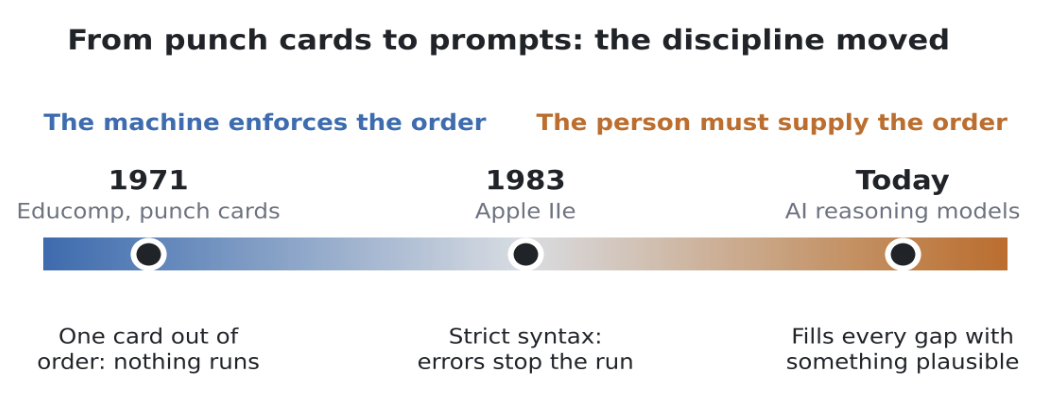
I am a nerd. I fell in love with the first computer I ever saw, in seventh grade (1971). It was an Educomp with a tape drive, and every instruction had to be entered via punch card, one card at a time, in exactly the right order, or nothing ran. Beyond a recurring fear that I'd drop my card stack while loading it into the feeder, I was all in.
Twelve years later, in 1983, I sat in front of an Apple IIe at Hoare Govett's Company Finance Department in London (my first job after college), looking at a blinking cursor and a crude program built to value convertible bonds. I asked the IT director whether I could make it more accurate. He laughingly told me to "go ahead" as he walked away. Two weeks later, the trading desk upstairs was pricing securities with my program.
In 2025, I wanted to understand our new investment models better than any off-the-shelf tool allowed, and I discovered new AI reasoning models could translate what I wanted into working code. That relationship has changed the economics of nearly everything my firm does today.
As much as we all hear that AI democratizes expertise, I see very directly how it does the opposite. The value of any AI interaction depends almost entirely on who is using it and how it is being directed. I maintain that the gap between how an expert and everyone else leverages these new tools has grown wider when any answer has to be judged rather than looked up.
What One Person Can Build
Since February 2026, I have been building FlightDeck, a market intelligence platform with live portfolio monitors, a market weather system, replays of historical crises, a regime classification history running back to 2000, and a publishing system for my firm’s research. It’s not a marketing site as much as an open kitchen where visitors can see the analysis and tools my colleagues and I use in our practice.
I am not a solo practitioner, but I am the chief engineer for our information systems as well as the chief portfolio and investment model designer. In other words, the Chief Nerd Officer speaks.
Compared with the way I would have developed this platform in 2019 (when I last undertook a large internet-driven project), it conservatively comes to the equivalent of roughly 3,800 hours of senior financial engineering. At the $150 to $200 an hour I would expect to pay experienced U.S. contract fintech engineers, that is well over half a million dollars before the first support ticket. Our actual cost was a handful of AI subscriptions, cloud hosting, and my design and engineering expertise in data fidelity across a site with many monitors and reporting modules.
That last item matters most: 40-plus years of knowing where data comes from, how it flows, and when a number is wrong is what made the design work. While everyone talks about democratization, the experts are getting “expertier.”
When I consider FlightDeck's impact on our business, the savings matter less than what it has unleashed for my team. Goodbye to committees! I can prototype in a well-focused afternoon what used to take months and far more money to test. Today, we cycle ideas far faster, because the feedback loop is shorter. Don’t blink — the fast got faster again.
Not Just Me
I see the same pattern among entrepreneurs around me, each with deep domain experience and enough programming background to know when the machine is bluffing. A web developer I work with, for example, expanded his business by deploying specially trained agents and internally trained LLMs, taking on more work while delivering higher quality.
At a private cybersecurity firm, where we are one of the two largest owners and also consult, AI reasoning engines have remade many parts of the business. The firm has used machine learning in its technology for more than 20 years, and top-of-the-line reasoning engines changed how it works in just a few months.
Anyone can rent the same engines. These folks showed up with something you can't rent: decades of knowing what “right” looks like in their own fields.
This is the AI game changer we were promised, and it comes with hard limits we should respect — or risk the wrong robot uprising.
The Car Now Wants to Drive Itself
Many AI cheerleaders skip this part, and I see it as a potentially dangerous pitfall. The AI engines almost ceaselessly offer to take control while I relax or move on to other issues. Many of us can quickly grow comfortable with that arrangement because, in my experience, the most advanced reasoning models from providers like OpenAI and Anthropic steer answers to the meaty middle of the road. In other words, AI loves a reasonable — and even consensus — answer based on all the material from which it learned.
While that's great for taking a Waymo taxi, the implications for investors and investment advisors are less rosy.
When investors and advisors who are not deeply rooted in company analysis and stock selection use AI, they tend to be steered toward this seemingly safe middle. The problem grows in two directions as more users crowd into similar-looking trades.
First, a crowded consensus is fragile. It risks the kind of violent unwind quant funds suffered in August 2007, when the forced selling of one or more large funds hammered others holding the same crowded positions (Khandani and Lo, 2007). Gary Gensler, before he chaired the SEC, warned that widespread use of deep learning could make the financial system more uniform, interconnected, and fragile (Gensler and Bailey, 2020). Second, because AI engines tend to trim away contrarian choices, nonexpert users risk being steered away from some breakout winners the consensus overlooks.
Three Times It Tried to Take My Wheel
If consensus pull is the slow danger, the confident wrong turn is the fast one. What follows are three among hundreds of misdirections I caught because I knew where the answer needed to be.
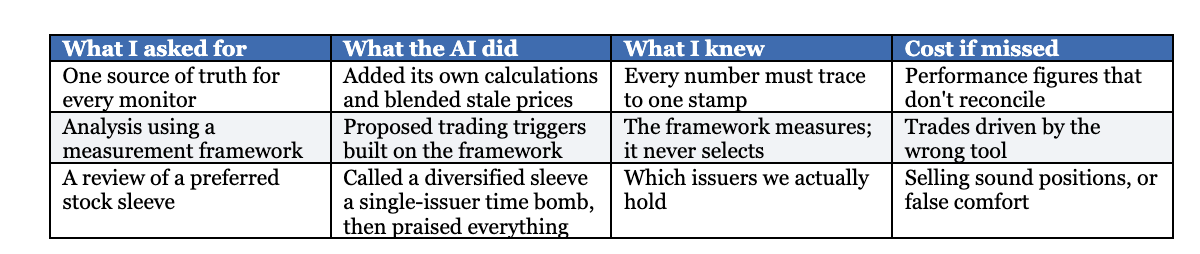
It overruled my architecture. FlightDeck runs on what I call the Riverhead Principle: one source of truth, stamped once a day from closing-auction prices, after which every monitor downstream simply reads it. Repeatedly, the AI decided it knew better than what I ordered and gave monitors their own calculations, blended stale live prices with the official numbers, and once proposed leaving the fix for another day.
Each presented change to my structure looked reasonable on its own, and the AI reported each problem as solved. However, when combined, the changes produced screens that disagreed about the same portfolio. For an RIA, performance numbers that don't reconcile are a compliance nightmare.
It wanted to trade on a measuring stick. Our research splits trading days into Pure Beta days, when big market moves swamp stock selection, and Alpha Opportunity days, when skill can actually show up. The framework exists to judge whether alpha can be measured at all. We never use it to pick stocks or time trades, yet the AI kept proposing rebalancing triggers built on it, turning our ruler into a steering wheel. A user who hadn't built the framework from conception would have had no reason to doubt the suggestion.
It invented a risk, then flattered me. Reviewing a previous preferred stock sleeve, the AI declared a "catastrophic" concentration in a single issuer and called it a ticking time bomb. In truth, it misread the tickers. The positions were spread across several mortgage REIT issuers, and our rebalancing was automated at the custodian. When I corrected it, the AI swung to the other extreme, heaping effusive praise on the very same process. Neither response was earned. A less experienced manager could have sold sound positions on the first answer, or stopped asking questions after the second.
Table 1. Three wrong turns, and what it took to catch them
Importantly, none of these was a classic hallucination, the made-up facts everyone worries about. Instead, each was a failure of comprehension and context at the prompt level: The machine filled a gap in my instructions with what it assumed I meant.
That raises the harder question every user should ask themself: When the answer is wrong, did the machine fail, or did I feed it garbage? An expert can usually tell the difference. A novice probably has little clue, and any answer engine most likely can't tell either.
Why the Gap Widens
The democratization argument assumes the scarce resource was execution: coding, drafting, and analyzing. It's true that lowering those barriers improves outcomes for everyone on many tasks, but where judgment is the scarce resource, expertise can become even more valuable.
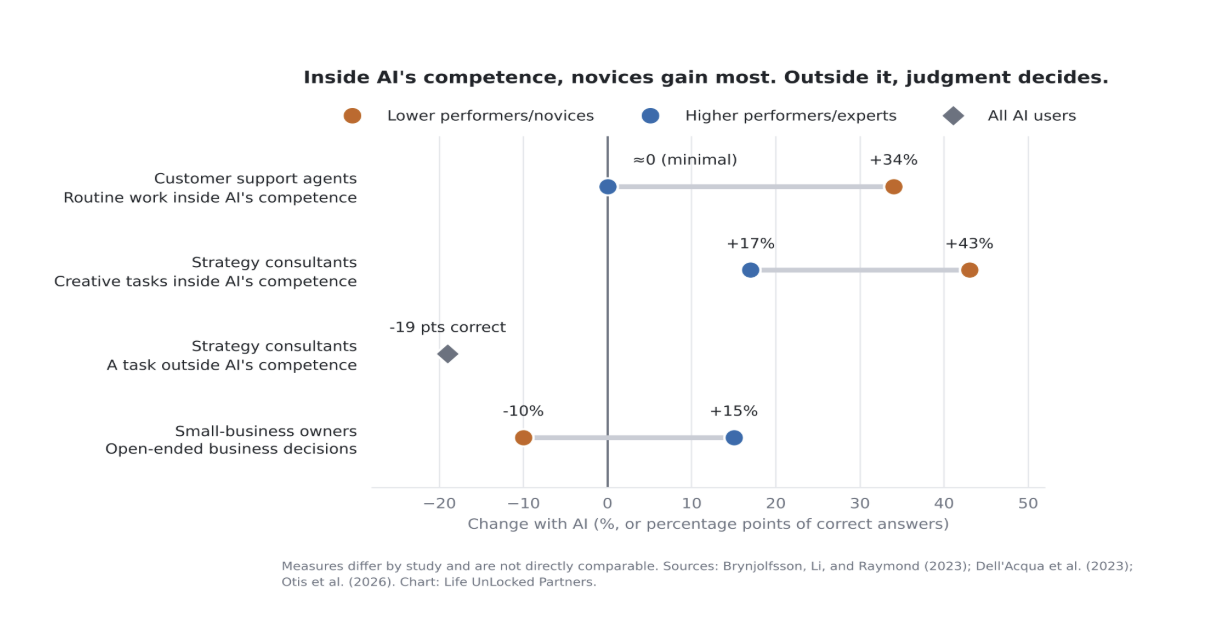
The research to date is mixed, but the pattern is telling. Among 5,179 customer support agents, AI raised productivity 14% on average and 34% for novices, with little gain for the most skilled (Brynjolfsson, Li, and Raymond, 2023).
Among 758 Boston Consulting Group consultants, below-average performers benefited significantly on creative tasks inside the AI's competence. But on a task outside it, one with a single right answer, the consultants using AI were 19 percentage points less likely to get it right (Dell'Acqua et al., 2023).
Among Kenyan small-business owners given an AI business assistant, high performers may have gained more than 15% in terms of productivity. However, low performers did nearly 10% worse (Otis et al., 2026).
My read is that AI lifts novices on routine work squarely inside its competence and hurts anyone who trusts it outside that zone. The people it hurts most are the ones without the judgment to spot bad advice. Crucially, portfolio management lives mostly outside the AI competence zone.
Figure 1. Inside AI's competence, novices gain the most. Outside it, weak judgment becomes costly.
While AI can drive the cost of execution toward zero, the remaining value concentrates in knowing the best answer for the user and recognizing when the AI's answer is wrong.
A novice with AI gets the reasonable middle, delivered faster and formatted better. An expert with AI gets the same reasonable middle, recognizes it as a starting point, and pushes off from it. The tool multiplies whatever judgment steers it. Think of AI as leverage, scaling the consequences of good judgment and bad judgment alike.
What It Means for Advisors
Advisors seem to sense this already. In an Advisor360° survey of 300 advisors released in January 2026, just 3% said they rely on AI-generated financial recommendations while 93% called retaining control over decisions and advice non-negotiable (Advisor360°, 2026). That is a promising result for an industry that too often plays follow-the-leader.
What does that look like in practice? Here are four habits drawn from my own wrong turns.
Keep one source of truth. Reconcile any AI-produced figure to your custodian or portfolio accounting records before a client ever sees it.
Know what each tool is for. A ruler built to measure performance should never take on inappropriate roles — even when a suggestion sounds good and insightful.
Distrust both the alarm and the applause. If the verdict flips when you push back, it’s likely neither version was good analysis.
Make it show its cards. Ask the AI to state its assumptions along with answers, then check them the way I once checked my card stack.
As we find more and deeper ways to integrate these 24/7/365 tools, I urge leaning into our expertise as it is our best defense against middling AI-driven answers and our best opportunity to add value for clients through our expert judgment.
Back to Punch Cards
While that early Educomp computer refused to run if any card was out of order, today's AI engines forgive everything.
Hand one a vague instruction and it will fill every gap with something plausible and run anyway. That forgiveness is the whole risk. If I ask it to help me compete with General Motors from the ground up, it will do its best. It will warn me once that the odds are very long, then hand me a full plan anyway, including crucial steps for the first 90 days. Yikes!
Figure 2. Back then, the machine enforced the order. Now, the person has to.
The discipline computer punch cards once imposed from the outside now has to come from the person making the request. They must know, card by card, the exact order of what the answer needs to be.
Fifty-five years later, I am still all in, and I still check my punch cards.
References
Advisor360° (2026). "Advisor360° Survey: Financial Advisors Are Optimistic About AI, But Insist on Oversight." Business Wire press release, January 13, 2026. Survey conducted by FUSE Research Network, fall 2025.
Brynjolfsson, E., Li, D., and Raymond, L. (2023). "Generative AI at Work." NBER Working Paper 31161. Published in Quarterly Journal of Economics 140(2), 2025, 889–942.
Dell'Acqua, F., McFowland, E., Mollick, E., et al. (2023). "Navigating the Jagged Technological Frontier: Field Experimental Evidence of the Effects of AI on Knowledge Worker Productivity and Quality." Harvard Business School Working Paper 24-013. Published in Organization Science 37(2), 2026.
Gensler, G., and Bailey, L. (2020). "Deep Learning and Financial Stability." MIT working paper, November 1, 2020. SSRN 3723132.
Khandani, A., and Lo, A. (2007). "What Happened to the Quants in August 2007?" Journal of Investment Management 5(4), 29–78.
Otis, N. G., Clarke, R., Delecourt, S., Holtz, D., and Koning, R. (2026). "The Uneven Impact of Generative AI on Entrepreneurial Performance: Evidence from a Field Experiment in Kenya." Management Science. doi:10.1287/mnsc.2024.06909. Earlier version: Harvard Business School Working Paper 24-042 (2023).
Disclosures
This article is provided for informational and educational purposes only and reflects the author's opinions as of the date of publication, which may change without notice. It is not investment, legal, or tax advice, and nothing in it is a recommendation to buy, sell, or hold any security or to adopt any investment strategy. Readers should consult their own advisors about their circumstances.
The examples drawn from the firm's own work are illustrative only. They describe research and technology processes, not investment results, and do not indicate past or future performance of any account or strategy. Statements about future conditions, including the effects of artificial intelligence on markets and on advice, are forward-looking and may not come to pass.
Third-party studies, surveys, and data are cited for discussion. They are believed to be reliable but have not been independently verified by the firm, and the charts summarize findings that use different measures and are not directly comparable.
Conflict of interest: the firm is one of the two largest owners of, and a consultant to, a private cybersecurity company described in this article.
Mark Tennenbaum is the Chief Investment Officer of Life UnLocked Partners, an investment adviser registered with the California Department of Financial Protection and Innovation. Registration does not imply a certain level of skill or training. More information about the firm, including its Form ADV Part 2A, is available at adviserinfo.sec.gov or on request.
Mark Tennenbaum is the founder and chief investment officer of Life UnLocked Partners, a California-registered investment adviser, and chief executive of Leyland Cypress. He began his post-MBA career on Wall Street, designing derivatives and cross-border M&A. Later, he served as chief financial officer of one of Los Angeles’s first commercial data centers and of SoftAware Networks, and co-founded a messaging-security firm acquired by Microsoft in 2005. Mark is the author of “Where Alpha Cannot Be Measured: Regime-Conditional Performance Attribution,” forthcoming in the Journal of Investment Management (ssrn.com/abstract=7658618).
A message from Advisor Perspectives and VettaFi: Discover something new! Click here to register for our upcoming webcasts.
More Wealth Management Topics >
 Advisor Perspectives welcomes guest contributions. The views presented here do not necessarily represent those of Advisor Perspectives.