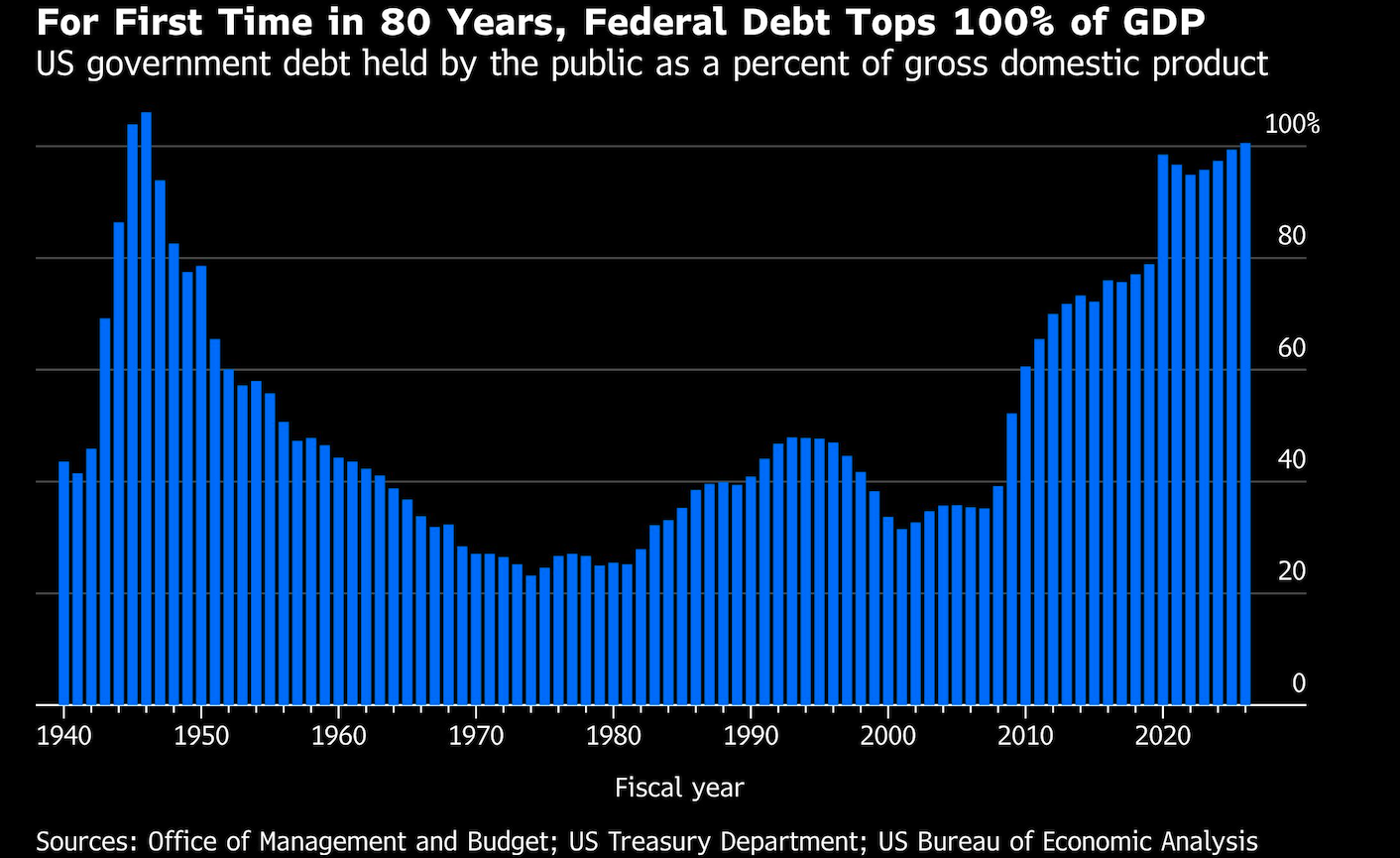
Last week’s US gross domestic product report made a couple of things that were already pretty clear even clearer. One is that federal debt held by the public is, at 100.6% of GDP for the recently ended 2026 fiscal year, bigger than economic output for the first time since 1946.1 The other is that although economic growth picked up in the third quarter, we’re still a long way from the sustained pace required to reduce the debt load without major tax increases, spending cuts or both.
This should not be reason for despair — the US has worked down big debt loads before, most notably following World War II. But doing so again will require, as it has in the past, more than just magical thinking about growth. Such magical thinking has dominated US fiscal policy for most of the past quarter century, with unsurprising results.
The significance of federal debt breaching the 100%-of-GDP threshold is debatable, but if debt keeps rising relative to the economy there is surely a point at which it becomes problematic for the US. In one sense it already has: net interest on the debt accounted for 14% of federal spending during the fiscal year that ended in September, and more than half the $2 trillion deficit.
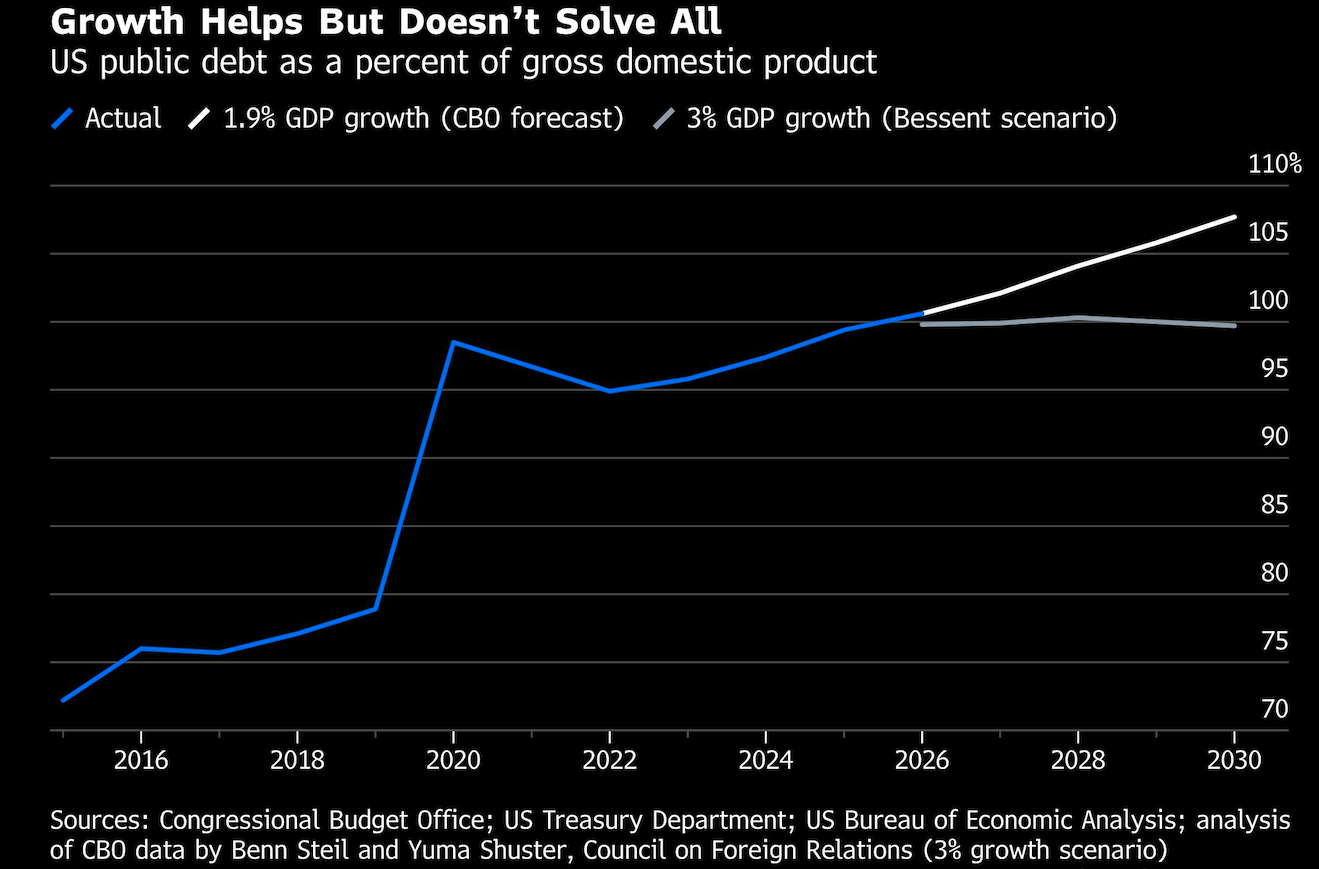
What would it take to turn things around? “With 3% growth, we grow our way out of this,” Treasury Secretary Scott Bessent said in September, but that’s not quite right. Inspired by Bessent’s remark, Benn Steil and Yuma Shuster of the Council on Foreign Relations replaced the 1.9% real growth rate used in Congressional Budget Office projections with 3% and found that it caused the debt-to-GDP ratio to stabilize but not much more than that. It would take sustained growth of 3.5% to 4% to really start to put a dent in the debt burden.
See more: A Crowded Exit? A Discussion on the Yen Carry Trade

While the economy did expand at a 3.4% annualized pace in the third quarter, that’s just one quarter, and quarterly GDP numbers tend to be affected by accounting quirks around exports and imports and other one-offs. Measuring growth over the past four quarters gives a better sense of the trend, and even amid a technology investment boom of historic proportions it’s just 2.1%. Since the start of President Donald Trump’s second term growth has been either 2.7% or 2.3% annualized, depending whether you measure from his first quarter in office or the quarter before. Long-run growth projections also have to take into account recessions that drag down the averages, and over the past 10 years, which includes the deep but very brief pandemic downturn, annualized growth was 2.5%. Over the past quarter century it was 1%.
There are, of course, optimistic scenarios where growth accelerates because generative artificial intelligence makes us more productive. But they are at this point still scenarios and any realistic view of an AI-driven productivity revolution has to include the possibility that it will at least temporarily throw lots of people out of work, causing federal tax revenue to drop and spending to increase, and probably be accompanied at some point by a stock market crash, because tech-investment booms almost always are. The Crash of 1929 and Great Depression came amid the greatest productivity boom the US has ever seen.
On a more positive note, there have been two episodes in the era of big government (which starts with World War II) where the US did succeed in substantially reducing the federal debt as a share of GDP. Economic growth played a big role in both, but so did fiscal policies that brought revenue and spending more closely in line.
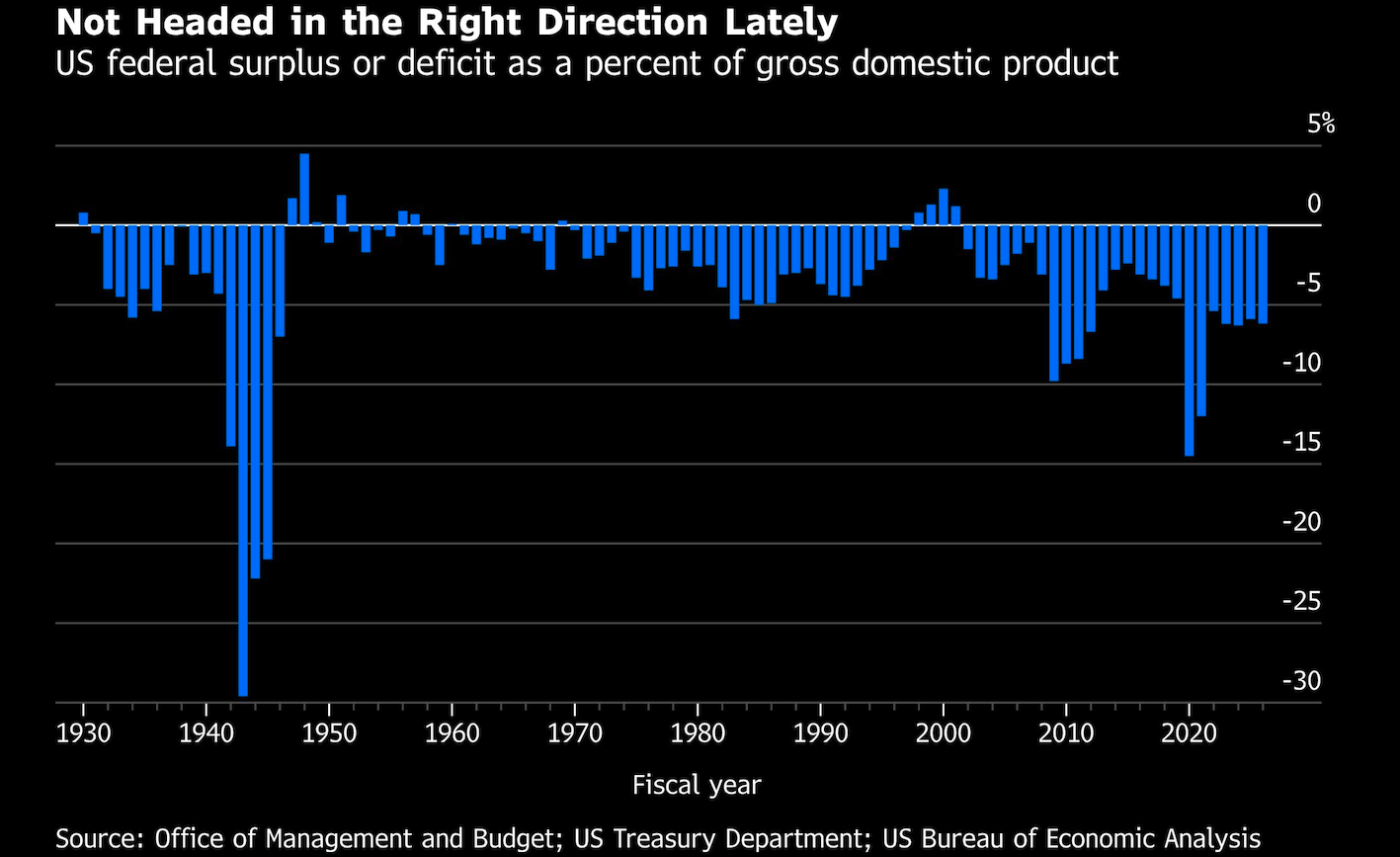
The post-World War II era is sort of the best-case scenario for debt reduction in a growing economy. Debt held by the public reached a record 106.1% of GDP in the 1946 fiscal year (which ended in June 1946; US fiscal years switched to their current ending-in-September calendar in the 1970s). For a couple of years after that, the government generated big surpluses and paid down some of the debt, but in the 1950s and 1960s it ran deficits most years and the dollar value of the debt rose. Rapid economic growth was key to the debt’s continued decline as a share of GDP, but so was the fact that the deficits just weren’t very big, with the fiscal balance averaging -0.4% of GDP from 1947 to 1974, when the debt-to-GDP-ratio bottomed out. In fiscal 2026, it was -6.2%.
The government didn’t exactly shrink from 1947 to 1974 — in inflation-adjusted terms federal spending tripled, and it went from 16.1% of GDP to 17.8%. But government revenue rose almost as fast. Again, economic growth was key, but so was tax policy. The period from 1947 through 1974 saw more tax increases than decreases, according to an invaluable 2013 Treasury Department accounting of major tax legislation since 1940. And as inflation began to pick up in the 1960s the government also reaped the benefits of not having income tax brackets indexed to the cost of living, a surreptitious means of increasing tax rates that finally met its (deserved) demise with the Economic Recovery Tax Act of 1981.
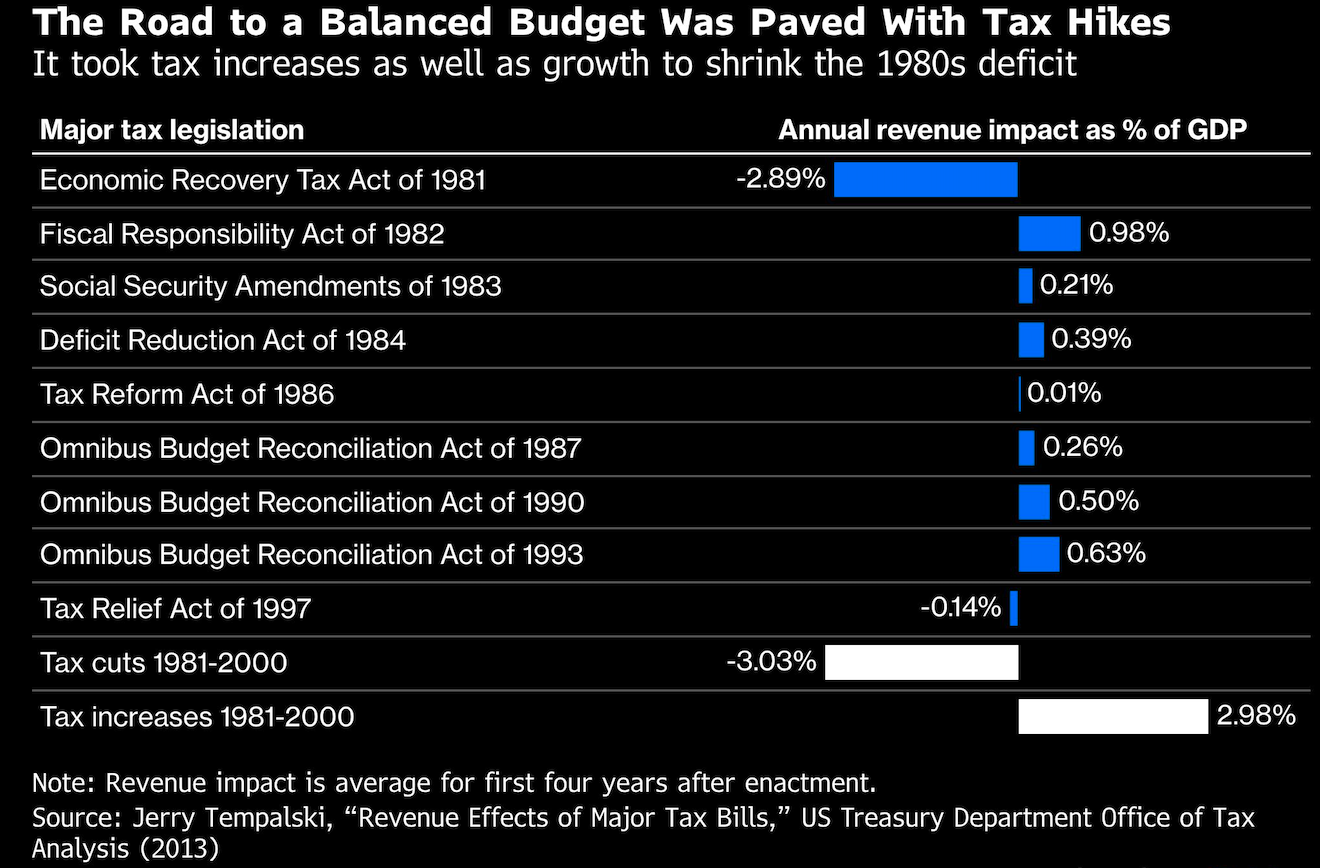
That law, also known as the Reagan tax cuts, is remembered variously as a budget-busting disaster and the driver of a new era of growth. There’s some truth to both portrayals, but what doesn’t come up nearly enough is that the 1981 tax cuts were followed by tax increases in 1982, 1983, 1984, 1986 (just barely; that year’s Tax Reform Act was supposed to be revenue-neutral), 1987, 1990 and 1993.
Thanks in part to the end of the Cold War, Congress was also able to reduce spending growth in the 1990s, with federal outlays falling from 21.7% of GDP in 1991 to 17.7% in 2000 and 2001. The result: four straight years of budget surpluses, and a debt-to-GDP ratio that fell from 47.9% in 1993 to 31.5% in 2001.
After that federal spending’s GDP share began to rise again (it was 22.9% in fiscal 2026), while Congress began approving tax cut after tax cut.2 That’s not sustainable. My fellow Bloomberg Opinion columnist Allison Schrager offered some ideas last week for reducing spending growth. On taxes, the most economically sensible approach would mix modest rate increases and loophole-elimination for corporations and the wealthy with the introduction of a modest national value-added tax on consumption. Is that politically feasible? Similar things have been in this nation’s past.
1. Since this ratio has been reported elsewhere as being 100.03% or 100.3%, let me explain how I calculated mine. I took the $32.4 trillion debt held by the public as of September 30 reported by the Treasury Department, and divided it by the $32.2 trillion average nominal GDP over the past four quarters reported by the US Bureau of Economic Analysis (which reports the quarterly numbers at annual rates).
2. I don't offer an accounting of those tax cuts here partly because the Treasury Department hasn’t publicly updated its analysis since 2013 but mainly because most major tax cuts since 2001 have come with sunset provisions that allow them to skirt Senate rules on budget legislation, then been followed up years later by legislation making some of the cuts permanent. Adding up the estimated revenue effects of every tax bill thus results in double-counting a lot of the tax cuts.
A message from Advisor Perspectives and VettaFi: Discover something new! Click here to register for our upcoming webcasts.
Bloomberg News provided this article. For more articles like this please visit
bloomberg.com.
More Tax Loss Harvesting Topics >