The world’s advanced economies could be facing a slow-moving train wreck that they appear powerless to stop. We are no longer producing enough babies.
The fertility rates in many European and East Asian countries along with the US are on an alarming trajectory. How alarming? Demographics may become nearly as big a deal for the US as artificial intelligence in the decades ahead — but working in the opposite direction. If AI adds economic growth, a shrinking population will subtract growth, leaving us without the resources needed to support an aging population and threatening unrest as young people balk at the welfare costs of ever more retirees even as their share of the pie shrinks.
The total fertility rate, the number of children a woman has in her lifetime, needs to be about 2.1 to maintain a stable population. The global rate is likely below the replacement level this year, according to estimates from the University of Pennsylvania’s Jesus Fernandez-Villaverde and Northwestern University’s Patrick Norrick. They expect the global population to peak at roughly 9 billion in 2056 and then start shrinking, “first slowly, then fast.”
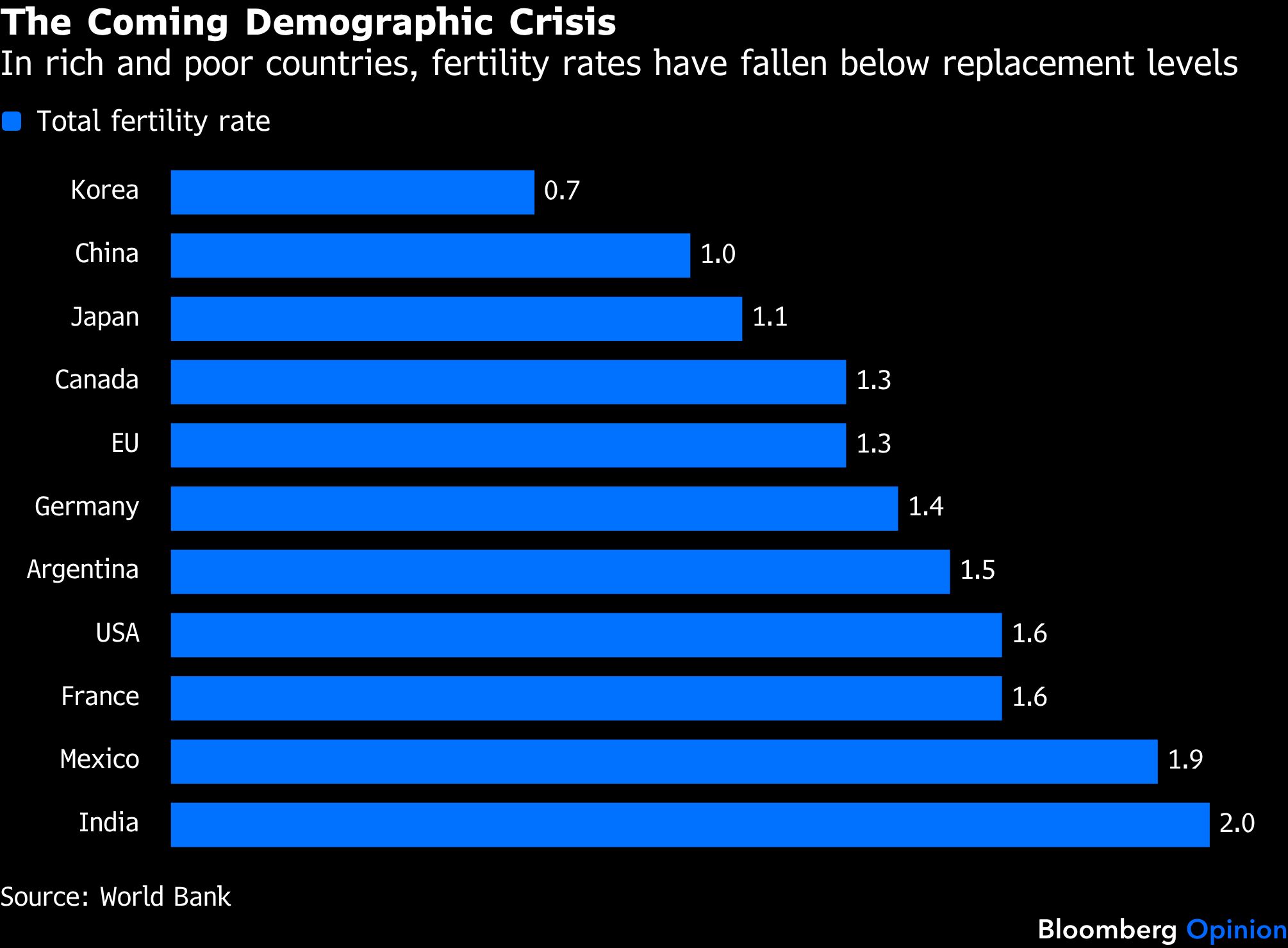
Fertility rates are already worryingly low in many richer economies: just 0.7 in Korea, 1 in China, 1.3 in the European Union and 1.6 in America. And it is not just a rich-country problem; India and Mexico are no longer having enough kids to replace their populations either.
A freakout about population trends is as old as modern times. Dire predictions in the past centered on worries about too many people. This ended up not being a problem because humans adapted by learning how to become more productive. Technology enabled us to make more with fewer physical resources, and better education made workers smarter. We will need to adapt again, but a population that’s shrinking and aging at the same time poses a difficult challenge.
The growth of economic output, or gross domestic product, has two components: productivity growth (how much more each person produces) and labor growth. Fernandez-Villaverde and Norrick illustrate how a shrinking US population would take 1.5 percentage points off average annual GDP growth by 2050, compared with the numbers at the turn of the century.
Perhaps artificial intelligence will make us so productive that it won’t matter. But making up 1.5 percentage points of lost GDP annually is a tall order, even for AI. Growth economists estimate that electricity, and all the innovations that came after, kept GDP growing by 2% a year over the last century. If we expect AI to be as impactful as electricity — a big if — a shrinking population will cancel out much of the benefit from the technology and leave us with slower growth.
This need not be a problem in theory. It’s better for the planet and means more housing and less crowding, while the economy continues to grow, albeit more slowly. But other problems such as paying for an aging population will be accentuated.
When we had a growing population and increased productivity, more workers were constantly being added to the mix, growing the economic pie. When you have an aging population and shrinking labor force, the pie grows more slowly and more resources are allocated to retirees. Young people are left with higher taxes and fewer benefits.
This can become a vicious cycle. It is already hard to get people to have more children — in many ways, a consequence of our economic success. Families spend more on their children in richer societies, and feel they can’t afford too many of them. Higher earnings also mean a bigger opportunity cost to children. Wages and skills tend to accumulate faster in your 20s and 30s, making these prime child-bearing years the worst time to be out of the labor force.
This may explain why government attempts to increase fertility have not been successful. Policies including paid maternity leave, baby bonuses and subsidized childcare aim to make having kids easier and cheaper. They may reduce some costs, but the generous benefits of Western European countries have not prevented their fertility rates from declining even further.
It could be that no government or employer benefit can compensate for the time and energy it takes to raise a child in the modern economy. People spend much more time with their children than they used to. Cultural norms often dictate not only how people raise their children but also how many they have. China, for one, has found it very difficult to revive population growth in the decade since it relaxed its one-child rule.
Norms can change, of course. There’s an emerging trend of very rich people having bigger families, and a return to organized religion could also shift views on parenting.
Policy makers’ best bet, in the meantime, is to focus on making the people we do have more productive. Maybe AI will pan out, but that remains uncertain. A more prudent move is to replicate the investment in people we made in the 20th century.
This will be harder than simply expanding schooling. We don’t know what skills will succeed in a world of AI, but investing in a workforce of better educated, critical thinkers is an important first step. In this light, the decline in math and reading scores since the pandemic requires urgent attention. Policy makers can hope technology will solve all our problems, or they can focus on developing a generation better trained to thrive alongside new technologies and better able to pay for the aging population they’ll need to support.