In the world of critical minerals, it’s either a drought, or a flood.
For years, companies trying to mine or process the rare elements vital to the performance of electric vehicles, drones, medical devices, LEDs, jet engines and computer chips had to fight for every cent.
The debt and equity investors that capital-intensive businesses need to get off the ground saw little reason to put money in. Operating costs are typically no better, and often far worse, than for more humdrum metals such as copper and aluminum. Small, illiquid markets make long-term cash flows nearly impossible to forecast with enough confidence for bankers to lend large sums.
And there’s good reason for that caution. Balancing supply and demand is difficult in any industry, but critical minerals are unusually vulnerable. If end-users develop new formulations that require less of a particular element — or none at all — they can destroy the investment case for an entire sector almost overnight. And looming over everything is China: a low-cost competitor with the power to turbocharge demand for alternative supplies by tightening export controls, or crush prices by loosening them.
The past two years have seen the situation rapidly reverse. Advanced economies made $65 billion in public commitments for critical minerals last year, more than four times the level in 2023. In theory, that should be more than enough to put the industry on a firmer financial footing. Yet the funds pledged by governments have yet to translate into money being put to work: actual investment, worryingly, fell 9% last year. Miners and processors are discovering what lottery winners sometimes learn the hard way: A sudden windfall can create as many problems as it solves.
Consider the fate of Energy Fuels Inc. Founded as a US uranium producer, the company had the misfortune of running into the collapse in nuclear-fuel prices that followed the Fukushima Daiichi disaster in 2011. During the first Trump administration’s trade wars, it reinvented itself, using its uranium mill in southeastern Utah to separate rare-earth elements.

See more: The Case for GARP: Finding Growth Without the Froth
That was a well-timed shift. Trial separation of the most scarce rare earths such as dysprosium, terbium and samarium — needed for magnets that can withstand high temperatures — began last year, just as US manufacturers were starting to panic after China choked off exports of such magnets in retaliation for President Donald Trump’s Liberation Day tariffs.
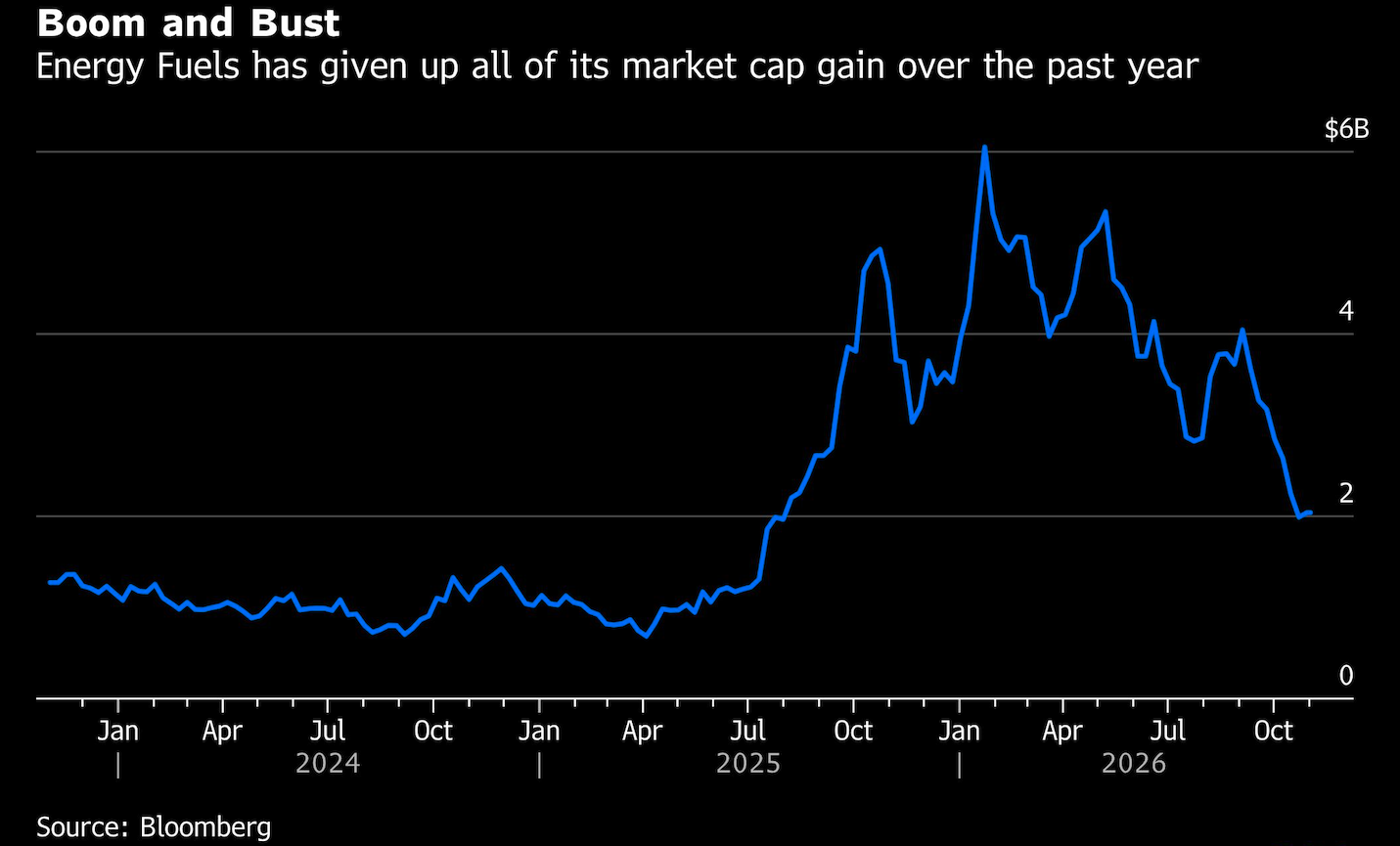
By late January this year, Energy Fuels’ stock was worth five times what it had been seven months earlier. Management was trying to turn the company into a vertically integrated “mine-to-magnets” rare-earth producer, spending $300 million on an Australian miner before laying out another $1.9 billion in June for magnet manufacturer VAC.
But that good run hit a major obstacle last month. General Motors Co., the customer for 90% of the output from VAC’s rare-earth magnet plant in Sumter, South Carolina, terminated its agreement, Reuters reported. Energy Fuels’ market capitalization, about $6.5 billion in January, is now less than a third of that.
The problem is that you can’t build a mine-to-magnets supply chain on excitable stock valuations. Breaking China’s stranglehold on critical minerals will require sustained investment at every stage — in miners, processors and downstream manufacturers. But that entire network ultimately rests on something governments can’t simply decree: steady demand from the companies that use their products.
When GM signed its anchor deal with VAC in 2023, Chief Executive Officer Mary Barra was talking about producing 1 million electric vehicles a year in North America by 2025. Instead, it produced just 170,000, and has since taken more than $11 billion in charges to shrink and restructure its EV program. The Detroit-based carmaker already has separate rare-earth magnet deals with MP Materials Corp. and Noveon Magnetics Inc., so VAC’s output now looks surplus to requirements.
Given the nervousness around rare earths worldwide, there should be plenty of alternative customers for VAC’s magnets. But there’s no guarantee they will materialize. The danger in such a small and fragile sector is that the loss of one giant end-user can cascade all the way down the supply chain. That wouldn’t just hurt the companies directly exposed. It could sour investors on critical minerals altogether, driving away precisely the private capital the industry needs to put itself on a stable footing.
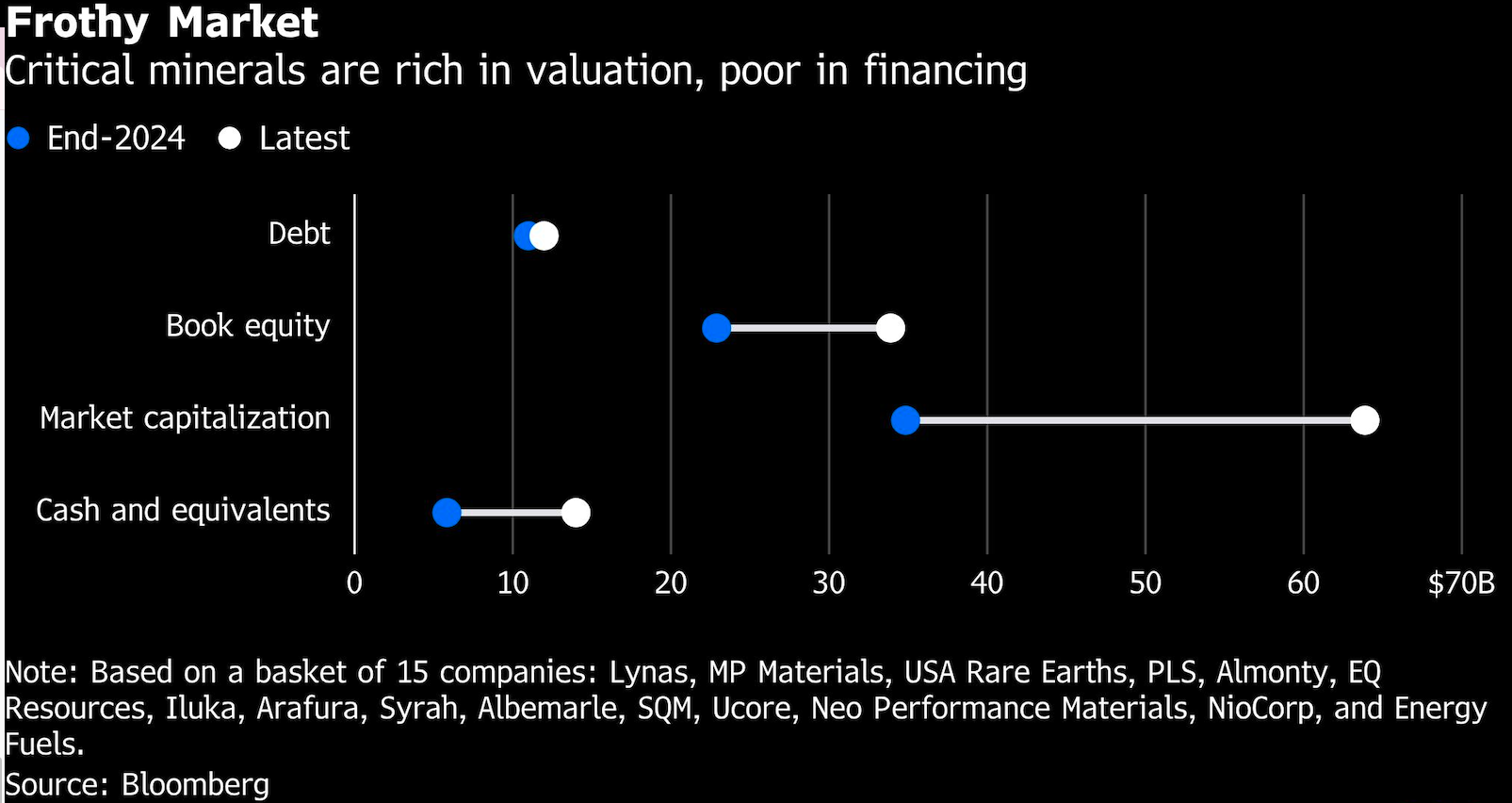
Look across the 15 or so companies that make up the listed critical-minerals sector, and the same pattern emerges. Stock prices, the fastest-moving part of corporate finance, have soared and, in many cases, already crashed. Cash holdings and book equity have risen too, as higher prices and valuations have boosted margins and allowed companies to raise money from shareholders. But debt — the gold standard for any business seeking to finance serious expansion — is still lagging.
The industry has more going for it than at any time in a generation: government-backed floor prices, public loans and equity investments, engaged private investors, and a compelling story about why these minerals will remain vital for years to come. What it still lacks, for the most part, is the sustained demand needed to turn all that into durable businesses. The test isn’t how much money governments pledge or how far shares rally. It’s how many businesses are still standing when the excitement drains away.
A message from Advisor Perspectives and VettaFi: Discover something new! Click here to register for our upcoming webcasts.
Bloomberg News provided this article. For more articles like this please visit
bloomberg.com.
Read more articles by David Fickling