The views presented here do not necessarily represent those of Advisor Perspectives.
The longer the bond term, the greater the volatility. Which raises the question: Do you get rewarded for the added risk?
Consider: Were we to ask whether investors get rewarded for the extra risk of equities, relative to fixed income, the answer would be a resounding yes. The existence of an ample equity risk premium is both axiomatic and empirically well-established in classical finance.
Are bonds like stocks? Do you get paid to take interest rate risk?
Roger Ibbotson and colleagues are here to help. They’ve updated the old “Stocks, Bonds, Bills & Inflation” yearbook series (SBBI) with multiple new bond series covering maturities ranging from 1 month to 20 years, in contrast to the old SBBI, which only tracked T-bills, 5-year bonds, and 20-year bonds.1
Duration Risk
A 30-day Treasury bill is unlikely to lose money at any point; as with any U.S. Treasury security, credit risk is not a worry either.
If bonds were like stocks, you’d earn more on the 90-day Treasury than on the 30-day, more on a riskier 1-year Treasury than on the 90-day, and so on out to 20 years, because the longer the bond term, the worse the roller-coaster. That’s what risk means in the Treasury space. In fact, at 20 years, “roller coaster” doesn’t do justice to the thrills and spills of a long maturity. During the 2022 decline, the 20-year bond lost 30% of its value — coupon included. Shortly before that, in mid-2020, it had returned 27%.
Over the 80 years since World War II, were bond investors rewarded for the volatility that comes with longer maturities? Let’s take a look.
Return by Length of Term
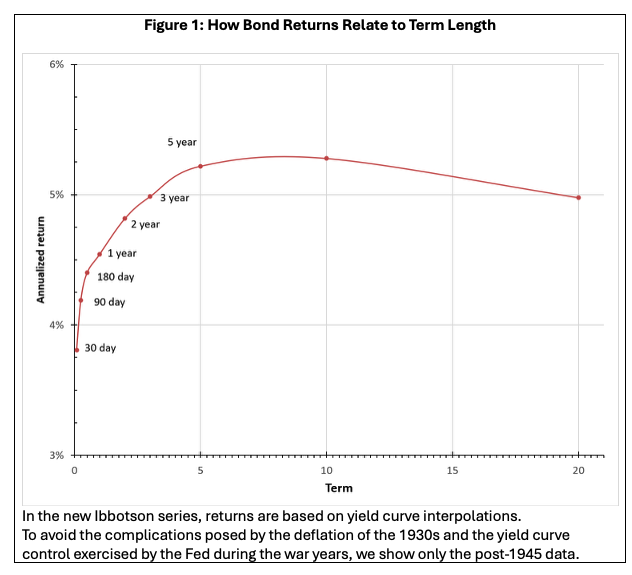
We plot annualized return — what you eat, as Bill likes to say — on the vertical axis, and term in years on the horizontal axis.
The chart tells two interesting stories, one on the left side and one on the right. On the left, we find substantial rewards for not insisting on the absolute return stability of the 30-day T-bill. If you are willing to deal with small fluctuations in value, you can add an extra 70 basis points to your return by going out one year.
First conclusion: You do get rewarded for pushing duration out, with a steep increase from 30 days to one year, and a more moderate — but still substantial — increment in return for going out to five years.
The second interesting story is on the right side: The reward for extending from 5 to 10 years is miniscule, and beyond that you pay a penalty. You most definitely do not get rewarded for pushing duration out past five years.2 Hold that thought.
In sum, as a stand-alone asset, Treasuries offer more return in exchange for more volatility, but only out to about five years. Beyond that term, bond risk earns ever less until it turns over and starts to bite you.
Asset Allocation
Of course, few clients own only bonds, and fewer still have holdings with an average duration beyond 10 years. Rather, the goal of portfolio design is to identify the stock/bond mix that will return the maximum amount for the degree of risk the client can tolerate. For reference: Decades ago, Peter Bernstein identified the human standard for return/risk, the central tendency among millions of investors, as 60/40 stock/bond.3
But your client is paying for customized advice, not a one-size-fits-all solution they could have overheard at the gym. You need to find them a comfortable allocation, maybe holding more than 40% bonds, maybe less.
This change of focus substantially reshuffles the question of what kind of fixed income to own. In this framing, bonds are no longer a stand-alone asset. Equities are the Armani suit, and bonds are the socks, shirts, and underwear required to wear the suit comfortably. Ever try wearing a suit to work without those? That’s a good metaphor for the discomfort of a human being holding a 100% stock portfolio.
Risky as some Treasury bonds are, stocks are far riskier and promise far more return on the upside as compensation for that risk. Outside of ferocious bear markets, you can’t add return to a stock portfolio by allocating a portion to bonds. In theory, in good times and bad, you can reduce risk, i.e., the standard deviation of the ensemble. And by the math of compounding, if you reduce the volatility of the portfolio, you get a boost to return.4
It is hard to overstate how much difference this reframing makes. The best bond diversifier may now be the one with the lowest correlation to stocks. In fact, if the correlation is low enough, that may suffice to overcome the higher raw return on another type of bond.
Back to the drawing board: Once we shift to the portfolio frame, we can’t be sure the 5-year Treasury will still hit the sweet spot.
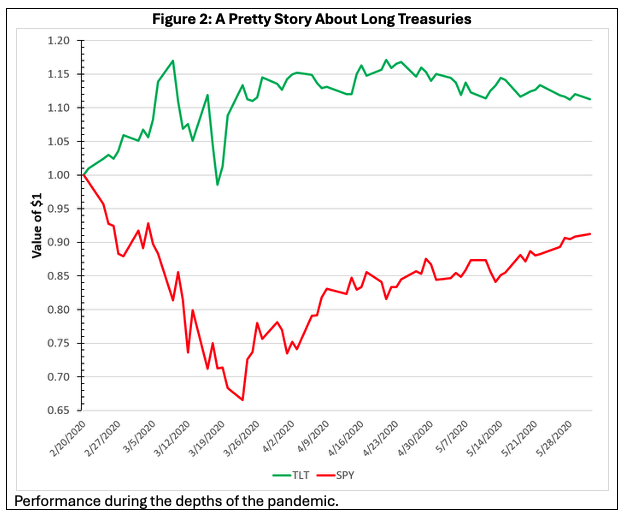
To give you a sense of why long Treasuries might reestablish themselves as the best supporting actor on the mean-variance stage, here is a day-by-day chart of the iShares 20+ Year Treasury Bond (TLT), which approximates the 20-year Treasury, and the SPDR S&P 500 ETF (SPY), during the darkest days of the COVID-19 pandemic.
Beautiful! When stocks zigged, long Treasuries zagged. Talk about diversification: The correlation over the 69 daily observations was an astonishing -0.50. If you had $60,000 in SPY and $40,000 in TLT to start, you ended the three months with a small gain.
Alas, history is a cruel mistress. Let’s run that movie again, this time in 2022. Stocks fell about 20% and long bonds fell half again as much. Oops. Stocks zigged and long Treasuries zigged harder, amplifying losses. The stock investor did worse with this bond diversifier than without it. That’s the point of these two examples: In a bond bull market, duration good; in a bond bear market, duration bad — very bad.
The importance of focusing on very long time spans cannot be overstated, as many enthusiasts of long bonds, snookered by their salutary portfolio characteristics just prior to 2021, soon found out to their chagrin. To illustrate the point, we’re going to break the 76 years from 1946 to 2021 inclusive into roughly two halves: 1946 to 1981 and 1982 to 2021.
As an aside: The examples thus far show why you need to use the longest available period of data when examining historical bond returns, and not short, cherry-picked time spans. Be wary of those who ignore that imperative.
One more thing: By 2020, long-term sovereign debt around the world sported the lowest yields over the 5,000 years of fixed-income history.5
The Great Bear: 1946–1981
The 1946–1981 period is also known as the Forgotten Bear Market. Even geezers like ourselves were only investing during the tail end of it, and most current investors just hold vague ideas about inflation being bad in the late 1970s and bonds suffering.
The forgotten piece is the slow, agonizing grind that went on for decades as yields notched up from their Depression lows. And went higher. Then started to soar around 1967. And went up from there.
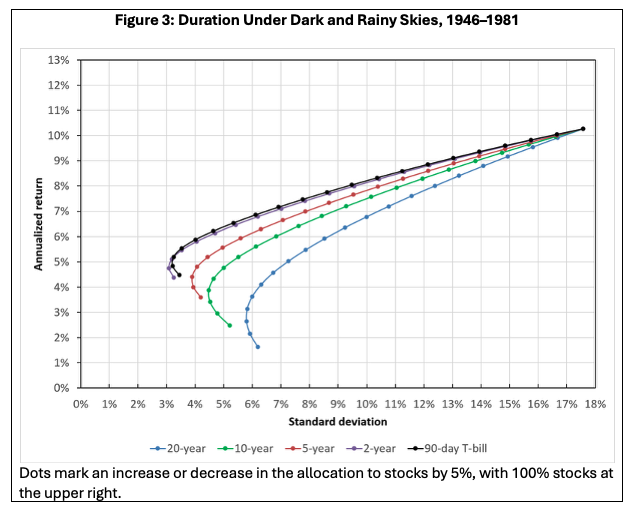
Let’s take a look.
Whoa! The longer the bond, the lower the return on the portfolio for a stated mix. The 20-year hurt performance the most, the 10-year the next most, and the 5-year didn’t save you. Only when you got duration as low as the 2-year did the benefits of going even shorter tail off.
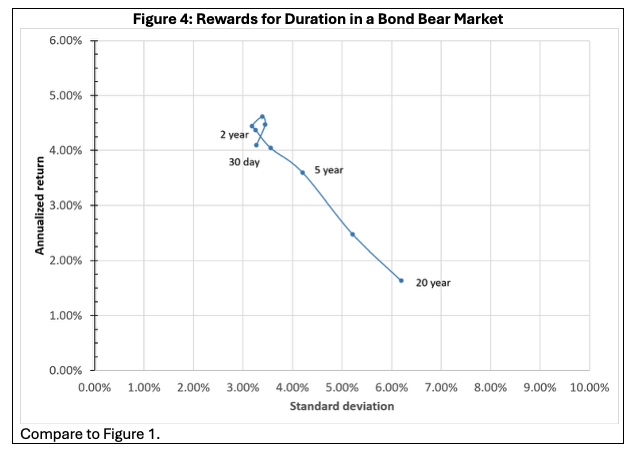
Here’s another version of Figure 1, now with standard deviation on the horizontal axis, showing returns for duration within the Forgotten Bear Market.
The line is drawn from the shortest duration (30-day T-bill) to the longest, in order. See that tangle at the upper left? That’s data-speak for “no reliable difference” in return/risk for a duration of two years or less. Conversely, when you go past two years under rainy conditions, you pay and pay, lowering return even as you increase risk.
The Great Bull: 1982–2021
This period was also known as Everybody Thinks This Is Normal. This is your bond market, not your father’s or grandfather’s. From a high in the mid-teens, long bond yields declined to under 1%. Bondholders enjoyed falling yields and rising prices year after year, decade after decade. It was during this period that John Bogle and Vanguard pioneered the bond index fund (1986). Later years saw the dawn of the target-date retirement fund, which brought bond funds to the masses.
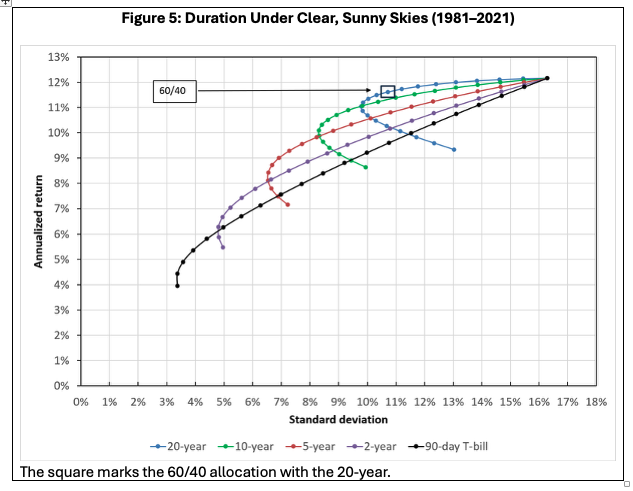
Here’s how diversification with bonds worked out over these sunny decades.
It’s . . . complicated. But in its curvaceous way, the results are just as clear in this bull market chart as in the earlier bear market one — except here, every increase in duration was rewarded with a higher portfolio return for a given level of risk. Reading up from the bottom left: The 2-year bond improved on the 90-day bill, the 5-year improved on the 2-year, the 10-year was better yet, and the 20-year, oh my. For a 60/40 allocation, the Peter Bernstein standard, with the 20-year Treasury you gave up only a handful of basis points of return, for example, from reducing your stock allocation to 60%, even as the long bond served to cut your risk by hundreds of basis points.
It’s true, you could cut risk still more by climbing back down the duration ladder from 20 years. Each reduction in duration pays off with another 100–200 basis points in risk reduction; but each maturity reduction penalizes portfolio return. Again, return is what you eat.
To put some numbers on the price for being more conservative and staying short under sunny skies, we’ll switch from bloodless percentages to dollars of wealth. A 60/40 mix using the long bond, with a return of about 11.5%, would have turned $10,000 into $778,000 over the 40 years charted. A 30/70 mix using 90-day T-bills, with a return of about 6.6%, would have produced $129,000. As a consolation prize, it would have cut risk in half compared to the 60/40 mix.
You pays your money and takes your choice.
If You Don’t Get to Choose Between Bull and Bear . . .
Now, let’s combine these two periods, add in the most recent four years as well, and examine the full 80-year record. To repeat, that includes the Great Bond Bear Market of 1946–1981, the Great Bond Bull Market of 1982–2021, and the first four years of what may turn out to be the Great Bond Bear Market of the 2020s (in case you’ve been following the bond market here in late 2026). That’s 40 years of “duration good” matched by a total of 40 years of “duration bad,” a balanced sample of bond heaven and bond hell.
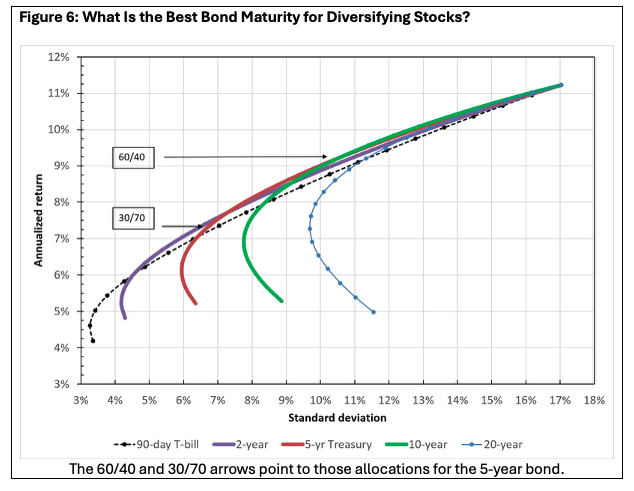
Figure 6 shows the result of looking at that balanced whole.
We played a visual trick in this final chart: we thickened the lines for the 2-, 5-, and 10-year bonds. With that modification, the extremes of duration, 20-year (blue) and 90-day (dashed black), emerge as somewhat inferior to the intermediate durations. Nonetheless, at higher stock allocations, it takes a magnifying glass to see the sacrifice of return for taking on too much or too little duration.
For a 60/40 allocation (on the 5-year), you’ll need something stronger than a magnifying glass to see any difference for holding the 2-, 5-, or 10-year maturities — maybe a Zeiss confocal microscope.
Only at 30/70 and below did you get paid for shedding even more duration. The 10-year is a bad choice versus the 5-year for such a conservative investor, and the 2-year is marginally superior to the 5-year — for those who can’t withstand even a 30% allocation to stock. Just remember: You get “paid” in the form of a still lower standard deviation in both cases — not in return.
The explanation for the microscopic difference between intermediate bonds is straightforward. Refer to Figure 1: All of these bonds have returns within a few dozen basis points of one another; and all of them have returns at least 600 basis points lower than stocks. Plus, all have the same near-zero correlation with stocks. That’s why they all cushion a stock portfolio about the same.
Conclusion
Unless you win the bond bull market lottery, duration doesn’t pay. And if you lose that lottery? Don’t go there. Remember that as you peruse the financial press here in late 2026. You are going to hear about how attractive rates on long Treasuries have become. Put down the apple and back away.
Neither does cranking duration down toward the 30-day minimum pay. You can go out a year or two if it’s part of your portfolio, and not your emergency fund.
From a portfolio point of view, and across bull and bear markets and typical allocations, the historical data set does not support any meaningful distinction between short bonds (two years) and intermediate bonds (up to 10 years).
Practical Advice
- If you are a conservative investor whose teeth start to grind whenever you see losses on any of your investments, and who appropriately plans a relatively low allocation to stocks, use an ETF like the Vanguard Short-Term Treasury ETF (VGSH), with an average maturity of two years.
- If you are a more aggressive investor — a follower of Peter Bernstein, perhaps, with a target allocation of 60/40 stocks/bonds — use the iShares 7–10 year ETF (IEF). The more so if you got your GED from Clairvoyant High and know that bond yields have already peaked here in October 2026, with a new bull phase about to begin.
- If neither of those self-descriptions resonates? Use the Vanguard Intermediate-Term Treasury ETF (VGIT) or the Schwab Intermediate-Term U.S. Treasury ETF (SCHR), each a rolling ladder of Treasuries extending from three years to ten.
One caveat: You may be a Warren Buffett type of investor, serenely committed to an 80% or 90% allocation to stocks for the long run. In that case, put the remaining 10%–20% in T-bills. At that high a stock allocation, the type of bond doesn’t make much difference, per Figure 6, but you’ll enjoy near-absolute safety on funds put in T-bills. You can goose the yield a bit by buying a 1-year every quarter for four quarters, and then roll to a new 1-year with each maturity.
Remember: There’s a reason why the Sage of Omaha holds nearly all of his fixed income in T-bills and cash equivalents.
***
But wait—what about a Total Bond Index fund, such as the Vanguard Total Bond Market ETF (BND) or the iShares Core U.S. Aggregate Bond ETF (AGG)?
These funds hold all kinds of fixed income securities, not just super-safe Treasuries, thus benefiting from credit spreads. Plus, these funds own the entire maturity range, from one year up to the longest maturity out there — 40 years and more. You can’t get any more diversified; it’s the bond market equivalent of a Total Stock index fund like the Vanguard Morningstar Total Stock Market ETF (VTI).
Why not BND?
Stay tuned for Part 2.
Endnotes
1 Disclosure: Ed contributed a chapter in the new volume, not discussed here. See: https://rpc.cfainstitute.org/research/foundation/2026/exponential-wealth-centuries-stocks-bond-returns
2 A brief note for the technically minded: We use duration loosely as a synonym for term or maturity throughout. Mathematically, duration is a nonlinear transform of remaining term; and modified duration is not the same transform as Macaulay duration. If you already knew the difference between these two, you may enjoy the technical discussion in Chapter 8 of the new Ibbotson volume.
3 A relative of Bill’s? He wishes.
4 As a rough approximation, G = A – V/2, where G is the geometric return, A is the arithmetic return, and V is the variance (the standard deviation squared). It is in that sense that reducing volatility increases return.
5 See, for example, Sydney Homer and Richard Sylla, “A History of Interest Rates."
Edward F. McQuarrie, Ph.D., is professor emeritus at Santa Clara University. He writes about financial history and its implications for retirement planning. His paper, “The 4% Rule Was Never Failproof,” won the 2026 Journal Research award from the Investments & Wealth Institute. Working papers describing his research can be downloaded here.
William J. Bernstein is a neurologist, the co-founder of Efficient Frontier Advisors, an investment management firm, and a writer with several titles on finance and economic history. He has contributed to the peer-reviewed finance literature and has written for several national publications, including Money magazine and The Wall Street Journal. He has produced several finance titles, and four volumes of history, The Birth of Plenty, A Splendid Exchange, Masters of the Word, and The Delusions of Crowds about, respectively, the economic growth inflection of the early 19th century, the history of world trade, the effects of access to technology on human relations and politics, and financial and religious mass manias. He was also the 2017 winner of the James R. Vertin Award from the CFA Institute.
More Municipal Bonds Topics >
 The views presented here do not necessarily represent those of Advisor Perspectives.