We are all Warren Buffett and Charlie Munger now.
I think of the dynamic duo often as artificial intelligence advances, takes over markets and mints new fortunes. I hark back to the 1990s and imagine the two watching in amazement as the internet emerged, creating a new world, language and vast riches.
Many investors are reliving that experience with AI. Buffett, who stepped down as chairman of Berkshire Hathaway Inc. earlier this year, and Munger, who died in 2023, won’t be active examples, obviously. But there are useful lessons in the way they weathered the previous tech revolution — and in how their decisions turned out all these years later.
The problem for Buffett and Munger was that they were in the business of beating the market, which was nearly impossible in the late 1990s without investing in technology and internet-related stocks specifically. But like most investors, they weren’t coders or engineers. They didn’t fully understand what was going on and where it was going, as they readily admitted. So they passed on the internet, and predictably, the market and tech sector ran circles around Berkshire’s stock during the dot-com boom.
What they did instead was stick to their strategy of investing in stable, highly profitable businesses. That all but eliminated internet companies in favor of stalwarts such as American Express, Coca-Cola, Freddie Mac, Geico, Gillette and Wells Fargo. Those companies weren’t cheap — quality businesses rarely are. As a group, Berkshire’s stocks traded at a valuation about 50% higher than that of the S&P 500 Index, but they were also twice as profitable. That strategy is now known as quality investing.
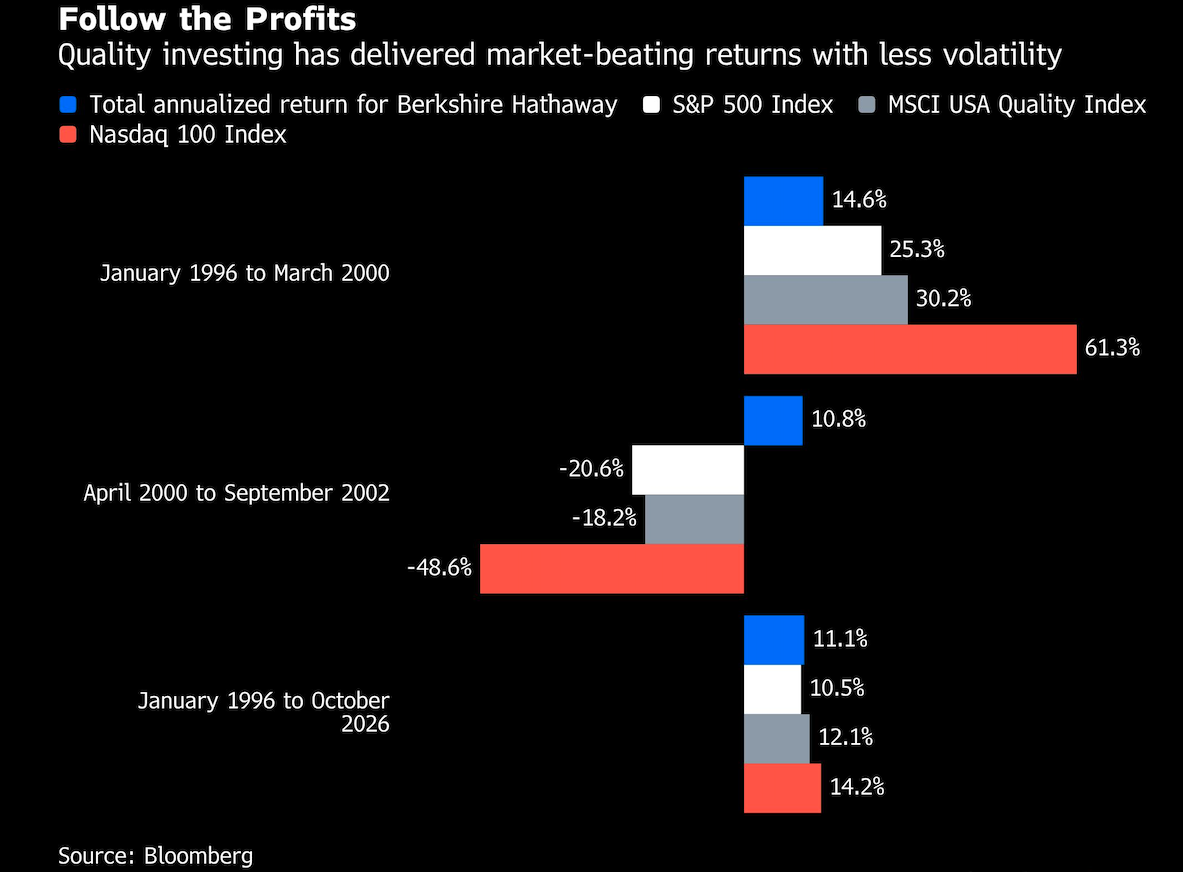
Buffett and Munger’s devotion to quality looked like a masterstroke when the internet bubble burst in 2000. Amazingly, while the S&P 500 was cut in half in the ensuing bear market, and the tech-heavy Nasdaq 100 Index tumbled well more than that, Berkshire made money. Berkshire’s performance was all the more astonishing given that the MSCI USA Quality Index also declined during that time. Buffett and Munger knew how to pick ’em.

See more: When AI Speeds Up the Advisor, Can the Rest of the Firm Keep Pace?
Time has been less kind, though. Some of those internet startups blossomed into formidable profit-making machines, such as Google parent Alphabet Inc. and Amazon.com Inc. Buffett and Munger were slow to spot them, and it cost them. Since 1996, Berkshire’s stock has kept pace with the S&P 500 but lagged the quality index by 1 percentage point annually and the Nasdaq 100 by more than 3 percentage points.
Berkshire’s first significant tech investment came many years later, with International Business Machines Corp. in 2011, a Buffett pick, followed by Apple Inc. in 2016, initiated by deputies Todd Combs and Ted Weschler, and more recently Alphabet. Berkshire is still light on tech relative to the S&P 500 and MSCI’s quality index. It has no stake in Microsoft Corp., Nvidia Corp. or Meta Platforms Inc., three of the quality index’s top five holdings.
In hindsight, Buffett and Munger didn’t need to know more about the internet; they just needed to stick to their strategy. Technology has dominated because it has become the most profitable sector. Had they kept following the profits, they would have owned many more great tech companies sooner.
But not too soon. Insisting on high and stable profitability, as Buffett and Munger did in the 1990s and quality investing does by definition, means sacrificing some early gains to avoid new businesses that never get there. The same can’t be said of the Nasdaq 100. It gathers the most valuable nonfinancial companies on the Nasdaq exchange regardless of profitability, making it a riskier bet than a quality strategy. The Nasdaq has been dominated by tech since the internet boom, which paid off because tech won, but it could have gone the other way.
Quality’s risk damper shows up in the numbers. Over the past three decades, the quality index has been about 40% less volatile than the Nasdaq 100 and 25% less than Berkshire’s stock. On a risk-adjusted basis, it has handily beaten the S&P 500, the Nasdaq and Berkshire, which was the worst performer by that measure.
The questions about AI are pretty much the same ones that investors asked about the internet. Will it create or destroy jobs? Will the value go to consumers or companies? And most relevant to investors, who will capture the profits? The answers are no easier today than they were for Buffett and Munger three decades ago.
The decision set, however, is the same. SpaceX, Anthropic and OpenAI, arguably the three leading AI companies, face an uncertain future. SpaceX does not yet make money consistently, while Anthropic and OpenAI generate huge losses, so profitability is far from assured. Still, SpaceX is already a prominent member of the Nasdaq 100, Anthropic is likely to join after its public debut later this month, and OpenAI is probably not far behind. The Nasdaq will have early exposure and a big boost if the trio wins the AI race.
A safer bet is to wait and see who comes up with the profits. Many of the highest quality companies are already AI leaders, including Nvidia, Microsoft, Alphabet, Amazon and Meta. More will join the list as AI advances, perhaps including some of today’s promising but still unprofitable AI darlings.
It’s a strategy that has beaten the market since the internet era, mostly by favoring the most profitable tech companies but without the heart-stopping volatility that tech investing has entailed. There’s a good chance it will navigate the AI era just as effectively. Buffett and Munger knew how to protect their money.
A message from Advisor Perspectives and VettaFi: Discover something new! Click here to register for our upcoming webcasts.
Bloomberg News provided this article. For more articles like this please visit
bloomberg.com.
More Innovative ETFs Topics >