Health Savings Accounts offer Americans a tax-free way to save for medical expenses. Now, some are using them to trade stocks — and dabble in risky bets they wouldn't touch in their 401(k) or brokerage accounts.
HSAs, often likened to 401(k)s for healthcare costs, are savings accounts for workers in high-deductible health plans. They come with souped-up tax benefits: Savers can contribute pretax income, grow their money tax-free while investing it in financial markets, and spend it on qualified medical expenses without paying taxes.
See more: Big Numbers, Big Expectations: Three Keys to Earnings Season
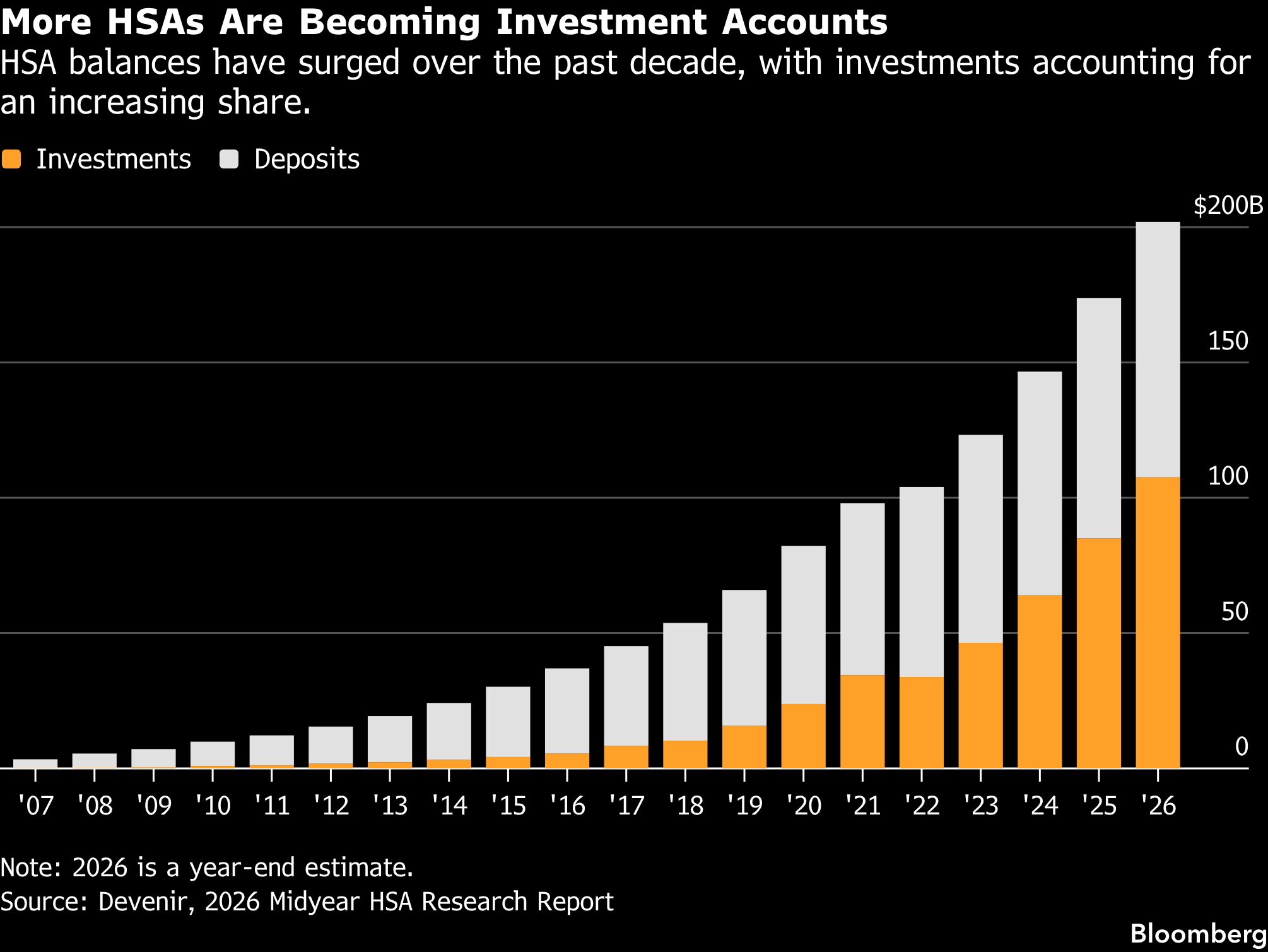
Those perks are making the HSA an unusually tempting place to take bigger or more creative swings, especially for savers with other well-funded portfolios. They’re reaching beyond the accounts’ standard fund-focused investment menus, aiming to trade stocks, exchange-traded funds, cryptocurrencies and even assets as unique as livestock. Still, many workers spend their HSA cash, and the majority aren’t investing. The number of accounts holding investments, however, is growing fast, jumping nearly 20% in the past year, according to HSA company Devenir.
Vincent Catalano, a healthcare and benefits consultant based in Sacramento, has about $150,000 in an HSA he’s been growing for a decade. Roughly five years ago, he rolled his workplace plan over to Fidelity Investments, looking for more choices, lower fees — and a little bit of recreation.
With an adviser already managing his brokerage and retirement accounts, Catalano sees his HSA as a smaller, stand-alone pot of money ideal for trying his hand at playing the market. Over the years, he’s made bets on volatile growth stocks in industries such as healthcare, defense and technology. He said he’d consider buying Anthropic PBC once it goes public, too.
Because he won’t owe taxes on his investment gains, Catalano says he’s felt free to experiment with rapid-fire trading tactics he wouldn’t dare to in his brokerage account. He’s bought dips, taken losses, made winning bets and occasionally sold too soon, but sees them as bets worth making.
“You can have more fun,” he said. “You get a chance to play with sectors that you may not normally play with.”
HSAs are becoming more common. The popularity of the accounts has climbed steadily over the past decade as more workers opt for high-deductible plans to avoid ballooning insurance premiums. About three in 10 workers covered by employer-sponsored insurance are enrolled in an HSA-eligible policy this year, up from 19% a decade ago, according to health research firm KFF.

Financial advisers warn that extra freedom comes with extra risk. Individual stocks held in an HSA are just as volatile, and alternative investments just as expensive and illiquid, as they are in an individual retirement account or brokerage account. One common guideline is to save enough cash to cover two to three years of routine medical expenses in an HSA before putting any money into long-term holdings like stocks.
“You don’t want to end up in a situation where the stocks you’ve picked are long shots or long-term plays, and they’re all down and you have a two-week hospital stay,” said Josh Chambers, a certified financial planner at Baird.
For some advisers, the lure of higher returns is hard to resist. Colin Zizzi, an independent certified financial planner, has about $100,000 in his HSA after funding it for roughly eight years. He currently keeps 85% in equity ETFs, 5% in cash and the rest in stocks he’s picked himself.
“I can’t resist having an individual stock or two in there,” Zizzi said. “I just enjoy it.” He uses his other savings to cover his family’s out-of-pocket expenses.
Most Americans access HSAs through their employer health plans. Contribution limits are $4,400 a year for individuals and $8,750 for families in 2026. Those limits include employer contributions, which averaged about $700 for individuals and $1,300 for families in 2026. Employer-sponsored HSAs, however, come with drawbacks. They typically include account fees and cash-balance minimums, while offering limited investment menus consisting of target-date funds or broad-based mutual funds and ETFs.
That’s left an opening for investment firms like Fidelity and smaller upstarts, including Lively and HSA Bank, whose platforms give account holders more control over their investments. Unlike with 401(k)s, HSA account holders don’t need to wait until they leave their job to move their money. The Internal Revenue Service also puts no limit on the number of direct trustee-to-trustee HSA transfers.
Investors can keep a workplace account open to make pretax deposits and collect their employer contribution, while maintaining an outside HSA that presents greater investment flexibility and the potential for higher returns.
Some longtime HSA investors with larger balances are venturing outside public markets altogether. Directed IRA, a custodian that helps IRA investors access alternative investments, oversees roughly 1,000 HSAs since starting in 2018, according to co-founder Mat Sorensen.
Over the years, Sorensen has helped account owners invest in everything from cryptocurrency to rental properties and livestock, which HSAs can hold through a custodian such as Directed IRA. The HSA pays for any costs associated with maintenance or upkeep, such as property insurance and feed for the animals, according to Sorensen. The assets can’t be for personal use. In the case of the livestock, they can’t live on the account holder’s property.
Cain Lee Chow, a 31-year-old investment researcher in New Jersey, started using his HSA to hold income and dividend funds after being stung by a hefty tax bill from their payouts in 2022. His primary investments include VictoryShares Free Cash Flow ETF (ticker VFLO), which targets growth companies with high free cash flow, and Amplify CWP Enhanced Dividend Income ETF (DIVO), which sells call options for extra income.
“I know investing should be boring, and a portion of my portfolio is boring, but these things keep me motivated,” he said. While he owns broad-based funds in his other accounts, the HSA lets him “mix it up and do something a bit more unique.”
A message from Advisor Perspectives and VettaFi: Discover something new! Click here to register for our upcoming webcasts.
Bloomberg News provided this article. For more articles like this please visit
bloomberg.com.
More Alternative Investments Topics >