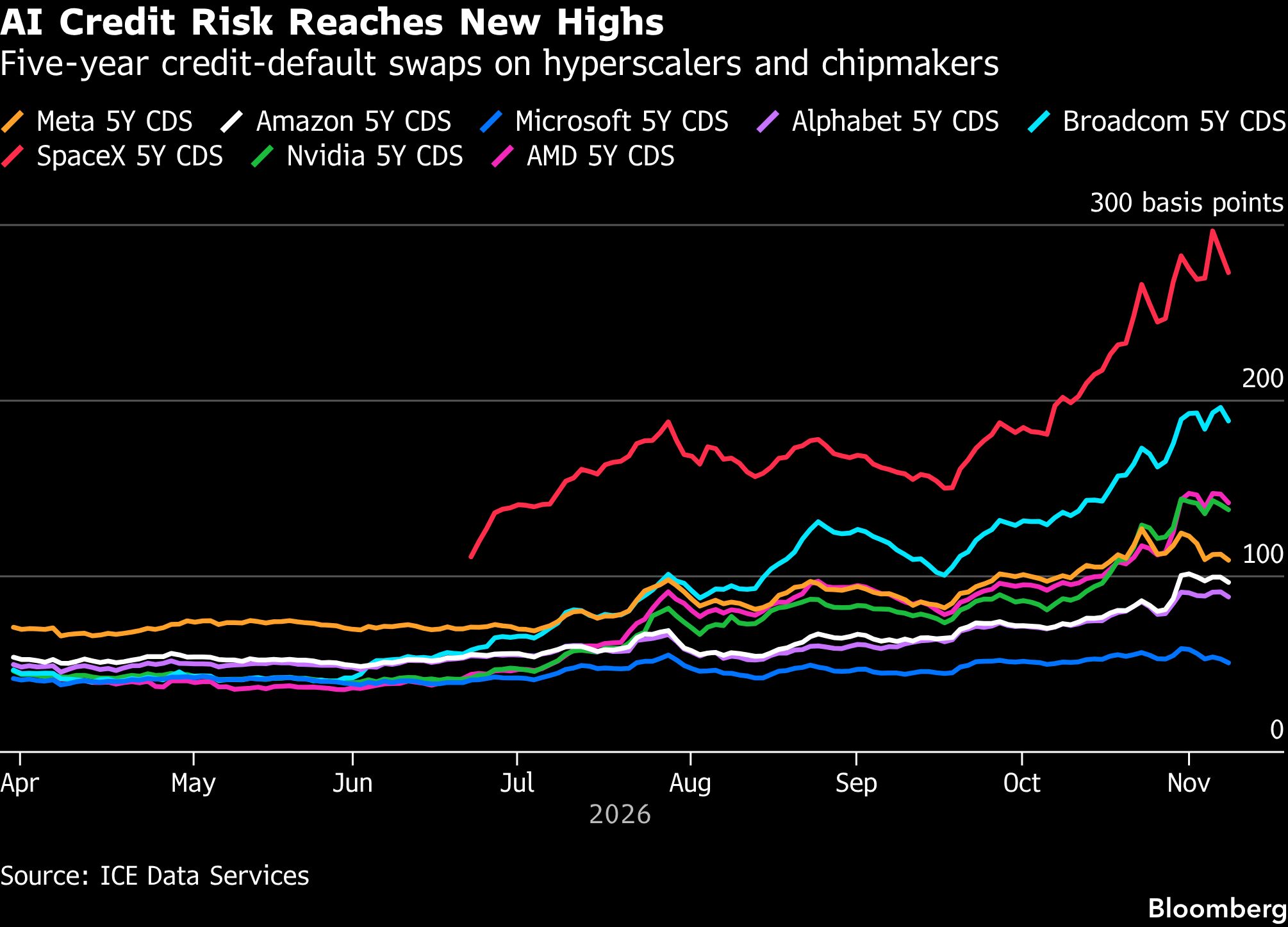
Two investment firms are seeking to launch exchange-traded funds that would let retail investors bet on fear about potential credit defaults at artificial intelligence companies, just as the AI trade reels from one of its sharpest selloffs in years.
Tuttle Capital Management and Defiance ETFs have each filed with the US Securities and Exchange Commission to offer funds tied to credit-default swaps separately on CoreWeave Inc. and Oracle Corp., and Defiance has one tied to Meta Platforms Inc. The derivatives, typically used by institutions to hedge against default, would also be packaged into highly leveraged ETFs linked to baskets of companies heavily exposed to the AI buildout, including chipmakers.
The offerings seek to capitalize on growing fears that companies at the center of the AI borrowing boom are taking on more debt than they can handle. As the Nasdaq slumped 15% from its October peak through Thursday, the cost of insuring debt issued by companies including CoreWeave and Oracle surged to new highs, rewarding investors who had bet on deteriorating creditworthiness.
See more: Leveraged ETFs: From Megacaps to Micro Trends
“There is always an ETF to meet a certain moment,” said Todd Sohn, chief ETF strategist at Baird Strategas. “This one is tricky, though, because CDS is not exactly a common instrument and has been tried before.”

Indeed, this isn’t Wall Street’s first attempt to bring credit-default swaps to a wider audience. The derivatives gained wider attention during the 2008 financial crisis, when investors used them to bet against mortgage-related debt. But when ProShares launched the first CDS ETFs in 2014, the products struggled and eventually closed.
Unlike those earlier funds, which tracked the broader CDS universe, the new offerings target individual companies and an AI boom whose staying power has come under growing scrutiny. The ETFs would compete with short selling and options, tools that retail investors can already use to bet against stocks.
Tuttle Capital is proposing five actively managed ETFs that effectively let retail investors buy leveraged credit protection on AI-related companies. Each fund is designed to rise when the issuer’s debt profile sags and credit spreads widen, or fall if the outlook brightens and the credit spreads narrow. Defiance plans to offer four ETFs that are similarly structured.
In some scenarios, investors instead could wind up losing money — even if the company’s shares are plunging — because the ongoing cost of maintaining protection with a CDS eats away at returns before anything bad enough happens to damage the company’s credit.
The movements either way could be amplified many times over because the fund managers plan to use borrowed money to augment their returns.
AI Jitters
The AI trade unraveled in recent weeks as investors grew increasingly concerned that enormous spending on the technology could take years to pay off while Democrats’ sweeping congressional victory raised the prospect of tighter regulation. Demand for protection has pushed the prices for CDS tied to hyperscalers and chipmakers to fresh highs, from almost nonexistent a year ago.
Oracle has the weakest credit rating among the largest hyperscalers and is widely seen as a proxy for AI debt risk. Its five-year CDS hit a record last month as credit risk across tech spiked on fears a post-earnings borrowing binge would overwhelm already swamped debt markets. Oracle disclosed that it was committing to just $10 billion of gross debt growth through fiscal 2030, helping ease investor angst.
CoreWeave, meanwhile, has tapped both the US high yield and loan markets with multi-billion dollar deals to finance its buildout. Contracts tied to the neocloud, which started trading a year ago, hit a fresh all-time high last month after the company’s talk of tapping vast pools of capital from insurers spooked investors. The swaps are currently pricing in a more than 60% chance of default within the next five years.
Representatives for Oracle, Meta and CoreWeave didn’t immediately respond to messages seeking comment. Debt issued by Oracle and Meta carries investment-grade credit ratings. CoreWeave is rated B by S&P Global Ratings.
Record Trading
Trading volumes for CDS tied to the 10 largest hyperscalers and chipmakers are at record highs, making the swaps among some of the most actively traded US contracts in the market outside of the financial sector.
Oracle CDS are by far the most active single-name contract in the US market at a record $47.6 billion, from just $8.7 billion this year through Oct. 30, according to an analysis of trade repository data by Barclays Plc credit strategist Jigar Patel. CoreWeave volumes stand at $4.6 billion, up from $145 million.
The new CDS-linked ETFs will likely struggle to win over retail traders because of their complexity, though a deeper AI selloff could change that, according to Bloomberg Intelligence analyst James Seyffart.
“Any random person who has read anything about the global financial crisis is going to know what these are. But will they actually buy an ETF based on it? Maybe. But I’m skeptical,” Seyffart said. “Still, no matter how niche, a product at the right place in the right time can have a snowball effect.”
A message from Advisor Perspectives and VettaFi: Discover something new! Click here to register for our upcoming webcasts.
Bloomberg News provided this article. For more articles like this please visit
bloomberg.com.
More Innovative ETFs Topics >