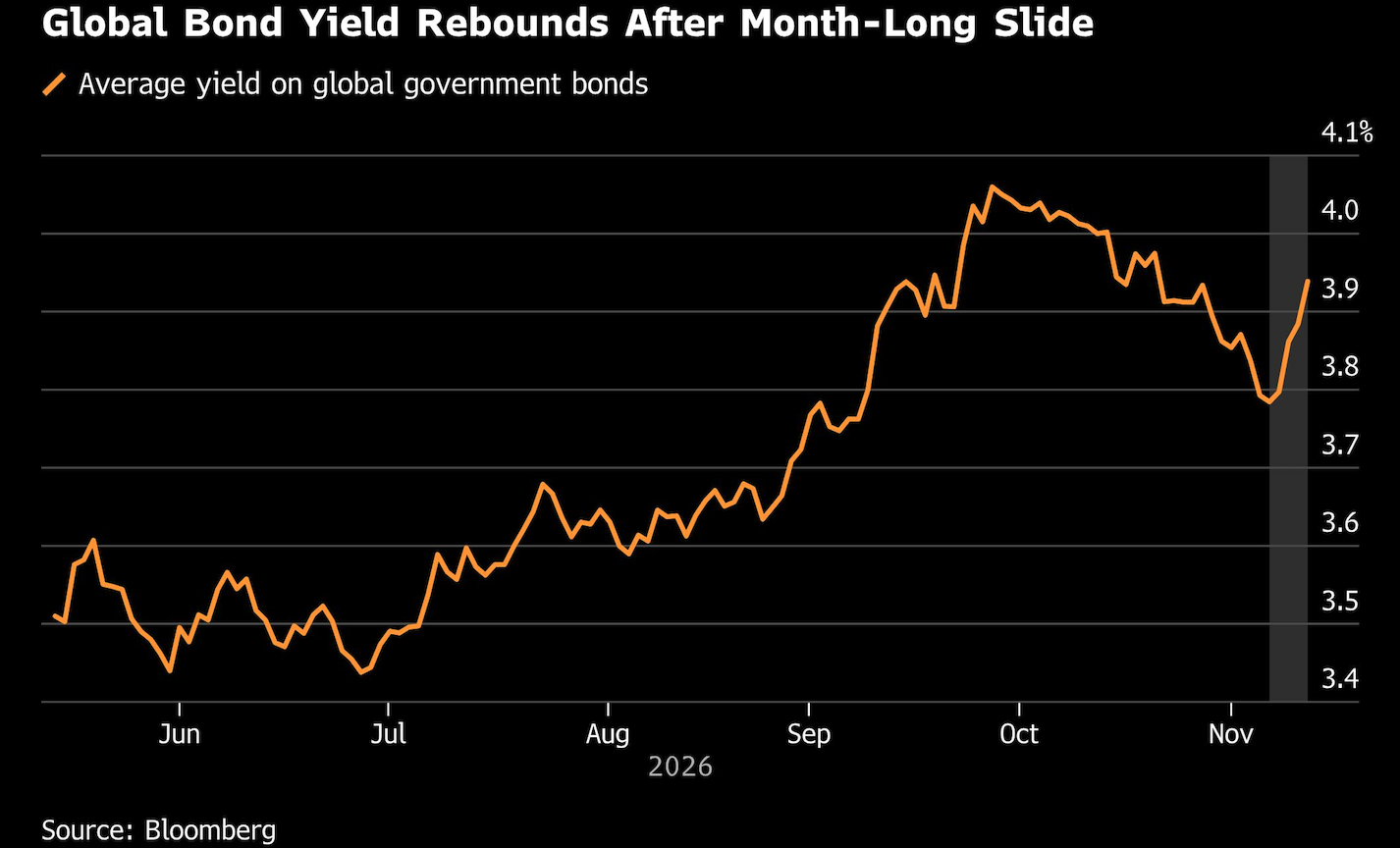
Just when global bond investors were starting to believe the worst of this year’s rout was over, surging Treasury yields are making them think again.
The forces roiling the world’s biggest debt market show little sign of fading, as stubborn inflation and hawkish Federal Reserve rhetoric have traders bracing for more interest-rate hikes, while growing debt supply adds to the upward pressure on yields. The selloff persisted even as turmoil around Nvidia Corp. rattled stocks and risk sentiment, undercutting hopes that Treasuries had reclaimed their traditional haven role.
“This is a tougher environment than during the Covid pandemic and the global financial crisis,” said Kellie Wood, a Sydney-based money manager at Schroders Plc who is currently short Treasuries. “Those were big directional moves — today it’s about rolling supply shocks and wild rates volatility. We still have to be on alert for higher yields all the way till year-end.”

Treasuries have had a bruising week, with the selloff stretching beyond the policy-sensitive front end. The combined jump in two-year US yields on Tuesday and Thursday — with cash markets closed Wednesday — was the biggest since March 2023, while the increase in 10-year yields was the most since April 2025.
See more: Do Bond Investors Get Rewarded for Taking Duration Risk? (Part 1)
The losses mounted at a slower pace on Friday, sending five- to 30-year yields to fresh weekly highs. The 10-year rose about three basis points to 5.16%, extending its weekly increase to 30 basis points. The market drew only temporary support from October producer price index data that showed a smaller overall increase than economists had estimated.
It’s a U-turn from just a week ago, when a Democratic sweep in the US midterms and jitters over AI sent investors flocking to Treasuries for safety. That rush of bullish positioning has since been upended, after Fed Governor Christopher Waller backed a rate increase and said he’d favor a half-point hike if inflation keeps accelerating. A hotter-than-expected consumer price report reinforced the shift, as did comments from Dallas Fed President Lorie Logan.
The pressure is rippling through global markets, with Treasuries setting the benchmark for borrowing costs worldwide. A Bloomberg gauge of returns on Treasuries is sliding again after the latest surge in yields, reversing a recovery that had pared its loss this year to 1%.
“The selloff of developed-market sovereign bonds is far from over,” said Tracy Chen, a portfolio manager at Brandywine Global Investment Management, adding that the main drivers are still going strong. “The next target level for 10-year should head toward 5.5% and then probably consolidate again.”
What Bloomberg Strategists Say...
“The selloff in two-year Treasuries has room to extend when the next leg of inflation data is released on Friday.”
— Alyce Andres, Markets Live strategist.
For some investors, the rise in yields is creating an opportunity. George Boubouras at hedge fund K2 Asset Management sees 10-year Treasuries as attractive at around 5.3%, saying the recent rally wasn’t a false start.
“We’re buyers of it at 5.3%, and we’ll be buyers of that until it pops to the new level,” said Boubouras, its managing director and head of research, investments and advisory, in Melbourne.
Strategists at Goldman Sachs Group Inc. this week forecast US 10-year yields will drop to 4.6% in 2027, citing the rising appeal of hedging and benign inflation.
Rate Bets
Beyond the US, yields in Japan and Australia are climbing back toward multiyear highs. Those in France, which have surged on concern over the nation’s fiscal outlook and political instability, are also resuming their advance after easing earlier in November.
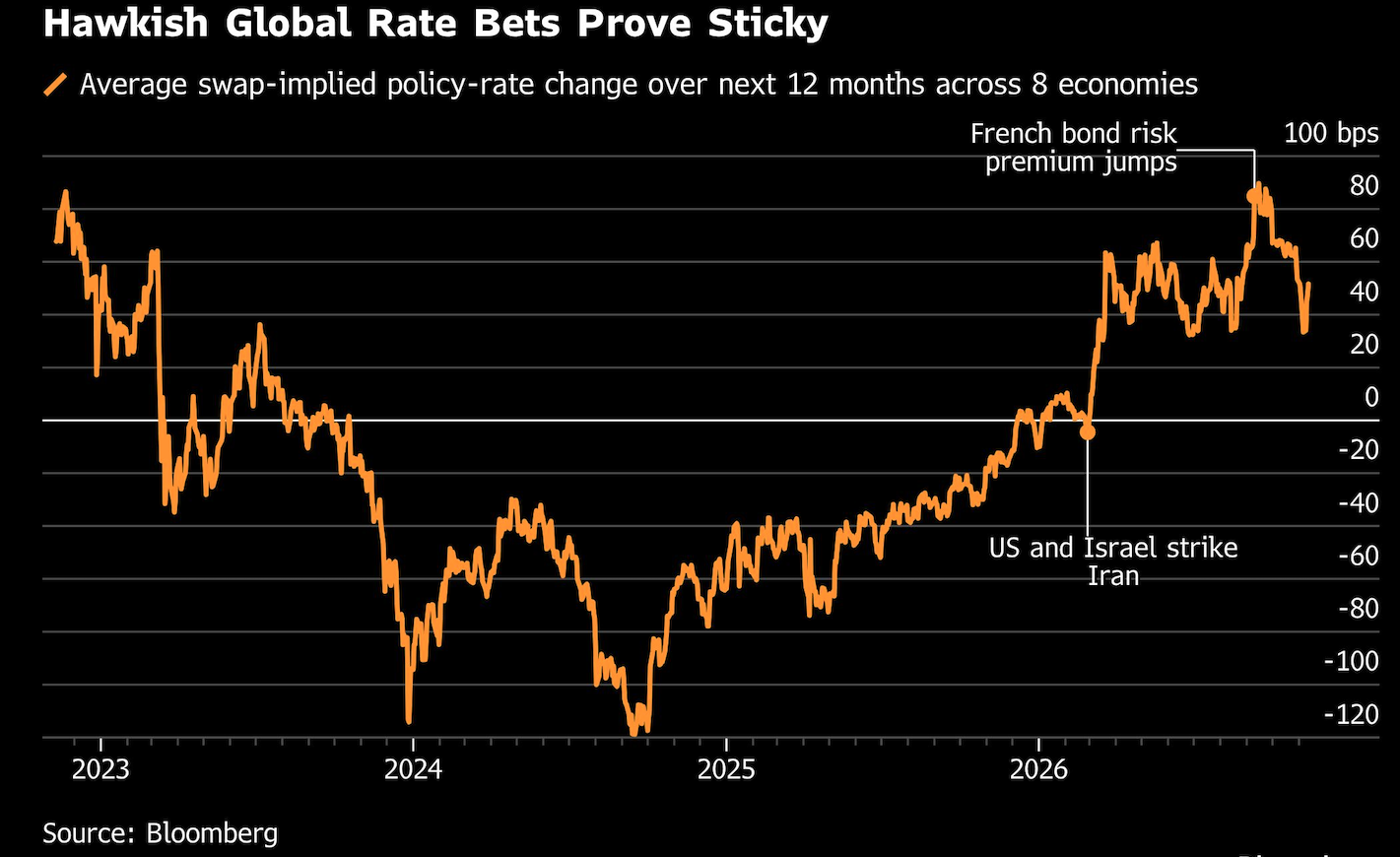
Traders are ramping up bets on tighter policy globally. Swaps are pricing in an average change of more than 50 basis points in policy rates over the coming year across eight economies, up from 33 basis points seen on Nov. 6, which was the lowest since June, according to data compiled by Bloomberg.
“Barring an abject crash in risk assets like stocks, or a return of oil prices to pre-war levels, the risk is that the banks will have to go further than the market is currently assuming,” Steven Barrow, head of G10 strategy at Standard Bank Group in London, wrote in a note.
Schroders’ Wood sees a more divided picture. While US rates may need to rise — potentially over 5% — as inflation accelerates and growth outpaces the rest of the world, she is long bonds in Australia and Europe, betting central banks there will ease in 2027 to head off recession.
“2027 will be the year of dispersion with each economy at a different stage of the cycle,” she said. “2027 is the year for the active bond manager.”
A message from Advisor Perspectives and VettaFi: Discover something new! Click here to register for our upcoming webcasts.
Bloomberg News provided this article. For more articles like this please visit
bloomberg.com.
More Innovative ETFs Topics >