Investors growing tired of the whiplash from the AI trade are seeking solace in value stocks.
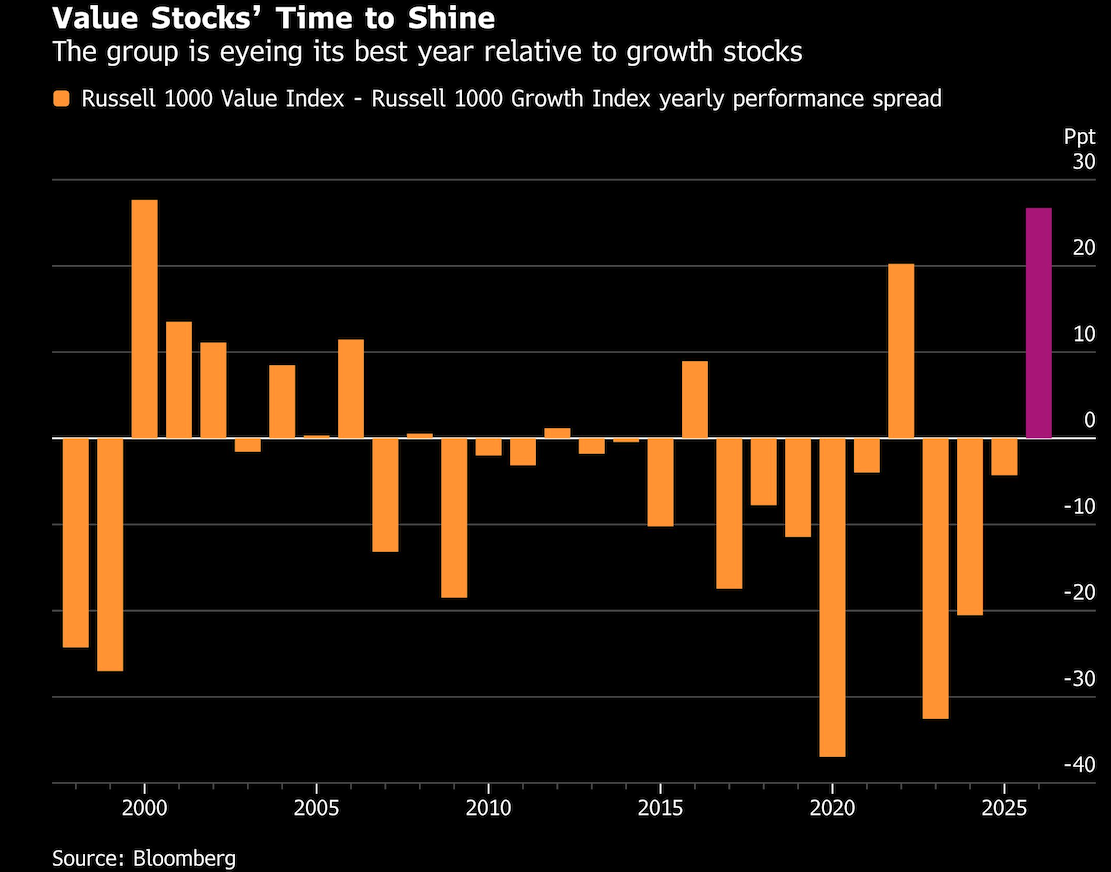
The Russell 1000 Value Index, made up of stocks in consumer staples, industrials and utilities sectors, is on track for its best year on record relative to the Russell 1000 Growth Index, which is filled with stocks that track the newest technologies.
Value’s return to glory comes as investors have been fervently questioning the earnings and spending plans of hot artificial intelligence companies relative to the tech’s future return on investment. Last week, concerns that the AI build-out will slow down after the Democrats swept the US midterm elections led to the tech-heavy Nasdaq 100 Index losing a record $2.3 trillion in market value in a single day.
“When we do have scares, what that often means is that investors don’t really believe in that growth rate for 2027 in those stocks, especially tech,” said Arun Sundaram, who now leads investment strategy at CFRA Research after Sam Stovall retired.

The fears came to a head when Nvidia Corp., the company at the center of the AI boom, ousted its Chief Executive Officer Jensen Huang after reports of multiple affairs, sinking the stock by 4.3% on Thursday. Its drop pulled the Nasdaq 100 and broader S&P 500 Index down by 0.3% and 0.4%, respectively.
Investors are questioning whether the projected earnings growth in tech stocks will come to fruition given negative free cash flows and increasing debt raises, according to Ed Clissold, chief US strategist at Ned Davis Research.
See more: Market Valuation: Expensive CAPE Or Cheap PEG?
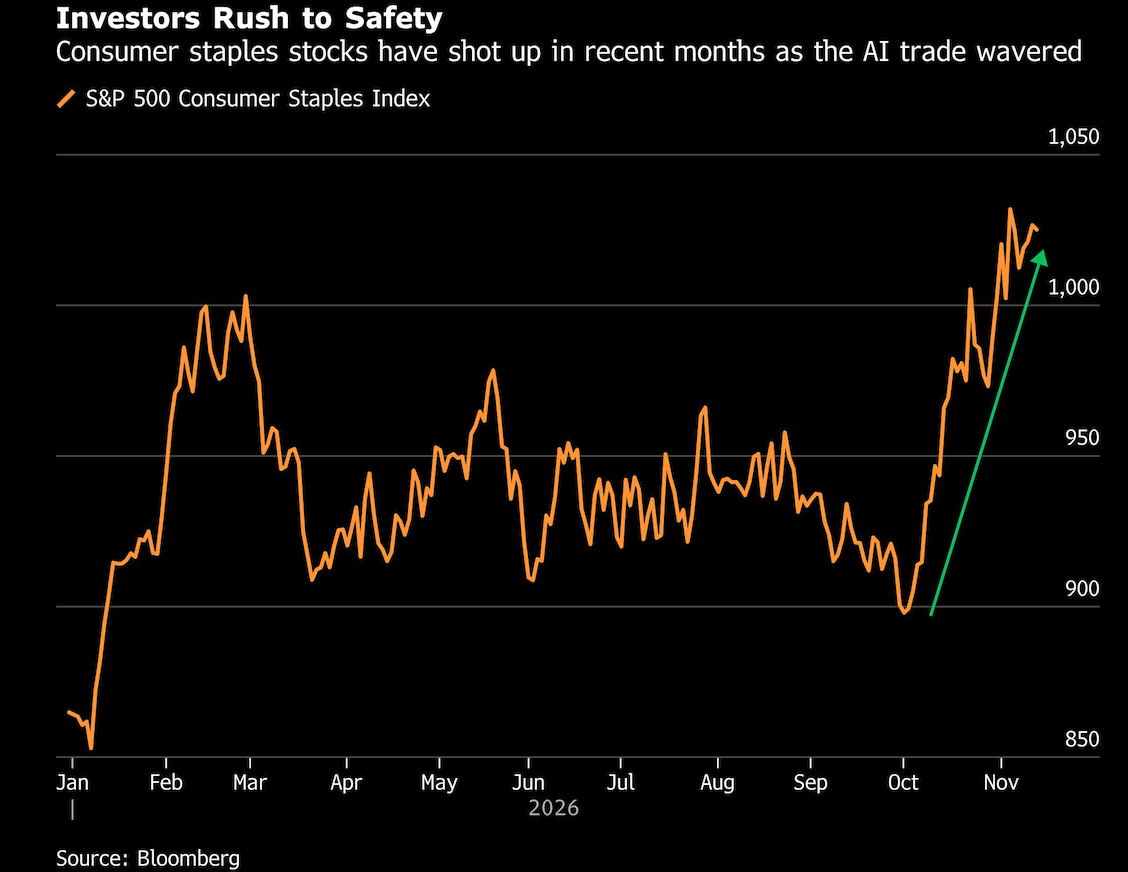
That skepticism is driving money into slower corners of the market. The value stock gauge has gained 25% so far this year, and the S&P 500 Consumer Staples Index is up 19%. Both are handily beating the S&P 500’s 11% advance. Meanwhile, the Russell growth index is down 1.8%.
In fact, consumer staples and other value-oriented stocks are now looking a bit expensive, said Sundaram. CFRA is underweight consumer staples.
Analysts at Barclays wrote in a note this week that consumer staples’ outperformance has been driven by “multiple expansion, not earnings,” which has pushed the group’s “relative P/E to recession-like extremes even as recession probabilities have fallen.”
The sector has gained 12% since the S&P 500 peaked on Oct. 6. If value stocks keep gaining while their earnings projections lag, that could cause a re-rating.
“At some point there will be a valuation reckoning if it gets too far out of whack,” Clissold said. “So, there is a limit for sure.”
To be sure, the Russell 1000 Value got a boost at the end of June when tech giants Apple Inc. and Microsoft Corp. joined the gauge. Meanwhile, Alphabet Inc. exited the value benchmark entirely and now sits exclusively in its growth counterpart.
Additionally, value’s record outperformance over growth stocks does not translate to their earnings growth projections. While value stocks tend to have slower growth forecasts by nature, analysts expect 2027 earnings to grow at 2.5% as of last week. They expect profit for growth stocks to grow by 41%.
Even so, investors are still piling into the cohort as a defensive haven while war in the Middle East drives oil prices higher, keeping consumer prices stubbornly elevated.
“If you want to look out to 2027, as long as the economic landscape is similar to today, which is inflation’s somewhat sticky and growth being driven by capex, less by the consumer, then I would expect value to continue to gain,” Clissold said.
History may also be on value stocks’ side. When value performs well for the first 10 months of a year, the group tends to maintain that momentum through year-end, according to Steve Desanctis, a Jefferies LLC strategist.
A message from Advisor Perspectives and VettaFi: Discover something new! Click here to register for our upcoming webcasts.
Bloomberg News provided this article. For more articles like this please visit
bloomberg.com.
More Innovative ETFs Topics >