Not long ago, there was this idea that artificial intelligence could help the planet avoid the worst of global heating by using its superior brainpower to discover climate solutions humans couldn’t. Lately, though, it seems that if AI is still going to save the global village, it will first have to destroy it. With climate change.
The trouble is that the mad scramble for the electrons to run the data centers that make the AI that will ostensibly save the planet is mostly being satisfied by the very fossil fuels that are making the planet hotter.
Data-center electricity demand will nearly quadruple by 2035, Bloomberg NEF estimated in a report released Wednesday, at which point it will account for 7% of global energy use. And that forecast might still be the “lower bound,” BNEF warned, as the pipeline for new projects is jammed full.
The simplest solution would be connecting to an existing power grid, but most grids aren’t built for such frenzied demand. Many US data-center projects are learning they can’t get a grid connection until, say, 2032, at which point President Alexandria Ocasio-Cortez might be on her way to a second term. AI mavens trying to satisfy hefty contracts for computing power can’t wait that long.
The quick-and-dirty solution for many developers is skipping the grid and burning fossil gas on-site, or “behind the meter.” Gas is relatively cheap and plentiful in the US, and if you don’t care too much about burning it efficiently, you can get quick power using repurposed jet engines or whatever else you can jerry-rig together. Such plants take only two years or so to get up and running, according to data-center tracker Cleanview, compared with up to seven years for a grid connection.
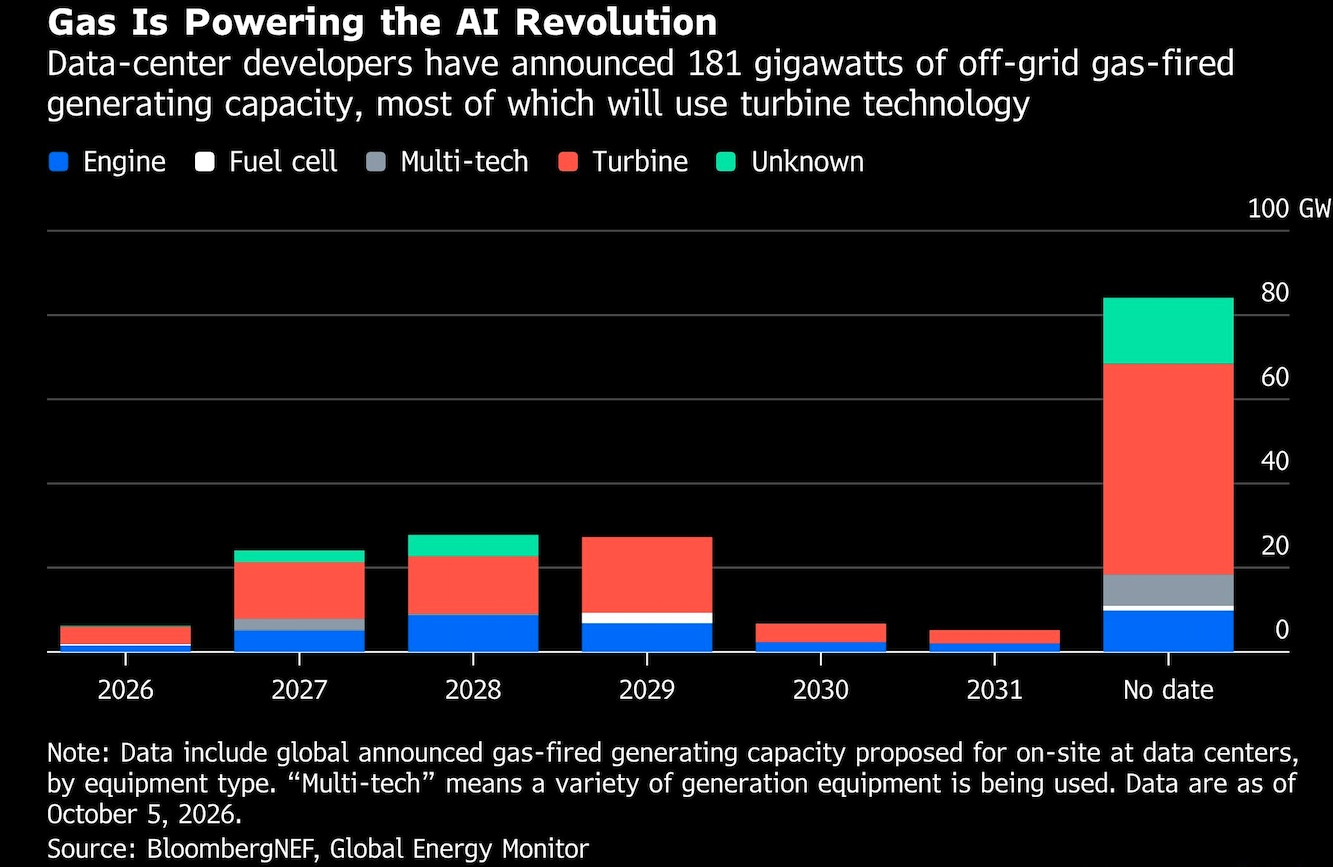
It’s little wonder that, by the end of 2025, developers had announced 50 gigawatts of off-grid gas capacity in the US alone, according to Cleanview, up from just 2 GW at the end of 2024. That growth just kept skyrocketing this year: The capacity of all off-grid generation in the global pipeline today totals 181 GW, BNEF estimates. That’s about a year’s worth of consumption for New York state.
Fortunately, much of this probably won’t be built, and not just because of Jensen Huang’s shenanigans. Only about 97 GW of the power in BNEF’s count has a specific startup date attached to it, suggesting the rest could be speculative. But 97 GW is still a lot, and most of it is scheduled to come online by 2030.
Faster grid connection, the goal of the permitting-reform bill called the Bipartisan American Affordability and Jobs Act, or BAAJA, might help keep some of this gas from polluting the atmosphere. On-site gas is often described as merely a temporary solution until projects can get on the grid.
But many developers will keep burning their own gas instead of dealing with the red tape of even a faster grid connection, BNEF warns. And not all of that grid power will come from renewables. If all the data-center capacity in the US pipeline connects to the grid by 2035, then power plants will burn 28% more gas than they do now, BNEF has projected. Gas will meet 76% of grid-connected data-center demand that year, up from 65% in 2026.
All of this gas is making the planet hotter. Fossil-fuel enthusiasts call it “natural” gas because that sounds cleaner. But it’s no more natural than coal. And in some cases it produces more heat-trapping emissions than coal once you include all the methane that gets leaked in the process of extracting, transporting and storing it. Methane is 80 times more effective at cooking the planet than carbon dioxide in the short term and 28 times more over a century.
If this country’s data-center frenzy goes as planned, the sector could belch 618 million extra tons of CO2 equivalent into the atmosphere by 2030, the Sierra Club has estimated, wiping out 15 years of progress in cutting the US power grid’s carbon pollution. Most of those emissions, 460 million tons, would come from gas plants that aren’t connected to the grid, roughly matching the annual output of Mexico.
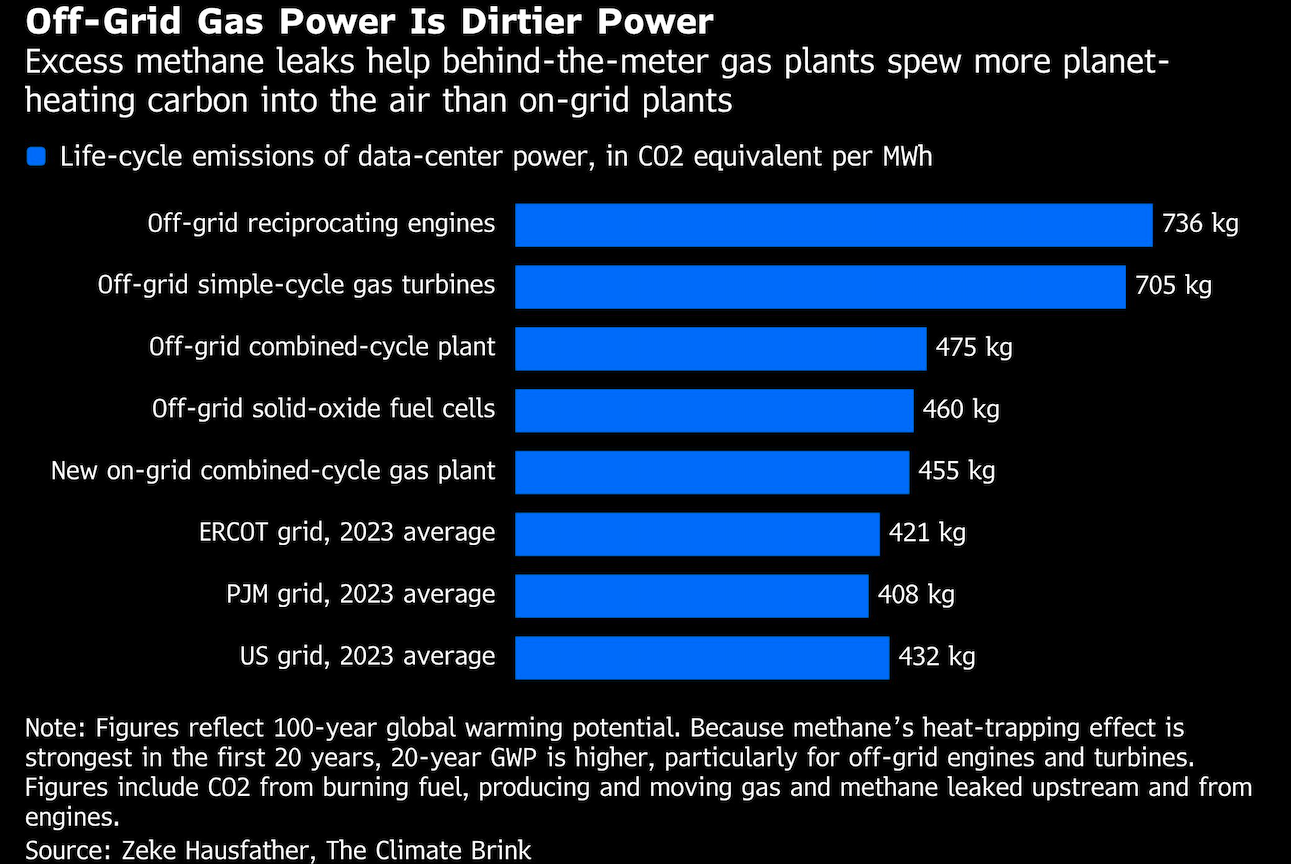
Those off-grid plants also leak far more methane than grid-connected ones because they typically use less-efficient technology. Methane leaks are 63% to 80% higher for off-grid plants, Zeke Hausfather, a climate scientist at the nonprofit research group Berkeley Earth, has estimated.
And 80% of planned off-grid generation will be in the form of reciprocating engines and simple-cycle turbines, Hausfather notes, which are the most wasteful of all. An off-grid reciprocating engine emits 736 kilograms of CO2 equivalent per megawatt-hour, 80% higher than the average pollution rate for the PJM grid, the biggest in the US.
All told, these behind-the-meter plants could pump 380 million tons of CO2 equivalent into the atmosphere in just the next 18 months, Olya Irzak, founder and CEO of Frost Methane Labs, a company that captures waste methane from manure, has estimated. This implies that AI’s climate impact will not only be long-lasting but also heavily front-loaded.
And if Big Tech’s fondest dreams are realized, then this damage will rise exponentially. AI executives have suggested the world needs 100 times more computing power. The energy required to meet that goal would produce 3 billion tons of CO2 a year by 2035, or 30 billion tons by 2045, Wim Vanderbauwhede, a professor of computer science at the University of Glasgow, has estimated. Given the world’s entire carbon budget for 2035 is 22 billion tons, these emissions “would be downright catastrophic,” Vanderbauwhede wrote.
And none of this accounts for the environmental harm AI is doing as we speak. Data centers get a lot of grief for the water they use to cool servers, but they’re using exponentially more water to generate power, somewhere between 211 billion and 4 trillion gallons of it each year, depending on which study you believe. They’re spilling “forever” chemicals and other pollutants into the water and land. Burning coal and natural gas to power them spews particulate matter into the air. They’re clear-cutting forests.
What does the planet get in exchange for this mistreatment? AI has already made climate research better, helping humans crunch data mountains to find patterns and impacts of a hotter planet. It’s arguably building better models for predicting destructive weather, though at the moment they’re still not able to keep up with the changes in an increasingly chaotic atmosphere. It can theoretically help grids, buildings, homes, farms and factories run more efficiently. It can theoretically figure out ways to capture carbon from the air. Maybe some future robot super-genius will finally build the Mr. Fusion Home Energy Reactor.
But many of these applications still exist mainly on whiteboards. Meanwhile, the fossil fuel industry is already using AI to get better at extracting and selling its product. Its minions are using AI to spread climate disinformation. Any economic productivity gains from AI will lead to more carbon emissions than not, unless renewables grow up to four times faster than fossil fuels, an August paper in Nature estimated.
Tally it all up, and AI is creating a “carbon debt” because “AI emissions are growing today, while AI-enabled emissions reductions will take time,” MIT researchers John Sterman and Jennifer Turliuk wrote in a recent paper on AI’s net climate impact. “Even if that debt is eventually repaid by AI climate solutions, the additional warming and climate damage will persist for decades to millennia.”
We can make that debt smaller by at least making data centers run cleaner. President Donald Trump’s government certainly won’t bother doing that and is in fact encouraging them to burn more fossil fuel.
But many state and local politicians just won elections rife with anti-data-center sentiment, with 46 of 47 ballot measures coming down on the side of banning or regulating them. Ireland makes them supply their own power, 80% of which must be renewable. We’ll need more such policies if we want to keep our village alive while we wait for AI to save it.