Advisor Perspectives welcomes guest contributions. The views presented here do not necessarily represent those of Advisor Perspectives.
Financial advisors face an array of challenges with clients: developing comprehensive plans, coordinating with a range of service providers, and providing ongoing financial and behavioral counseling.
At the heart of the advising process is a fundamental decision. Will I cater to client emotions, or will I structure my practice to mitigate the financial damage of emotional decisions? In other words: cater or mitigate?
How clients respond to the emotions generated while making investment decisions is the most important determinant of long-term wealth. That may sound like a bold claim, but considerable evidence supports it, and you've likely seen it in your own practice.
Panicked clients call, demanding that you sell their stocks during market drops, often at the exact moment it makes more sense to buy. They insist on selling losers to buy recent winners, paying the well-known cost of performance chasing. Some keep their money under the mattress and miss unforeseen rallies, while others want to chase the latest hot investment or react to whatever doom scenario is making the rounds.
Avoiding these emotional mistakes can add hundreds of thousands, if not millions, of dollars to a client’s portfolio over the long run. The challenge is helping clients manage the powerful instincts that underlie wealth-destroying decisions.
Some researchers believe the fear triggered by a crashing stock market is comparable to what our ancestors felt when facing a saber-toothed tiger. That gives you a sense of the magnitude of the challenge.
Building a Practice That Mitigates
You can take on this challenge by building your practice around mitigating emotional damage to client wealth. This means:
- Using the liquidity, income, and growth bucket model for planning;
- Funding each of these three needs with a separately managed portfolio;
- Hiring competent specialists to deliver the full range of services clients need; and
- Providing ongoing behavioral education and coaching.
Or you can cater to client emotions by giving in to their emotional demands. Many advisors choose this less stressful route, which lowers clients’ long-term wealth and often leads to a smaller practice. Most practices fall somewhere in between, catering to some clients while working to mitigate emotional damage with others. The truth is that some clients, no matter how you try to persuade them, will remain captive to their primitive emotions when making financial decisions.
To be clear, mitigating does not mean trying to eliminate client emotions. It means helping clients manage how they respond to them.
In fact, humans generally have difficulty making decisions without emotions. Studies of patients with damage to the frontal lobe, the part of the brain involved in regulating emotion, show that these patients often struggle to make even simple decisions.
Because emotions are always present, the goal is to help clients understand that emotions should not be the primary driver of their financial decisions. Ultimately, you want them comfortable looking past their emotions, so they are more likely to make fact-based decisions.
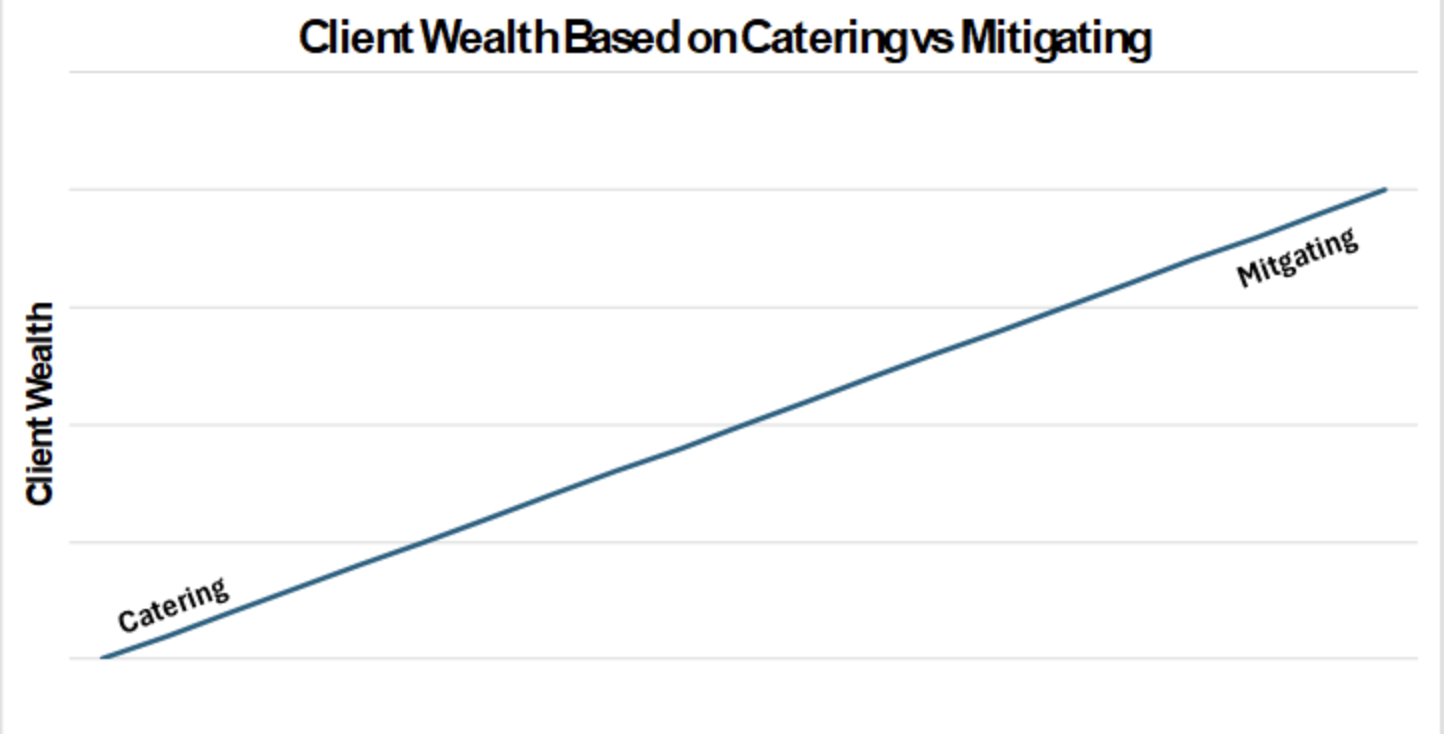
As the graph below shows, the more an advisor mitigates rather than caters, the greater the client’s long-term wealth tends to be.
Faux Risk Measures
One of the most pervasive barriers to moving from catering to mitigating is the industry’s conflation of emotions with risk. It began nearly 75 years ago, when Harry Markowitz introduced mean-variance portfolio optimization. He proposed that variance (or standard deviation) be treated as the risk of holding a portfolio. If that is true, then a portfolio that minimizes volatility for each level of expected return is “optimal.” The industry’s widespread acceptance of Markowitz’s model has been destructive to client portfolios.
In the 1960s, Bill Sharpe and others made matters worse. Building on Markowitz’s work, they developed the Capital Asset Pricing Model, which put forward beta as an alternative measure of risk.
By the 1970s, modern portfolio theory had become the industry standard, with two supposedly objective risk measures: standard deviation and beta, which is derived from it.
The problem is that, in general, neither one captures risk. Instead, both reflect return volatility driven by investor herding and other emotional behavior. That is why I call them faux risk measures, particularly when they are applied to long-term growth portfolios. The root problem is that the industry treats them as legitimate.
So, what does constitute risk in an investment portfolio? When investing for a near-term goal, volatility is certainly a risk. The bucket model handles this by funding liquidity needs with low-volatility, short-term securities.
For a diversified, long-horizon portfolio, however, volatility fades into insignificance as the time frame lengthens. A single stock is risky because its price can fall to zero, but a broad market ETF such as SPY or IWM has a vanishingly small chance of doing so. Using volatility as the measure of risk in this situation makes little sense.
There is another mark against volatility-based risk measures. To derive their models, Markowitz, Sharpe, and others had to assume away investor emotions so stock returns would fit solvable mathematical formulations. Later attempts to reintroduce emotions into these models have failed. Mathematical models and human emotions are simply incompatible.
Despite empirical evidence against these risk measures, both remain firmly entrenched in the financial planning and investment industries.
Faux Risk Management
Faux risk management begins early in the planning process. New clients are often asked to complete a risk tolerance questionnaire, and the results are used to offer portfolios ranging from conservative to moderate to aggressive.
A closer look shows that these questionnaires actually measure a client’s emotional reaction to volatility. Building portfolios from the results is therefore catering to client emotions, which reduces long-horizon wealth. Making matters worse, regulators require these questionnaires. It seems that regulators are fond of catering.
Rather than taking questionnaire results at face value, use them to help you understand a client’s emotional and behavioral profile. That information is valuable for developing a plan to mitigate emotional mistakes. Used as is, however, risk tolerance results lead to de facto catering.
The Industry Encourages Catering
Getting clients to look past their emotions is challenging enough, but an elaborate industry structure encourages (or even forces) advisors to cater to them.
Everywhere you turn, volatility is reported and used to build risk-return portfolios. Returns are risk-adjusted using both standard deviation and beta. Common examples of these faux risk-based analytics include the Sharpe ratio, the Sortino ratio, and alpha calculated using beta.
In each case, measuring risk as short-term volatility (typically the annual standard deviation of returns) turns what is supposed to be a risk-return analysis into a short-term emotion-return analysis. Long-horizon returns are penalized in order to minimize short-term volatility. This is a stealth way of catering to emotional reactions to volatility, and long-horizon wealth suffers because of a faulty industry methodology.
Conventional Wisdom Encourages Catering
Conventional wisdom also encourages stealth catering. One common example is the claim that offsetting a market loss requires a much larger positive return. To recover from a 30% loss, for instance, you need a 43% gain! This amplifies an already strong fear of market declines (recall the saber-toothed tiger) and makes mitigating that much harder.
There are problems with this argument. First, it is usually presented as an objective result of the math behind losses. But the only real things in markets are prices.
Returns are derived from prices and don’t exist without a beginning and ending price. If we focus on prices rather than returns, recovering a loss looks far less daunting.
Take a $100,000 investment that loses 30%. The loss is $30,000, and to recover, the same $30,000 has to be earned back. Gains offset losses dollar for dollar. The dollar loss is still substantial, but earning it back looks like a much smaller mountain to climb than when the loss is framed in percentages.
Thinking in dollars also highlights a more encouraging view of recovery. Stock market history shows that, over many decades, dollar gains have exceeded dollar losses. In fact, the market is currently at an all-time high, meaning every dollar lost has been more than recovered. Framing losses this way makes it easier to avoid catering.
Another common inducement to cater is the argument that when market valuation ratios are high (the best known being the Shiller CAPE ratio), subsequent returns will be low. This prediction fits neatly with the conventional wisdom “what goes up must come down” and reinforces investors’ well-known loss aversion.
The problem is that there is little or no evidence that CAPE or other valuation ratios predict future market returns. Several recent, carefully researched academic papers have reached this conclusion. A few papers propose complicated adjustments that provide some predictive ability, but the unadjusted ratios practitioners actually use are of no help in predicting returns.
The bottom line: Market predictions are mainly useful for justifying catering to clients’ emotional reactions to losses.
The Scramble to Underperform
Advisors and investors can’t help themselves. To reduce short-term volatility, they diversify long-horizon equity holdings with bonds, money market securities, and alternatives, arguing that this improves performance. In reality, they have only reduced long-term wealth potential, since each of these additions will most likely underperform stocks. That is a high price to pay for reducing meaningless short-term volatility in a long-horizon portfolio.
The current craze for alternatives is a major driver of catering. Alternatives can be fun to explore, and the stories behind them are often compelling. But my research, along with that of others, shows they significantly underperform equities. Passing on them may cost you a great party anecdote (“Hey, have I got a story for you…”), but your clients’ wealth will thank you.
Over the years, conventional wisdom has settled on a 60/40 stock/bond mix as the best allocation for long-term portfolios, particularly retirement accounts, with the mix tilting further toward bonds as retirement approaches. Congress reinforced this view in 2006 with the Pension Protection Act, which ushered in the explosive growth of target date funds built to satisfy its recommendations.
A 2026 paper by Aizhan Anarkulova and colleagues examines the optimal life-cycle investment mix. They found that a portfolio of 100% equities (U.S. and international) held throughout an investor’s life produced the best combination of wealth building, capital preservation, retirement income, and bequests. In other words, the optimal portfolio held no bonds at any point. Their strategy also outperformed both the 60/40 mix and target date funds.
This confirms that the 60/40 mix and target date funds are forms of stealth catering: both reduce short-term volatility at the expense of long-horizon wealth.
Catering Dressed Up as Conventional Wisdom
Everywhere you turn, you are encouraged to cater rather than mitigate. Regulators are only too happy to reinforce this. The result is less short-term volatility at the expense of long-horizon wealth.
By not helping clients mitigate costly emotional investing errors, and by going along with industry conventional wisdom, you are leaving money, probably substantial money, on the table for both your clients and your firm.
C.Thomas Howard, PhD is the director of research and portfolio manager at Quartz Investment Partners.
A message from Advisor Perspectives and VettaFi: Discover something new! Click here to register for our upcoming webcasts.
More Innovative ETFs Topics >
 Advisor Perspectives welcomes guest contributions. The views presented here do not necessarily represent those of Advisor Perspectives.