Anthropic’s initial public offering, set to price Wednesday, is the final step in a time-tested process that brings a company from private hands into the public market.
But the IPO’s traditional role as the gateway to the hottest companies is fading, as Wall Street’s years-long push to turn virtually every sought-after investment into something ordinary investors can buy — or at least bet on — gathers pace.
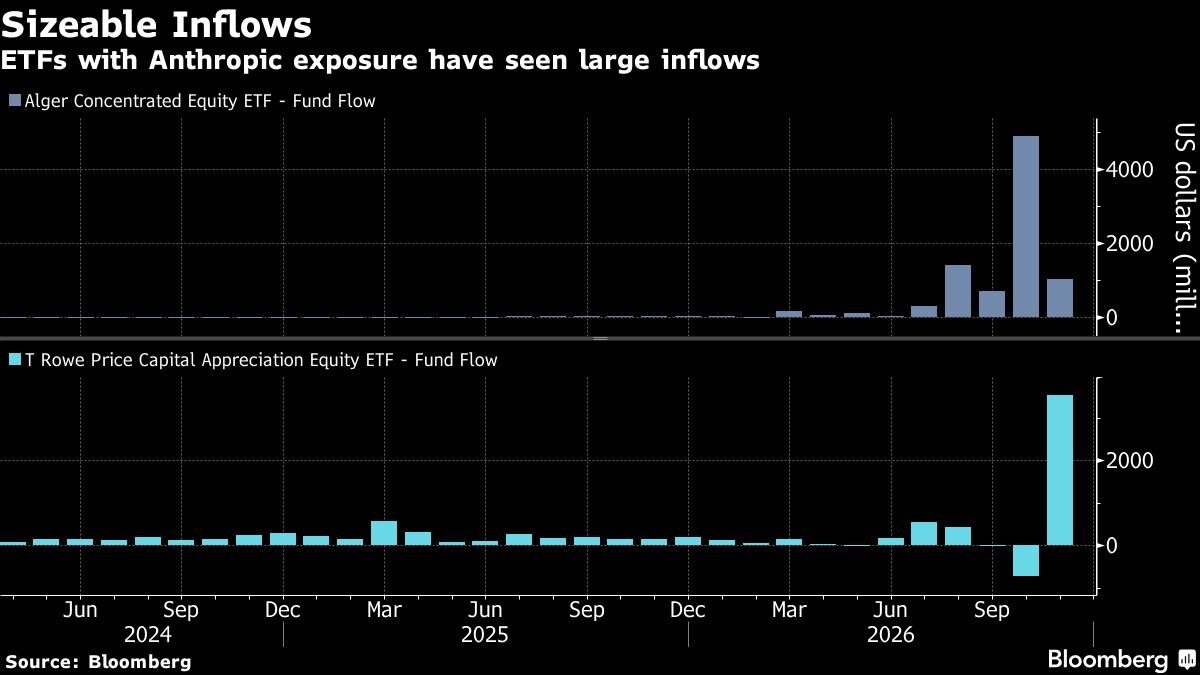
Even before shares in the maker of the Claude chatbot begin trading, at least 14 exchange-traded funds already offer exposure to Anthropic, either by owning shares directly, investing through vehicles that hold its private stock or using derivatives tied to the company’s value, according to Bloomberg holdings data. Retail and institutional investors have poured more than $8 billion into the group over the past month.
See more: Record ETF Launches Push Issuers to Rethink Fund Lineups
Anthropic and its co-founders are seeking to raise as much as $90.4 billion through the IPO and a private placement, according to its filings with the US Securities and Exchange Commission. The rush that preceded the debut is part of a broader contest for individual investors’ money. Those who once needed connections with venture capitalists to get near Silicon Valley’s hottest private companies can now choose from an increasingly bewildering menu of funds, crypto-style derivatives and specialist marketplaces.
About 90 ETFs hold stakes in private companies, including OpenAI, Databricks, Kalshi and Stripe. The inflows into Anthropic-exposed funds reflect demand for portfolios holding other investments too, making it difficult to isolate how much money investors are directing specifically toward the AI company.
“The era of private markets being almost entirely off-limits to retail investors is over,” said Elisabeth de Fontenay, a professor at Duke University.

Almost 500 closed-end funds hold private-company stakes, including in e-cigarette maker Juul Labs, video-game maker Epic Games and fashion brands Tory Burch and Fabletics. Assets in so-called semiliquid funds, which can hold harder-to-sell investments and limit when investors can withdraw, grew to nearly $390 billion in 2025 from $15 billion in 2018, according to the Federal Reserve.
BlackRock Inc. announced this week it is seeking approval for a fund structure that would bring some of the trading convenience of ETFs to private assets. Investors could trade its shares on an exchange throughout the day at the going price, while the fund would offer to buy back only a portion of its shares each month. That would give it more room than a conventional ETF to hold investments that take longer to sell.
The industry’s pitch is that being shut out comes with a cost. Jeff Weniger, chief investment strategist at Corgi Invest, calls it “omission risk”: missing out on exposure while some of the world’s biggest companies are still private. The firm’s MANGOS fund uses derivatives linked to perpetual futures to get exposure to private companies. Its website makes the pitch in fewer words: “Exposure to OpenAI & Anthropic. Six companies. One ETF.”
De Fontenay and a co-author take issue with the premise that individuals have been “unfairly excluded” from private markets. Getting exposure to a sought-after company, they argue, doesn’t give individual investors the terms or protections available to institutions that negotiate private deals.
“The public markets offer retail investors the benefits of market efficiency, liquidity, and the ability to index at negligible cost,” they wrote in a recent paper. “Private equity, by contrast, depends on illiquidity, bespoke contracting, limited transparency and regulation, and a governance and reputation ecosystem built around sophisticated repeat players — none of which translates readily to a mass retail market.”
Emily Lauter, a 33-year-old retail investor from Chicago, said she invested roughly $1,000 in the Tema Photonics & Optical ETF (ticker LAZR) in late August. “I thought it was a good opportunity for me to pre-invest in Anthropic because for most retail investors, they don’t get that opportunity,” Lauter said of the fund, which offers exposure to the AI firm via a special-purpose vehicle.
“It’s part of that AI buildout, including Anthropic, obviously. I thought ‘Alright, this will probably eventually keep going up,’” she added.
Still, the fund hasn’t performed as she hoped, losing roughly 45% since she invested. “Honestly, at this point, I’m just hoping to break even,” she added.
The risks of piling into the market’s hottest trades have shown up repeatedly this year. A July selloff in AI chip stocks hammered leveraged funds tied to the sector. Bullish SpaceX funds tumbled after its debut. And when crypto bellwether Strategy came under pressure, leveraged funds and preferred shares tied to the company fell together, among other examples.
Once Anthropic lists, the funds that sold access will have a new competitor: the stock itself. Issuers are already preparing funds designed to amplify gains or let investors bet against the shares. One proposal would pair a bet on the stock rising with the sale of call options to generate income. Another would use options that expire the same day in a covered-call fund, with versions of the same strategy proposed for SpaceX, OpenAI, Anduril and Figure AI.
“There’s a race in the industry right now to offer something unique and provide solutions that have not already been provided,” said Paisley Nardini, head of investment strategy at Tema ETFs. “It’s like throwing darts against the board — you’ll see what sticks.”
SpaceX offers an early indication of how many might stick. Issuers raced to build products around the rocket company before it went public. Of the roughly 14 products in the SpaceX fund lineup, only one has topped $100 million in assets.
“All of these Anthropic ETFs, they can’t all make money — but one will,” said Bloomberg Intelligence’s Athanasios Psarofagis. “So the barriers to entry are so low, but the barriers to success are really high.”
A message from Advisor Perspectives and VettaFi: Discover something new! Click here to register for our upcoming webcasts.
Bloomberg News provided this article. For more articles like this please visit
bloomberg.com.
Read more articles by Vildana Hajric, Micah Barkley, Emma Haidar