The artificial intelligence boom is making the US economy more prone to disruption and market volatility, strengthening the case for Treasuries and other high-quality bonds, according to Pacific Investment Management Co.’s Daniel Ivascyn.
US government debt is flirting with its first annual loss since 2022. Longer-term yields aren’t far below multi-decade highs as investors brace for further Federal Reserve interest-rate hikes to tame inflation, which has been above the central bank’s target for more than five years.
Looking to the next few years, however, “there’s plenty of other risks in terms of financial accidents associated with AI, or potential disruption to old-economy business models that could lead to short-term pressure on economic growth,” Ivascyn, Pimco’s chief investment officer, said in an interview.

Markets got a stark reminder over the past week of the sway the AI investment outlook holds over bonds and other assets. On Friday, as the unraveling AI trade spurred a rout in equities, haven buying triggered a surge in Treasuries and led traders to trim bets the Fed would raise rates as soon as next month.
Then on Monday, chipmaker Nvidia Corp.’s move to rehire Jensen Huang as its leader fueled a major reversal, sparking a tech-led rally, while traders rebuilt bets on Fed policy tightening into next year.
See more: Quick Gains. Forgotten Growth?
Stronger Link
“One important theme that has developed, particularly over the course of the last year, is this much stronger linkage between the financial economy — tied to AI CapEx, AI-related earnings potential and AI disruption — and the real economy,” Ivascyn said.
The stronger connection, he said, “is one reason why we do think there would be a benefit for having the diversified qualities of fixed income.”
“Equity valuations are still stretched,” Ivascyn said. And given the threat AI poses to various industries, Pimco has reduced holdings of weaker-quality bonds — those ranked below investment grade — to the lowest since 2008.
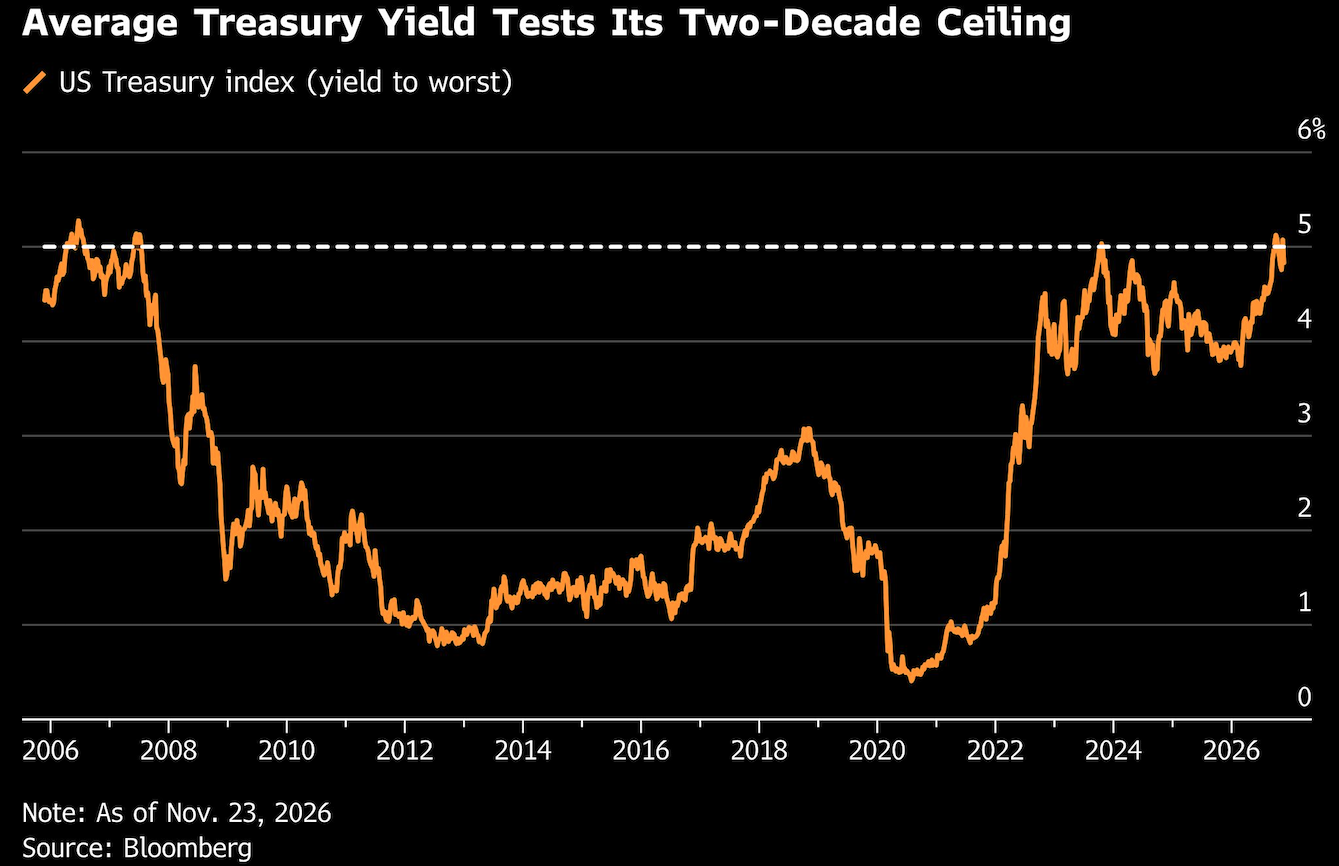
The average yield on the Bloomberg US Treasury index topped 5% this year and remains near that threshold. Before this year, the yield on the Treasury index hadn’t reached that level since October 2023, and before that, since 2007.
Pimco’s main funds, such as its Pimco Income and Total Return offerings, remain slightly overweight in the five- to 10-year area of Treasuries, and are “fairly neutral on the yield curve,” the CIO said.
The $224 billion Income Fund, which he helps manage, is down roughly 0.4% this year as of Nov. 23, roughly in line with its benchmark, the Bloomberg US Aggregate Total Return index.
In September, he told Bloomberg that the increase in long-term Treasury yields above 5% had led the firm to trim its underweight position on the debt.
“We’re perfectly happy staying up in quality bonds and mortgages,” and using those liquid assets to fund “more interesting and attractive investments” in the corporate, asset-backed or commercial mortgage-backed universe, he said.
“While yields very well may stay here in the base case, there’s lots of scenarios that could lead to a sudden and somewhat unpredictable drop in yields in the future,” Ivascyn said.
A message from Advisor Perspectives and VettaFi: Discover something new! Click here to register for our upcoming webcasts.
Bloomberg News provided this article. For more articles like this please visit
bloomberg.com.
More Fixed Income Topics >