The Land Down Under Looks North
Early in 2011, The Economist magazine ran a cover story titled ‘The Next Golden State.’ The title, incidentally, referred to Australia.
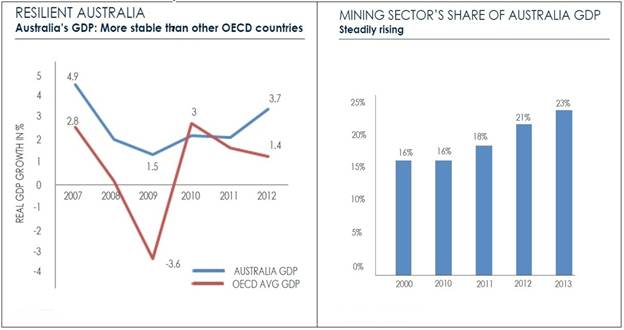
The large island down under has been in an enviable state for the greater part of the last decade: Australia escaped the global financial crisis of 2008 with only minor scratches, attracted plentiful mining investments from all over the world, and made its citizens happy by creating new jobs.
Today, Australia’s citizens enjoy some of the highest standards of living anywhere in the world. With a real income of $62,000 per person in 2012, the country ranked 13th worldwide. Five of the ten best livable cities in the world are in Australia. But, for all its advantages, the country’s contribution to the world economy in absolute terms is small. It accounted for just over 1 percent of world GDP in 2011.
Source: OECD Source: Minerals Council of Australia
This can be explained by several factors. Geographically, Australia is far off from some of the world’s largest markets like the U.S. and Europe. For that, it has been tagged a victim of the ‘tyranny of distance.’
Further, a large part of Australia’s growth over the past five years has come from mining investments fueled by a commodity boom in Asia.
Mining booms are enjoyable as long as they last but when they eventually end, they often inflict a painful blow. Australia understands this. It has been trying to diversify its economic base by expanding services and producing value added goods.
What’s more, the country is embracing its geography, shaking off its ‘tyranny of distance’ label, and gaining economic might with its Asian neighbors like China, India, and Indonesia.
Source: Australia in the Asian Century White Paper
Source: Australian Government, Department of Immigration and Citizenship
In fact, Australia is betting heavily on increasing trade with Asia for a broad-based growth. The island is gearing up to deepen cultural, strategic and trade ties with Asia. It calls its plan “Australia in the Asian Century.” According to the initiative, Australia has mapped out a series of objectives to achieve over the next two decades.
WHY ASIA?
Two decades ago, when the Australian Government commissioned a study of parts of Asia, the findings of the report were modest. Although the report held promise for Asia in general, much of the region then was agrarian and rural, and poor and destitute.
So much has changed since then.
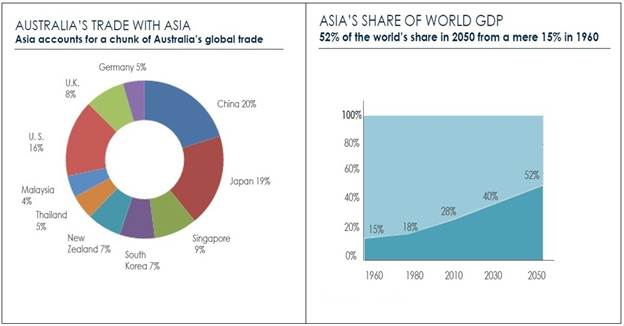
Today, two of the most populous nations in the world, India and China, have made great strides along with other countries such as Indonesia, Thailand and Malaysia. Thanks to Asia’s rise, nearly a third of the world’s population is enthusiastically taking part in a globalized world. Over the past 20 years, billions of people in Asia saw an improvement in their standard of living, received better access to healthcare, and witnessed a robust rise in income. And if Asia’s growth persists at the current rate, it will account for 52 percent of the world GDP by 2050, according to the Asian Development Bank.
Source: Australian Trade Commission Source: Asian Development Bank
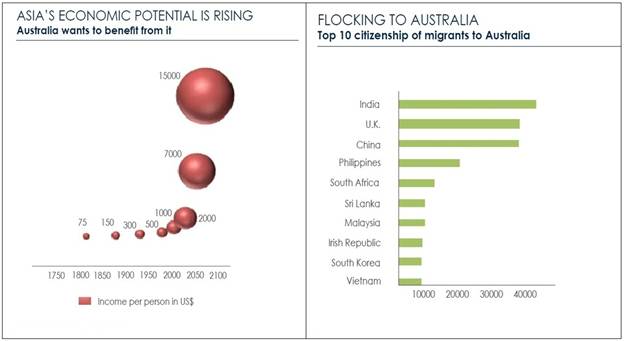
Asia’s ascent carries great implications for the world, ranging from global security to climate change. But Australia is focusing on one important aspect of Asia’s growth: the rise of Asia’s middle class and the resulting opportunities for Australia to increase trade with Asia. The middle class population is growing across the world. But with Asian economies growing at a faster clip, the growth of the middle class on the continent is even more pronounced, as millions of people are being lifted out of poverty. By Australia’s own estimate, Asia will be the home to a majority of the world’s middle class by 2030. Australia also forecasts that real income in Asia is poised to double to $15,000 per person by 2025.
AUSTRALIA SEEKS AN EDGE IN ASIA
Australia already holds a significant edge when it comes to trade with Asia. Over the past decade, many Asian countries surpassed other nations to become Australia’s largest trading partners.
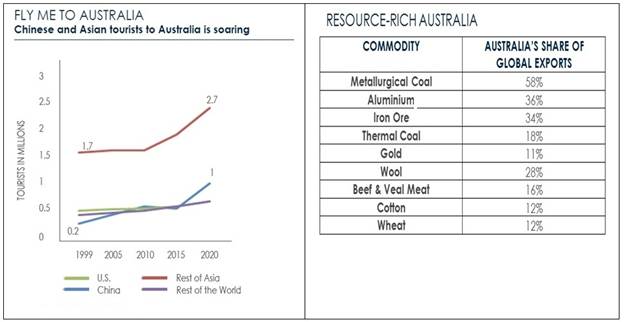
Seven of Australia’s ten largest trading partners are from the Asia Pacific region and China is the largest. In the $24 billion Australian tourism and travel industry, the country counts Asian countries such as Vietnam and Indonesia, along with China and India, as the largest inbound tourist nations. Australia estimates that over the next two decades, potential travelers from Asia will number close to 540 million and Australia will attract a significant number of these visitors.
Source: Australia in the Asian Century White Paper
And, with the charm of Europe waning, many Asian citizens look to Australia for a prosperous life. At a time when many of the world’s developed countries are actively discouraging migrants in the wake of slowing growth and a backlash against immigrants at home, Australia is welcoming immigrants with open arms. Again, seven of the top ten migrants to Australia are from Asia, with India leading the pack. In its policy paper “Australia in the Asian Century,” the country emphasized a series of measures aimed at deepening ties with five priority nations including India, China, Indonesia, Japan and South Korea.
To build its strengths with Asia, the policy document identified five key areas of needed improvement: skills and education, innovation, infrastructure, communication, and the tax system.
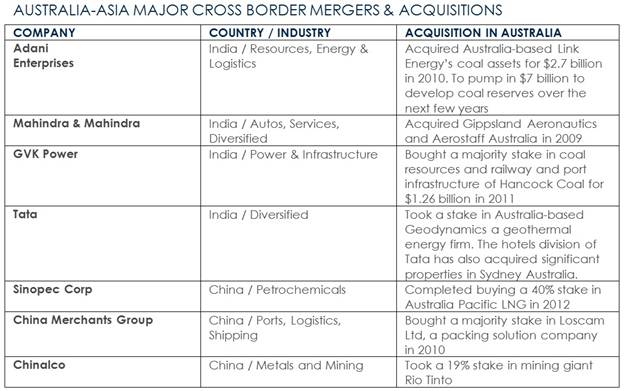
AUSTRALIA HAS AS MUCH TO OFFER ASIA AS IT CAN GET BACK FROM ASIA
While Australia is opening up its minerals and mining industrial resources to Asian companies, in turn, Australian companies from the consumer staples and services industries are increasingly trying to benefit from a rapidly urbanizing Asia. Australia plans to increase its trade with Asia to 33 percent of its GDP by 2025 compared to 25 percent currently.
FORWARD LOOKING STATEMENTS
Certain statements made in this article may be forward looking. Actual future results or occurrences may differ significantly from those anticipated in any forward looking statements due to numerous factors. Thomas White International, Ltd. undertakes no responsibility to update publicly or revise any forward looking statements.
© Thomas White International