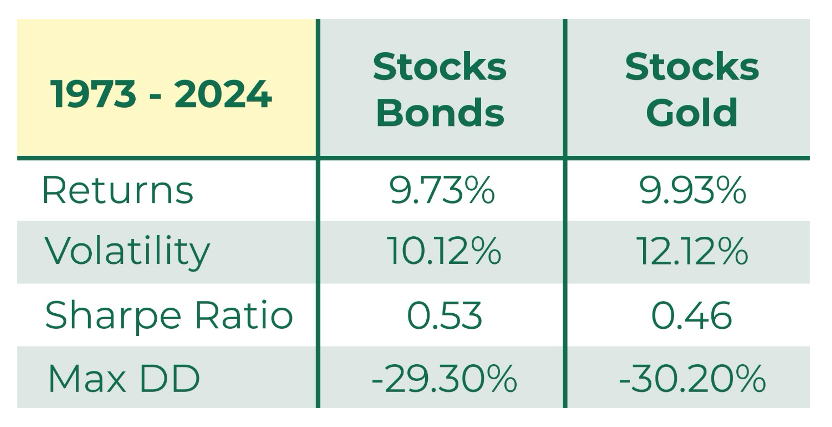
For decades, the 60/40 portfolio—60% equities and 40% bonds—has been the backbone of traditional investing. It’s simple, time-tested, and grounded in one key assumption: when equities fall, bonds rise. That inverse correlation has been the safety net investors count on to reduce volatility and preserve capital.
But what happens when the safety net starts to fray?
Recent data suggests that the historical negative correlation between stocks and bonds is weakening. According to research from AQR and Barclays, the long-standing relationship that helped define risk management and asset allocation isn’t as reliable during periods when inflation surges.
This is more than just a statistical quirk. If stocks and bonds start moving together, the very foundation of the 60/40 model collapses. Investment Magazine recently highlighted that shocks to both stocks and bonds are prompting institutional investors to rethink their core allocations.
So, what’s next?
Some investors are turning to an asset that’s stood the test of time: gold.
Gold vs bonds: What the data says
Skeptics often say gold doesn’t belong in a serious portfolio because it doesn’t produce income. But some professional investors look at gold not just as a doomsday hedge.
Meb Faber and Bob Elliott show something surprising: historical portfolios that swap gold for bonds not only maintain risk-adjusted performance, they improve it. Over multi-decade periods, gold has shown a similar (and in some cases superior) ability to preserve capital and deliver returns compared to bonds.

And unlike bonds, which may be vulnerable to inflation and rising interest rates, gold has no counterparty risk, no maturity date, and no central bank manipulating its yield curve.
We’re not saying bonds don’t have a place in any portfolio—we're saying gold has a place too.
Still, many institutional investors remain hesitant. Why?
Part of the answer is psychological inertia—bonds have always been the default. But there’s also a practical concern: gold doesn’t pay interest. Bonds do. And institutional portfolios rely on income to meet their obligations and liabilities.
But that last objection is becoming obsolete.
The rise of gold fixed income opportunities
What if your gold allocation didn’t just sit in a vault, silently absorbing storage costs?
What if your gold earned a yield—paid in gold?
That’s not a hypothetical. That’s what Monetary Metals does.
By leasing gold to pre-qualified companies that need it for inventory or work-in-progress, or by lending it to qualified borrowers that amortize the gold bonds, you can now earn income on your gold holdings. And that income isn’t paid in dollars, it’s paid in more gold.
This changes the equation entirely. Investors no longer have to choose between either holding a yieldless safe haven asset or navigating the bond market. With gold fixed income you can own an asset that’s trusted for its stability and durability-- and earn a yield on it.
In short, you can replace your dollar fixed income with gold fixed income.
Our white paper, The Case for Gold Yield in Investment Portfolios, explores this idea in detail—backed by data-driven analysis, portfolio modeling, and professional asset allocation frameworks.
A new era for diversified portfolios
With inflation still eating away at fixed-income returns and threatening the once-reliable stock/bond inverse correlation, it may be time to update your portfolio playbook.
Many investors are reallocating away from over financialized assets and returning to real world assets that deliver compelling returns and income.
Gold alone can supplement bonds in terms of diversification and long-term capital preservation. But gold with yield? That’s a different paradigm altogether.
Ready to rethink your portfolio?
Download our white paper to explore the numbers behind this analysis in greater detail, and see how gold—and more importantly, gold yield—can enhance your portfolio in today’s uncertain market. Download the White Paper
A message from Advisor Perspectives and VettaFi: To learn more about this and other topics, check out some of our webcasts.
© MonetaryMetals
Read more commentaries by MonetaryMetals