Value Vantage Point: Why Currency Diversification Matters
Membership required
Membership is now required to use this feature. To learn more:
View Membership BenefitsMany US investors are overweight US equities, making them also overweight US-dollar exposure. Given recent international equity market outperformance versus US equities as well as a weakening greenback, could it be time to reconsider that asset mix? We think diversifying makes sense, particularly given the US-dollar headwinds from a potential increase in US debt-to-GDP (gross domestic product), lower interest rates, fading US exceptionalism and the strengthening of non-US economies such as Europe and Japan. These factors could reverse both the long-term strength of the US dollar and US outperformance trend, leaving behind the undiversified.
The US market: It’s more concentrated than you think
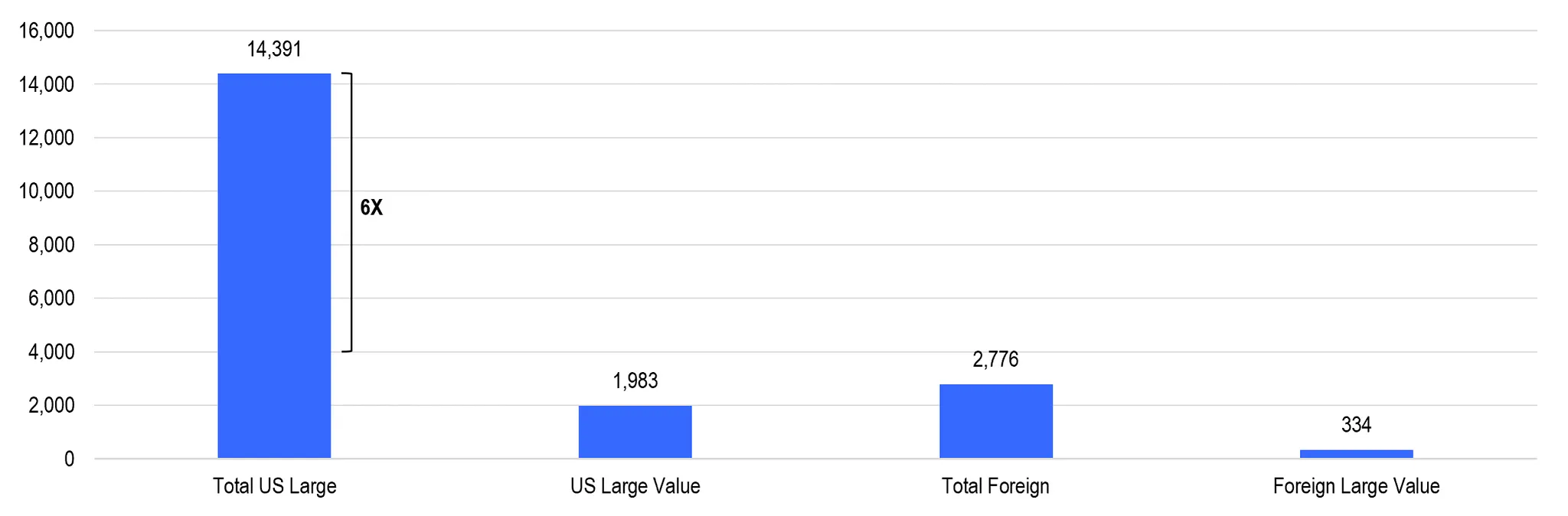
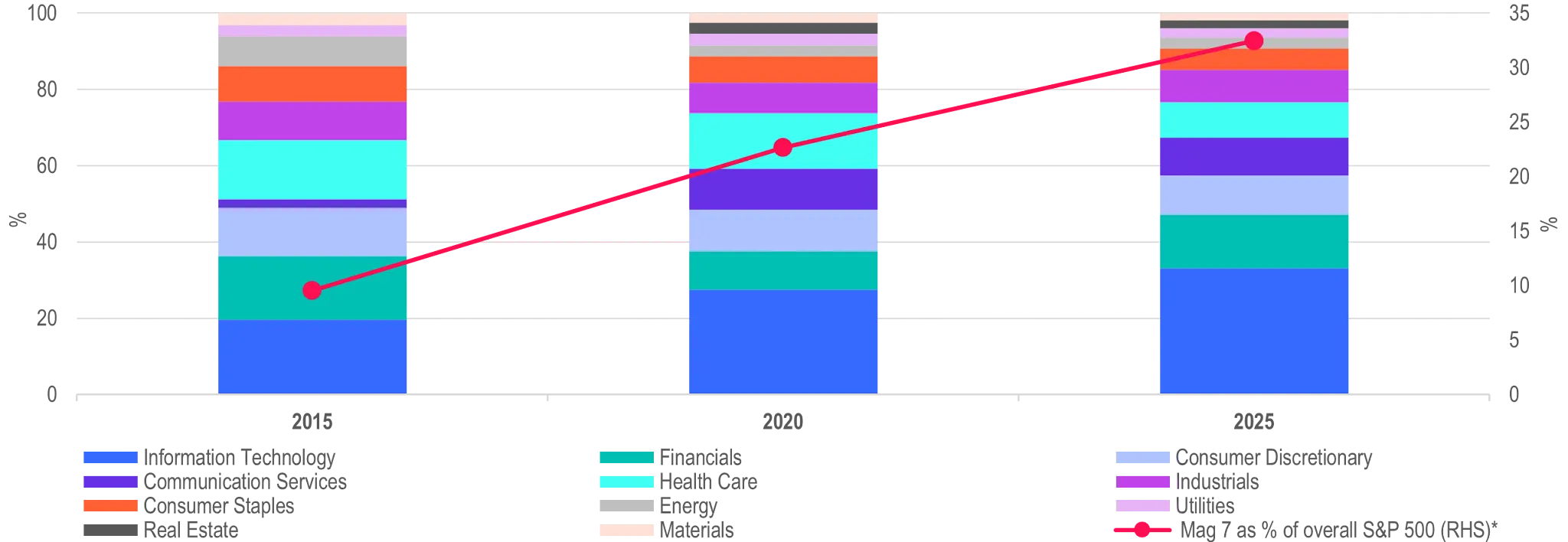
It’s no secret that US investors love US companies. In the United States, people have more than six times as much money invested in US names than in those domiciled overseas (Exhibit 1). As money has poured into large-capitalization companies, the S&P 500 Index has become increasingly concentrated in information technology companies, with the Magnificent Seven1 big-tech names growing their share to a third of the overall index (Exhibit 2). This concentration creates a lot of risk exposure to both the domestic business cycle and the US dollar (USD).
Exhibit 1: Investors Are Grossly Overweight US Large Cap...
Assets by Morningstar Category (USD billions) as of June 30, 2025
Source: Morningstar.
Exhibit 2: ...And Increasingly Concentrated in Technology and Mag Seven Holdings
S&P 500 GICS Sector Weights. June 2015 vs. June 2020 vs. June 2025
Sources: FactSet, S&P Dow Jones Industries. Indexes are unmanaged and one cannot directly invest in them. They do not include fees, expenses or sales charges.
Currency diversification casts a wider net for performance gains
In addition to country exposure, we believe diversifying by currency exposure is important. The greenback does not weaken in a vacuum and has an inverse relationship with other currencies, like the euro or Japanese yen—when the dollar weakens, the other currency strengthens. Owning something that is falling in value, while owning something else that is increasing in value, can smooth out the overall return of the portfolio over time.
Furthermore, equity returns have multiple components, including changes in asset price and underlying currency valuation. When the euro strengthens, for example, it can bolster euro-denominated equity prices. Diversifying away from US-based, dollar-denominated investments into non-US, local-currency investments not only can broaden country exposure but also help capture the currency component of total return.
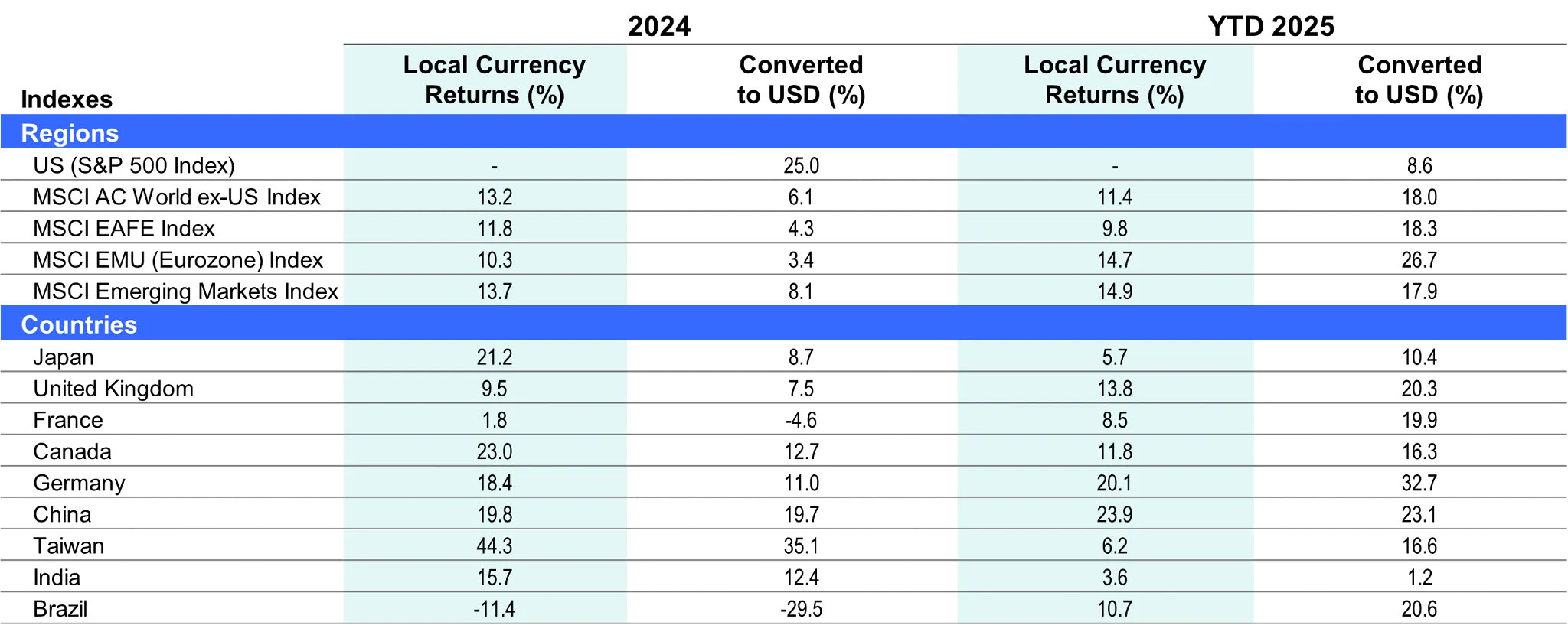
As shown in Exhibit 3, when the dollar was stronger in 2024, currency effects reduced returns in non-US-dollar denominated markets. Year-to-date (YTD) 2025, a weakening US dollar has reversed that trend, giving non-US, local-currency returns a boost.
Exhibit 3: Local-Currency Returns Can Vary Widely from USD Returns
Total Performance by Region and Country as of July 31, 2025
Sources: FactSet, MSCI Indexes, S&P Dow Jones Industries. Past performance is not an indicator or a guarantee of future performance. Indexes are unmanaged and one cannot invest directly in an index. Important data provider notices and terms available at www.franklintempletondatasources.com.
Our cyclicality, ourselves: US outperformance historically coincides with a strong US dollar
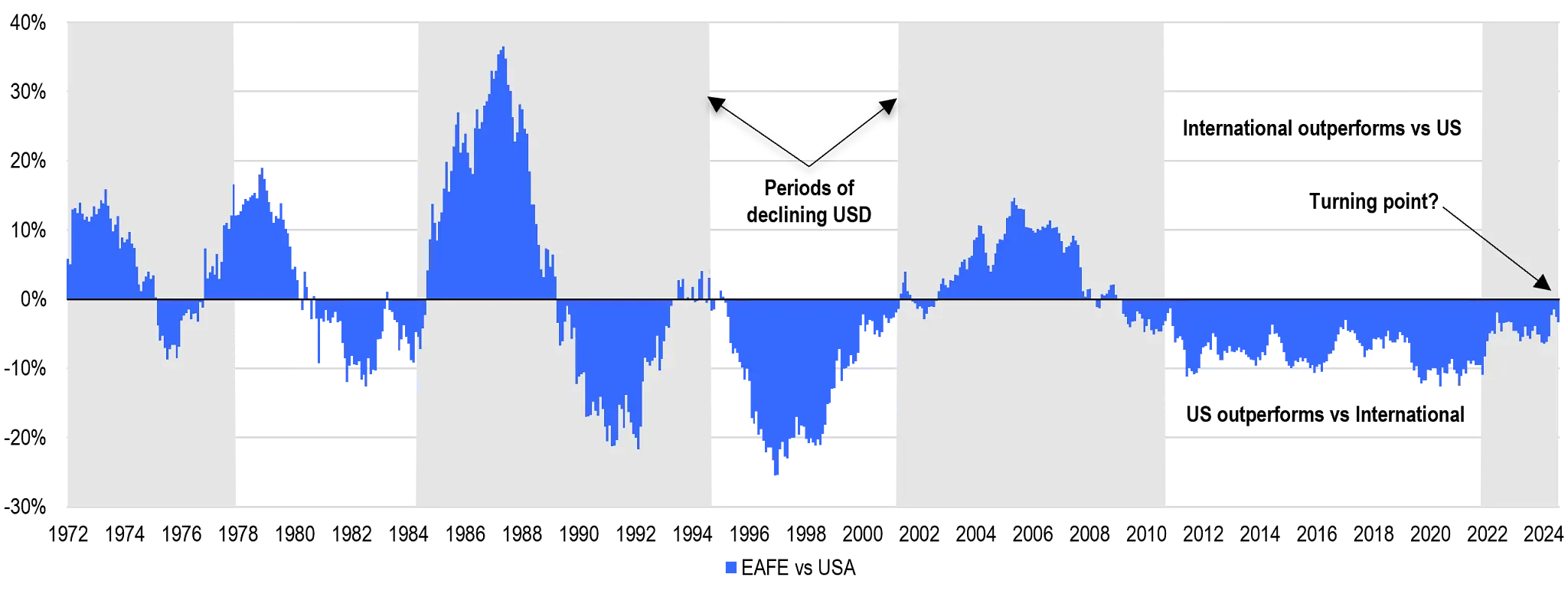
Whether or not you are bearish the US dollar, given its cyclicality, we think it is good to stay diversified regardless of the environment. US-dollar strength and related US equity market outperformance both tend to be cyclical, and top-performing equity markets are found across the globe. As shown in Exhibit 4, cycles of US equity outperformance come and go and have been closely related to periods of US-dollar strength. Because these cycles are difficult to predict, we believe maintaining global diversification is a prudent strategy. In our opinion, rather than trying to time currency or market movements, investors may benefit from maintaining broad positioning across countries and currencies.
Exhibit 4: US Underperformance Can Coincide with US-Dollar Weakness
MSCI EAFE Index vs. MSCI USA Index
Three-Year Rolling Excess Returns Annualized Returns for Periods Ending June 30, 2025
Sources: FactSet, MSCI. Returns in base currency. Gray shaded areas indicated periods of weakening USD. Past performance is not an indicator or a guarantee of future performance. Indexes are unmanaged and one cannot invest directly in an index. Important data provider notices and terms available at www.franklintempletondatasources.com.
A ”weaken”ings: sources of downward pressure for the US dollar
A sense of US exceptionalism, and possibly recency bias, has convinced some investors that the last decade of US-dollar strength can continue indefinitely. However, we believe the environment is changing. The US dollar has weakened versus the euro and yen for much of 2025 (Exhibit 5). Capital flows into the United States have been slowing, and demand for US dollars has fallen due to rising debt levels, the possibility for lower interest rates and a more unpredictable business and regulatory environment.
Exhibit 5: The US Dollar Has Weakened Versus Other Major Currencies YTD
USD/JPY and USD/EUR Exchange Rates
January 1, 2018–May 8, 2025
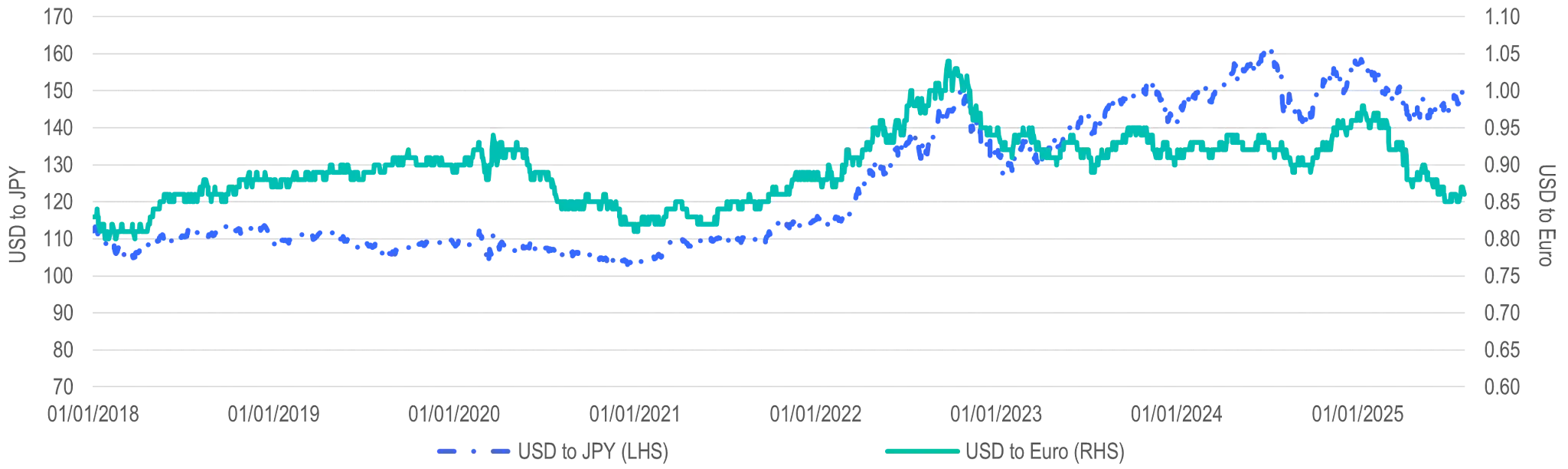
Source: FactSet. Past performance is not an indicator or guarantee of future results.
Most people understand debt-to-income ratios and how a higher ratio can negatively impact one’s credit score. For countries, the equivalent measure is the debt-to-GDP ratio, which reflects national debt relative to economic output. The recent US tax bill includes several provisions which analysts expect to increase US debt-to-GDP. As shown in Exhibit 6, the United States has a higher-than-average debt ratio when compared to other major North American and European economies, and it is projected to increase. As it rises as a percentage of GDP, it signals increased risk, potentially making US debt less attractive to investors.
Exhibit 6: The US National Debt Burden Is Growing
Major Economies’ Government Debt as a Percentage of GDP
March 2020 to 2030 Forecast
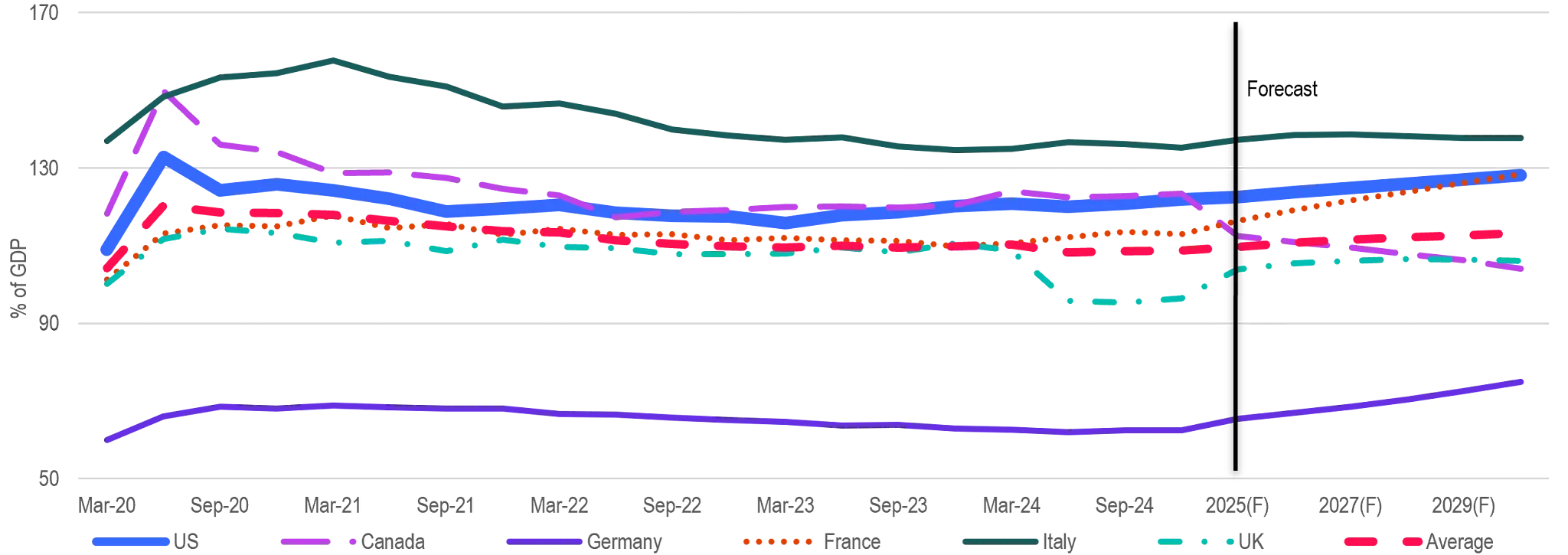
Sources: FactSet, Federal Reserve, US Bureau of Economic Analysis, US Department of the Treasury, Statistics Canada, Deutsche Bundesbank, Statistics France, Eurostat, Office for National Statistics UK. There is no assurance that any estimate, forecast or projection will be realized.
Lower interest rates could also curb demand for the US dollar. Investors generally favor higher rates when investing in cash and debt instruments. If US rates fall below levels that are competitive, it could mean fewer capital inflows and further weakness (Exhibit 7).
Exhibit 7: Lower Interest Rates Can Lead to US-Dollar Weakness

For illustrative purposes only.
In addition to a strong fiscal position, US markets have long benefited from a stable regulatory environment, strong global relationships and robust trading alliances. However, if the United States becomes a less predictable global trading partner, it is possible that demand for US dollars will fall as countries do more trading in other currencies. As participation in global trade falls, the current administration may continue policies aimed at weakening the US dollar in an effort to make US exports more desirable. Furthermore, less faith in both US regulatory institutions and markets could also cut capital inflows. All these factors, either alone or in concert, could put pressure on the US dollar.
Meanwhile, other regions around the world are making efforts to improve their appeal. In Japan, the Tokyo Stock Exchange has been trying to make Japanese companies more investable, which can draw capital and increase demand for the yen. Efforts to increase competitiveness and boost spending on infrastructure and defense in Europe could lead to greater economic growth, further stock price appreciation and a stronger euro.
Currency Diversification to Mitigate US-Dollar Risk
Home-country bias, while it has worked well for US investors in past years, may not always lead to outsized returns. Markets are cyclical, and it is impossible to know when the trend will reverse. Rising US debt loads, lower interest rates, decreased enthusiasm about the United States as an economic partner, and the rising financial strength of other nations could keep downward pressure on the US dollar, in our opinion. Regardless of how the cycle plays out, we believe country and currency diversification are sound ways to mitigate risk should the US dollar continue to fall.
1. The Magnificent Seven comprises Alphabet, Amazon, Apple, Meta, Microsoft, NVIDIA and Tesla.
WHAT ARE THE RISKS?
All investments involve risks, including possible loss of principal.
The investment style may become out of favor, which may have a negative impact on performance.
Equity securities are subject to price fluctuation and possible loss of principal. Small- and mid-cap stocks involve greater risks and volatility than large-cap stocks. There can be no assurance that multi-factor stock selection process will enhance performance. Exposure to such investment factors may detract from performance in some market environments, perhaps for extended periods.
Active management does not ensure gains or protect against market declines.
International investments are subject to special risks, including currency fluctuations and social, economic and political uncertainties, which could increase volatility. These risks are magnified in emerging markets. Investments in companies in a specific country or region may experience greater volatility than those that are more broadly diversified geographically.
Small- and mid-cap stocks involve greater risks and volatility than large-cap stocks.
Investments in companies engaged in mergers, reorganizations or liquidations also involve special risks as pending deals may not be completed on time or on favorable terms. Low-rated, high-yield bonds are subject to greater price volatility, illiquidity and possibility of default.
Dividends may fluctuate and are not guaranteed, and a company may reduce or eliminate its dividend at any time.
WF: 6490186
A message from Advisor Perspectives and VettaFi: To learn more about this and other topics, check out some of our webcasts.
IMPORTANT LEGAL INFORMATION
This material is intended to be of general interest only and should not be construed as individual investment advice or a recommendation or solicitation to buy, sell or hold any security or to adopt any investment strategy. It does not constitute legal or tax advice. This material may not be reproduced, distributed or published without prior written permission from Franklin Templeton.
The views expressed are those of the investment manager and the comments, opinions and analyses are rendered as at publication date and may change without notice. The underlying assumptions and these views are subject to change based on market and other conditions and may differ from other portfolio managers or of the firm as a whole. The information provided in this material is not intended as a complete analysis of every material fact regarding any country, region or market. There is no assurance that any prediction, projection or forecast on the economy, stock market, bond market or the economic trends of the markets will be realized. The value of investments and the income from them can go down as well as up and you may not get back the full amount that you invested. Past performance is not necessarily indicative nor a guarantee of future performance. All investments involve risks, including possible loss of principal.
Any research and analysis contained in this material has been procured by Franklin Templeton for its own purposes and may be acted upon in that connection and, as such, is provided to you incidentally. Data from third party sources may have been used in the preparation of this material and Franklin Templeton ("FT") has not independently verified, validated or audited such data. Although information has been obtained from sources that Franklin Templeton believes to be reliable, no guarantee can be given as to its accuracy and such information may be incomplete or condensed and may be subject to change at any time without notice. The mention of any individual securities should neither constitute nor be construed as a recommendation to purchase, hold or sell any securities, and the information provided regarding such individual securities (if any) is not a sufficient basis upon which to make an investment decision. FT accepts no liability whatsoever for any loss arising from use of this information and reliance upon the comments, opinions and analyses in the material is at the sole discretion of the user.
Franklin Templeton has environmental, social and governance (ESG) capabilities; however, not all strategies or products for a strategy consider “ESG” as part of their investment process.
Products, services and information may not be available in all jurisdictions and are offered outside the U.S. by other FT affiliates and/or their distributors as local laws and regulation permits. Please consult your own financial professional or Franklin Templeton institutional contact for further information on availability of products and services in your jurisdiction.
Issued in the U.S. by Franklin Templeton, One Franklin Parkway, San Mateo, California 94403-1906, (800) DIAL BEN/342-5236, franklintempleton.com. Investments are not FDIC insured; may lose value; and are not bank guaranteed.
You need Adobe Acrobat Reader to view and print PDF documents. Download a free version from Adobe's website.
CFA® and Chartered Financial Analyst® are trademarks owned by CFA Institute.
Membership required
Membership is now required to use this feature. To learn more:
View Membership BenefitsSponsored Content
Upcoming Virtual Events View All