There are many ways to navigate market uncertainty, and pursue both upside participation and some level of downside protection. Options-based approaches such as the Defined Outcome ETF category loom large here, fit for purpose. But there are other strategies, too, that navigate risk in a more quantitative, disciplined approach. These toggle between risk and defensive positioning according to what the data is telling them.
Consider two ETF examples in a category that’s incredibly diverse: HTUS and FCUS.
The team behind the Hull Tactical ETF (HTUS) is expertly quantitative and incredibly prolific in their research, which offers insight into the firm’s approach to markets. In a recent note, questioning a well-known Peter Lynch piece of advice where he calls for sticking with what you know, they offered:
“Good stocks tend to have certain measurable traits: low beta, high value, small size, high quality, strong momentum. There’s a century of research behind these conclusions. Investing in “what you know” might produce the occasional big winner and a nice burst of validation, but investing in robust factors will win in the end. The market rewards discipline, not clairvoyance.”
Perhaps the crucial insight here is the focus on data and, above all else, discipline in approach. Words like repeatable, consistent and robust are often associated with these strategies. These are all defining characteristics of quant ETFs that set out to navigate the market’s ups and downs.
HTUS: A Long/Short Approach
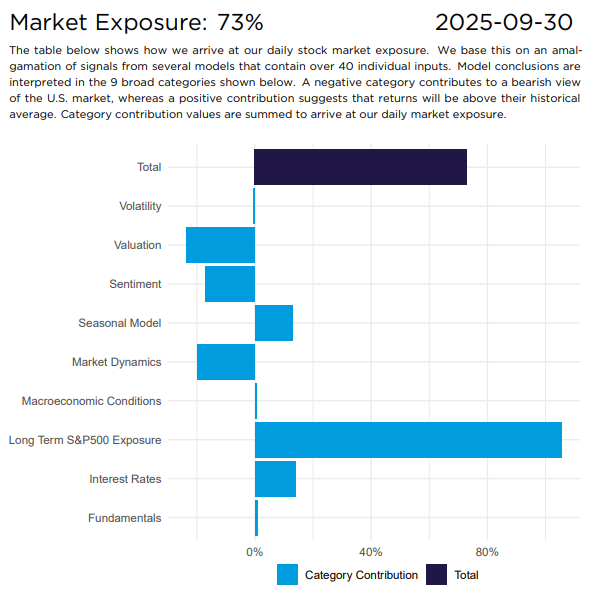
In the case of HTUS, the fund is a hedge-fund-like long/short portfolio. It’s centered on the S&P 500, and adjusts its exposure daily, ranging anywhere from 100% short the index to 200% long, based on a market sentiment score. That score is the output of models inputting between 30 and 40 different signals daily to determine where the S&P 500 is headed next.
Right now, the fund’s “market sentiment meter” is sitting around 73, which translates into “mildly bullish” on the market, as measured by the S&P 500. (You can read more about the strategy here.)

Source: Hull Tactical
Below, we see a glimpse into what a 73% sentiment score translates into from a market exposure perspective. HTUS is up about 10% year-to-date.
Source: Hull Tactical
FCUS: Toggling Between Equities & Bonds
Another quant strategy approach is the type that toggles between equities, Treasuries, and cash equivalents in order to manage downside risk. The Pinnacle Focus Opportunities ETF (FCUS) is an example.
FCUS begins by fishing in a big stock pond, looking at the top 1,000 U.S. companies. From that broad universe, it narrows selection to 30 names based on momentum, relative strength and earnings criteria. The methodology then applies two different algorithms to identify market risk on a monthly basis.
The methodology dictates the following:
- If both algos signal positive, the ETF holds all 30 names, delivering 100% exposure to risk assets.
- If the signals are mixed, 25% of the portfolio gets allocated to Treasuries, cash or bond ETFs.
- If both signals are negative, FCUS becomes a 50-50 basket: 50% equities, 50% bonds.
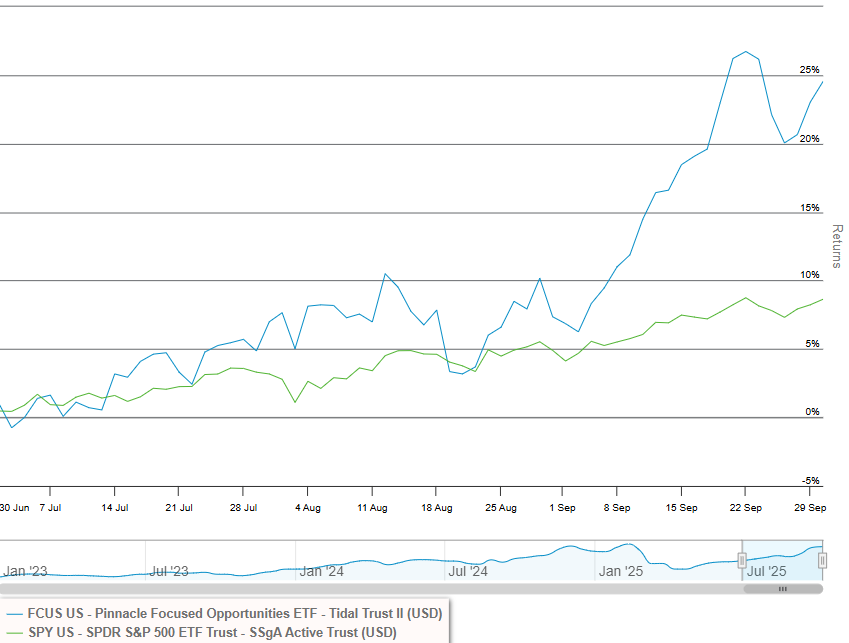
In the last quarter, FCUS has delivered double-digit returns, navigating risk and protection well, relative to the S&P 500 (as measured by SPY). In the past 12 months, FCUS is up 21%, outpacing the 18% gains of the S&P 500 in the same period.
3-Month Performance Chart
Source: VettaFi PRO
While just two ETF examples of different ways of navigating market risk, these funds illustrate the value proposition of a quantitative approach where discipline and a data-driven methodology drives outcomes.
As market uncertainty remains one of the year’s hottest themes, and the news cycle continues to throw curve balls at investors — i.e., a government shutdown this week — exploring ways to grow as well as to protect capital is good investing practice. And ETFs offer myriad strategies and many sharp tools with which to achieve the outcome you seek.
To dive deeper, start at etfdb.com. And let us know if we can help with your research!
VettaFi is the index provider for FCUS, for which it receives an index licensing fee. However, FCUS is not issued, sponsored, endorsed, or sold by VettaFi. VettaFi and its affiliates have no obligation or liability in connection with the issuance, administration, marketing, or trading of FCUS.
For more news, information, and strategy, visit ETF Trends.
A message from Advisor Perspectives and VettaFi: Discover something new! Click here to register for our upcoming webcasts.
More Specialty Investments Topics >