The Federal Reserve’s (Fed) balance sheet runoff — commonly referred to as quantitative tightening (QT) — is set to conclude on December 1. Since initiating QT, the Fed has reduced its balance sheet by over $2 trillion, largely through the drawdown of its overnight reverse repo program (O/N RRP). However, recent volatility in short-term funding markets prompted the Fed to end the program earlier than anticipated. However, the end of QT doesn’t spell the beginning of quantitative easing (QE). At least not yet.
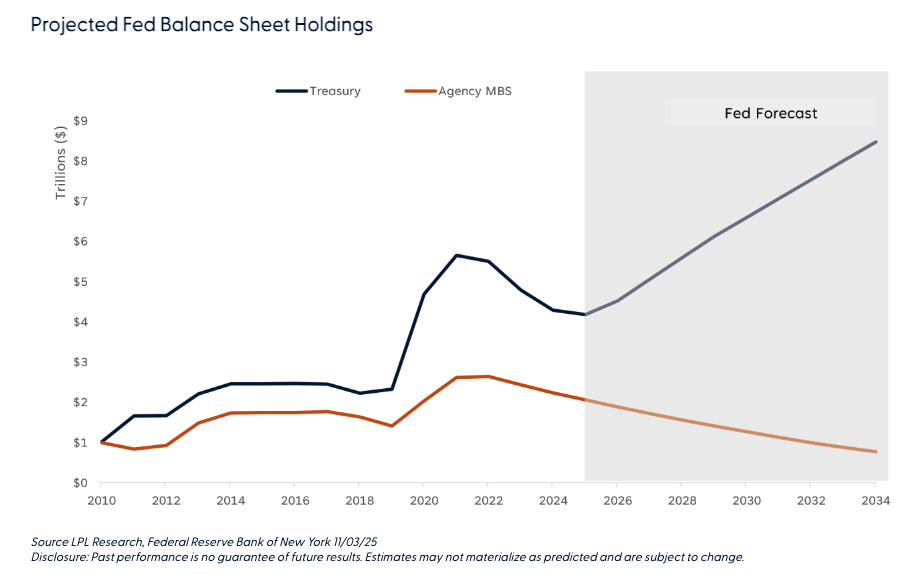
Looking ahead, the Fed has outlined its strategy for balance sheet management in the New York Fed’s Annual Report on Market Operations. The report suggests the balance sheet, once QT has ended, could resume expanding, primarily driven by organic growth in reserve demand and currency in circulation. Importantly, the Fed anticipates that its balance sheet will eventually exceed prior peak levels, a shift that could provide support for risk assets by increasing system-wide liquidity.

While the Fed loosely ties reserve demand to gross domestic product (GDP), this approach overlooks the regulatory nature of reserve requirements. Banks must hold reserves to meet capital and liquidity standards, and as the financial system grows, so too does the need for reserves. This dynamic suggests that reserve demand is more structural than cyclical and will likely continue to rise even in a low-growth environment.
Another notable shift is the Fed’s intention to transition toward a portfolio composed almost entirely of Treasury securities. Currently, the Fed holds approximately $4.2 trillion in Treasuries and $2.1 trillion in agency mortgage-backed securities (MBS). Over the next decade, officials aim to reduce MBS holdings from 33% of the portfolio to just 10%. During the maintenance and growth phases, all MBS principal payments will be reinvested into Treasuries, reinforcing this shift.
However, it will likely take years for the Fed’s Treasury holdings to more closely resemble the composition of the broader market. The Fed is notably underweight Treasury bills and significantly overweight in long-duration bonds. Currently, Treasuries with maturities of 10 years or more make up nearly 38% of the Fed’s holdings, compared to just 18% of the outstanding Treasury market. While other sectors are roughly aligned, this imbalance reflects the Fed’s reinvestment strategy and its historical focus on longer-dated securities.
This skew toward the long end of the curve resembles aspects of an “Operation Twist” in terms of duration extension. However, because reinvestments have occurred at auction, the pricing impact has likely been muted. It’s difficult to assume the Treasury would have issued the same volume of long-dated bonds absent Fed demand. More likely, issuance would have been distributed more evenly across the curve.
As mentioned, while QT is ending, MBS will continue to roll off and be replaced by Treasury bills, likely keeping upward pressure on mortgage spreads. Our view on MBS remains constructive but is moderating given tighter spreads.
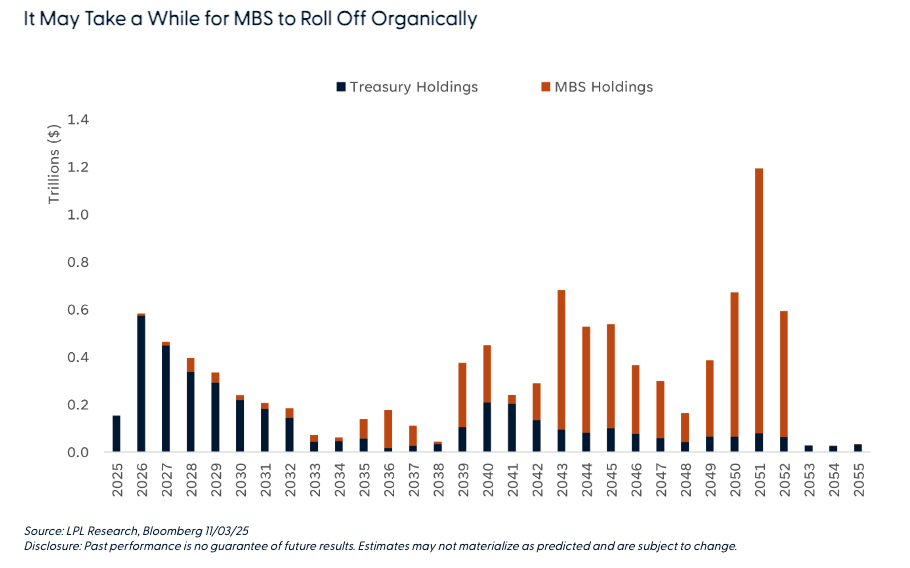
Complicating the Fed’s ability to reduce its MBS holdings is the composition of the portfolio itself. Much of the Fed’s MBS exposure is in longer-dated securities, with a substantial portion maturing in 2051. Given the current level of mortgage rates, prepayment activity has slowed dramatically. To meaningfully reduce these holdings, either mortgage rates would need to fall sharply — encouraging refinancing — or the Fed would need to sell MBS outright. While the Fed has not signaled any intent to sell, this remains a key risk to spreads and market pricing.
Conclusion
As the Fed winds down QT and shifts toward a more Treasury-centric balance sheet, the implications for fixed income markets are marginally net positive, in our view. While the continued roll-off of MBS will likely keep upward pressure on mortgage spreads, eventual balance sheet growth should help support Treasury prices. Moreover, while the Fed’s balance sheet may plateau in the near term, its eventual expansion — driven by reserve demand and currency growth — could reintroduce liquidity into the system in ways that support risk assets. The transition won’t be immediate, and the Fed’s portfolio composition will take years to align more closely with market benchmarks. But, with the conclusion of QT in sight — without a repeat of 2019’s spike in repo rates, which happened the last time the Fed implemented QT — an immediate risk to funding markets has been taken off the table.
Lawrence Gillum, CFA, guides the fixed income view for LPL Financial Research and has over 20 years of investing experience.
A message from Advisor Perspectives and VettaFi: Discover something new! Click here to register for our upcoming webcasts.
Important Disclosures
This material is for general information only and is not intended to provide specific advice or recommendations for any individual. There is no assurance that the views or strategies discussed are suitable for all investors. To determine which investment(s) may be appropriate for you, please consult your financial professional prior to investing.
Investing involves risks including possible loss of principal. No investment strategy or risk management technique can guarantee return or eliminate risk.
Indexes are unmanaged and cannot be invested into directly. Index performance is not indicative of the performance of any investment and does not reflect fees, expenses, or sales charges. All performance referenced is historical and is no guarantee of future results.
This material was prepared by LPL Financial, LLC. All information is believed to be from reliable sources; however LPL Financial makes no representation as to its completeness or accuracy.
Unless otherwise stated LPL Financial and the third party persons and firms mentioned are not affiliates of each other and make no representation with respect to each other. Any company names noted herein are for educational purposes only and not an indication of trading intent or a solicitation of their products or services.
Asset Class Disclosures –
International investing involves special risks such as currency fluctuation and political instability and may not be suitable for all investors. These risks are often heightened for investments in emerging markets.
Bonds are subject to market and interest rate risk if sold prior to maturity.
Municipal bonds are subject and market and interest rate risk and potentially capital gains tax if sold prior to maturity. Interest income may be subject to the alternative minimum tax. Municipal bonds are federally tax-free but other state and local taxes may apply.
Preferred stock dividends are paid at the discretion of the issuing company. Preferred stocks are subject to interest rate and credit risk. They may be subject to a call features.
Alternative investments may not be suitable for all investors and involve special risks such as leveraging the investment, potential adverse market forces, regulatory changes and potentially illiquidity. The strategies employed in the management of alternative investments may accelerate the velocity of potential losses.
Mortgage backed securities are subject to credit, default, prepayment, extension, market and interest rate risk.
High yield/junk bonds (grade BB or below) are below investment grade securities, and are subject to higher interest rate, credit, and liquidity risks than those graded BBB and above. They generally should be part of a diversified portfolio for sophisticated investors.
Precious metal investing involves greater fluctuation and potential for losses.
The fast price swings of commodities will result in significant volatility in an investor's holdings.
This research material has been prepared by LPL Financial LLC.
Not Insured by FDIC/NCUA or Any Other Government Agency | Not Bank/Credit Union Deposits or Obligations | Not Bank/Credit Union Guaranteed | May Lose Value
For Public Use – Tracking: #820454
Read more commentaries by LPL Financial