Key takeaways:
- AI infrastructure spending is accelerating faster than markets expected, with hyperscaler capex forecasts more than doubling since early 2025, driving unprecedented funding requirements.
- Rising tech debt issuance is likely to increase supply pressure, potentially keeping investment grade technology spreads wider than other corporate sectors despite strong underlying company fundamentals.
- This heavy supply may favor allocating to sectors where supply dynamics are more supportive or selectively capturing opportunities in high yield and securitized markets.
Back in November 2025 we warned about the level of capital raising that would be needed to fund the artificial intelligence (AI) buildout and how supply from tech companies – particularly the hyperscalers – was set to reshape the technical picture for corporate credit. While we were right to be cautious, the market, if anything, underestimated the level of tech supply and we argue might still be doing so.
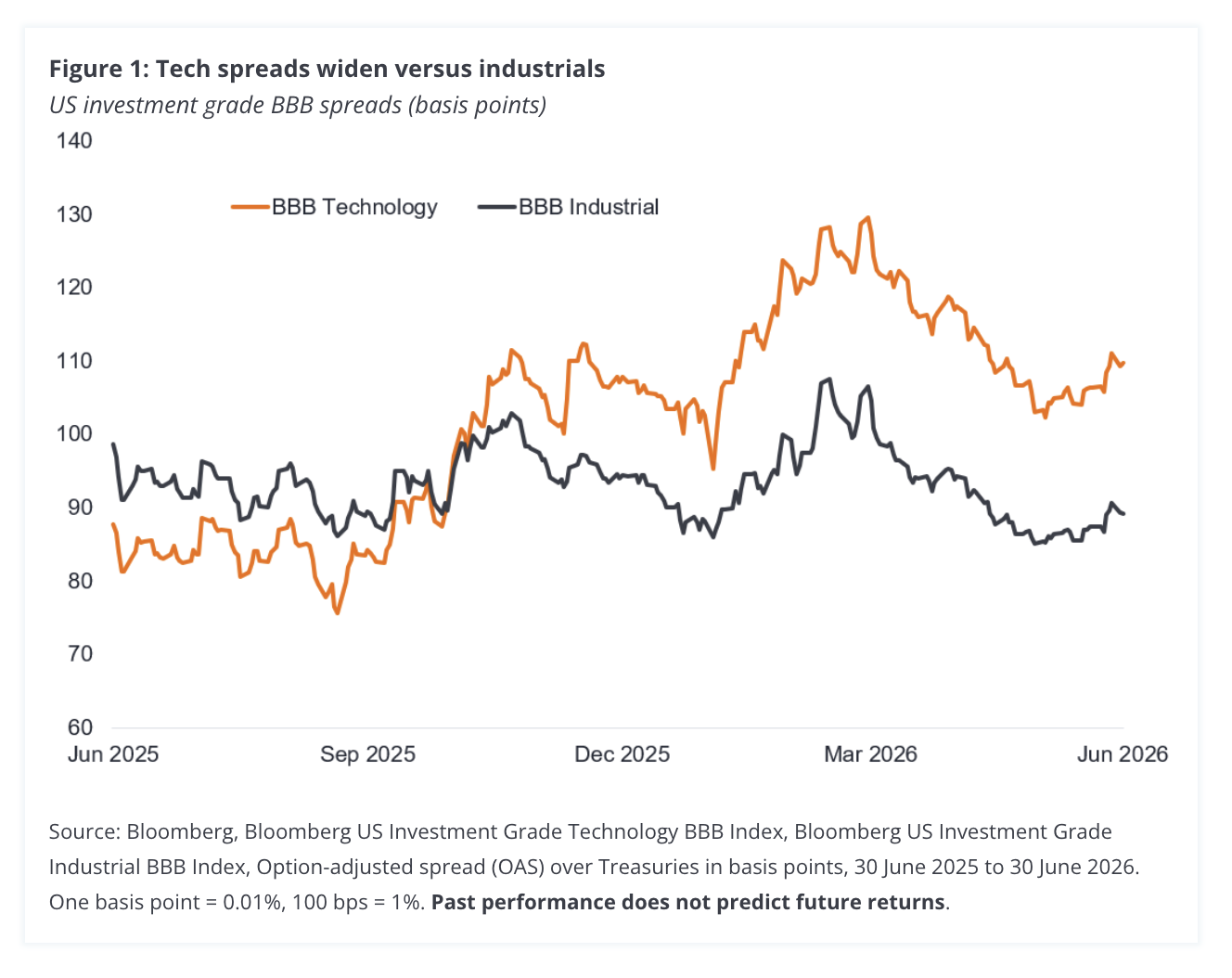
Our caution toward investment grade tech proved to be the right call as spreads on investment grade (IG) industrials have tightened since November while tech has seen a noticeable widening. For example, BBB spreads on tech and industrials were both around 100 basis points back in November, yet tech has gapped 10 basis points wider to end June 2026, while industrials have tightened around the same over that period.

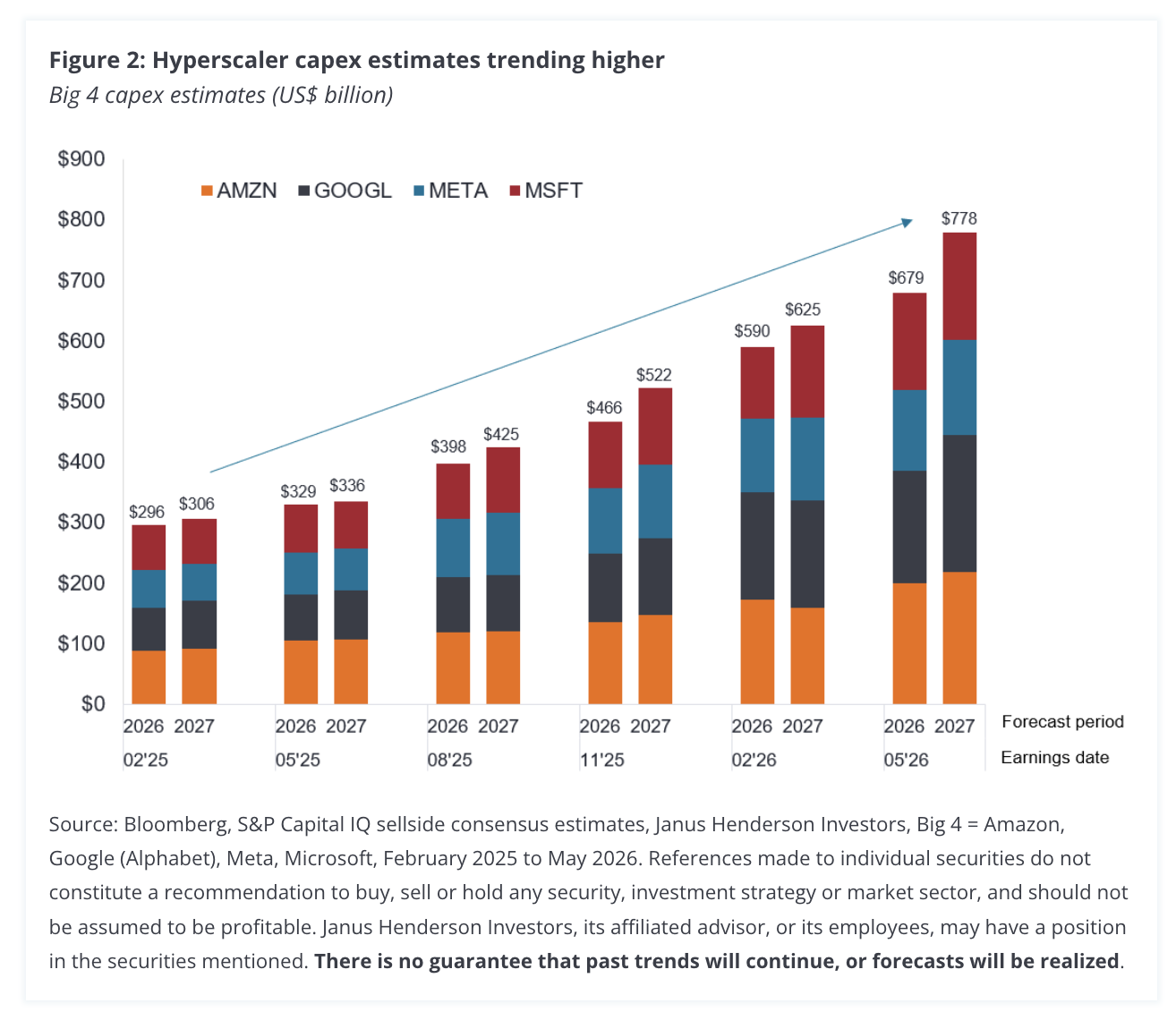
Driving the pressure on tech related spreads has been the sheer scale of capex spending. The following chart reveals how much estimated capex spending projections have risen over the course of the last 18 months. The projections are derived from market estimates around each quarterly earnings period for the Big 4 hyperscalers. Back in February 2025, the market was predicting around US$300 billion in capex in 2026 and 2027. Fast forward to May 2026 and the market is anticipating more than double the level of capex it suggested back in February 2025.
The race to build out AI is unlikely to ease, particularly as some of the questions around payback may begin to fade. One of the big AI companies, Anthropic (only founded as recently as 2021) has seen its revenue balloon and is anticipating moving into quarterly operating profit for the first time, potentially as soon as its next set of results.1 Anthropic is one of several large clients of the hyperscalers, so strong unit economics combined with unprecedented growth at scale should underpin continued demand. More anecdotally, companies are noticing that if they are not using AI they risk being left behind. This is increasing uptake and leading to heavy demand for the level of compute available, particularly as more users use advanced agents rather than simpler chat. Monetising compute is therefore becoming less of a concern, but users are noticing that bills are rising as greater usage outstrips the fall in the cost of tokens (the basic metric of AI input and output). The bottleneck remains available compute, creating demand for the AI buildout.
Organic cash flow can pay for some of the AI capex but even the cash-generative hyperscalers are having to tap capital markets. Barclays reckons the Big 4 hyperscalers together with Oracle, will issue around $240 billion in IG bonds this year alone.2
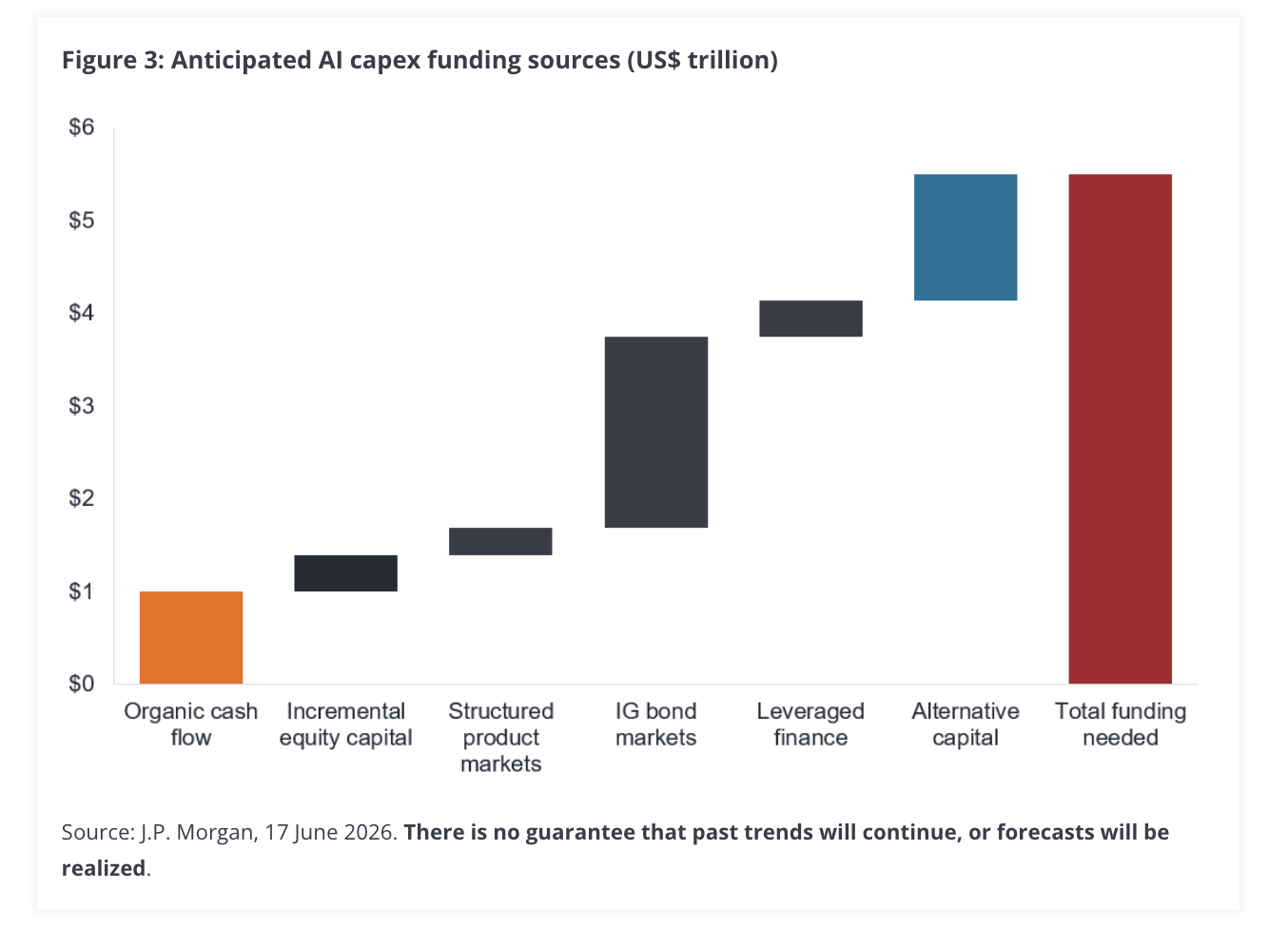
Widening the remit more broadly to cover hyperscalers, data center owners and potential chip financing and J.P. Morgan reckons organic cash flow will represent around one fifth of $5.5 trillion of capex funding over the next five years, with IG bonds needing to fund almost two fifths, around $2.1 trillion, and incremental equity capital around $400 billion. The rest to be made up of funding from leveraged finance, securitized markets and alternative capital.3
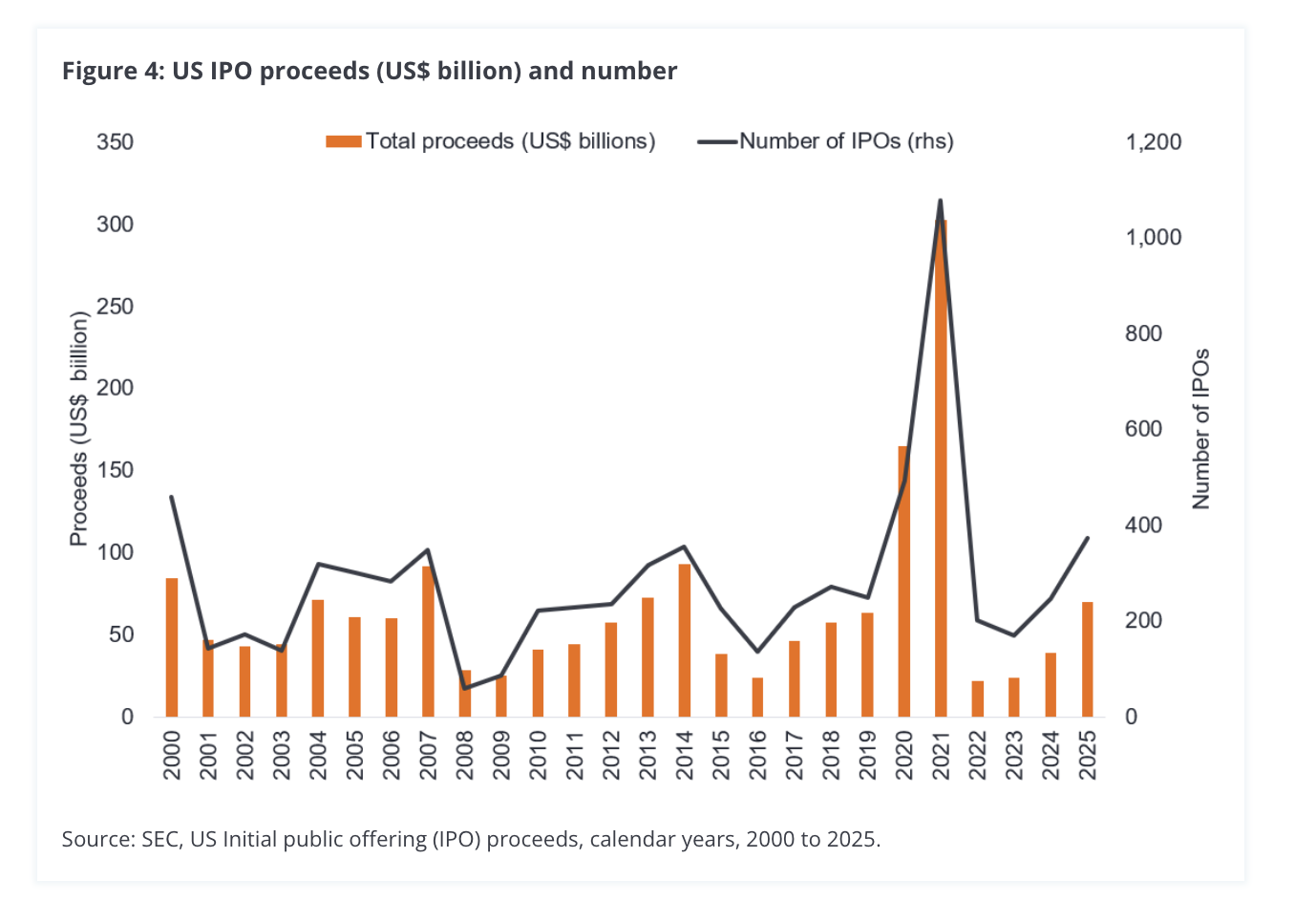
These are all big numbers. The demands on the IG bond market are coming at a time when the US equity market is set to make a bigger call on investors. Many of the hyperscalers are beginning to undo years of carefully manicured capital allocation, with share buybacks now making way for share issues. Amazon alone raised US$85 billion in equity in the first half of 2026.4 Meanwhile, SpaceX raised US$86 billion through its initial public offering (IPO) once over-allotments are included.5 Based on the chart below the SpaceX IPO alone would catapult 2026 into the biggest year for IPO proceeds since 2021. The second half of this year already has potentially huge IPOs from Anthropic and OpenAI (ChatGPT) waiting in the wings, although the latter may delay until 2027.
Credit markets, therefore, are not just competing for attention among fixed income investors but also having to contend with an equity market that is itself looking for historically high levels of funding. And this comes at a time when the US economy is showing signs of a pickup, so demands for working capital increase.
The pressure on companies is reflected in the diversification in funding. Jumbo issues are being denominated in multiple currencies. In some respects, this is helpful because it widens exposure of the AI story to European investors looking for EUR and GBP issues. It is also creating opportunities within high yield and securitized, both directly in AI capex and wider infrastructure and energy requirements. Returning to the earlier point on monetisation, it is possible that some of the high yield-rated projects might get upgraded to investment grade as they near completion – ironically further swelling the proportion of tech within investment grade.
As of 30 June 2026, technology made up ~10% of the US Corporate Index (banking is the highest at ~22%). The US Corp Index is US$7.6 trillion in size, while tech is ~US$767 billion.6 So three years of $250bn+ (on the conservative side) in issuance doubles the technology market and likely pencils to a high-teens percentage of the index, or double where it is today. Investors tend to be wary of sectors that see an explosion of debt (think telecoms or energy in the mid-2010s) and typically demand a premium for lending. While many of larger AI-related borrowers retain enviably strong balance sheets, it is challenging not to envision spreads on IG tech going wider.
1Source: Wall Street Journal “Mind-blowing growth is about to propel anthropic into its first profitable quarter”, 20 May 2026.
2Source: Barclays, 21 May 2026. There is no guarantee that past trends will continue, or forecasts will be realized.
3Source: J.P. Morgan, 17 June 2026. There is no guarantee that past trends will continue, or forecasts will be realized.
4Source: Alphabet press release, 2 June 2026.
5Source: SpaceX press release, 15 June 2026.
6Source: Bloomberg, Bloomberg US Corporate Index, market value weights in US dollars,30 June 2026.
Note: Après-moi, le déluge (After me, the deluge) is a phrase attributed to King Louis XV of France. This phrase of indifference to excess was seen as a portend of the revolution to come.
Fixed income securities are subject to interest rate, inflation, credit and default risk. The bond market is volatile. As interest rates rise, bond prices usually fall, and vice versa. The return of principal is not guaranteed, and prices may decline if an issuer fails to make timely payments or its credit strength weakens.
High-yield or “junk” bonds involve a greater risk of default and price volatility and can experience sudden and sharp price swings.
Securitized products, such as mortgage- and asset-backed securities, are more sensitive to interest rate changes, have extension and prepayment risk, and are subject to more credit, valuation and liquidity risk than other fixed-income securities.
James Donahue is a Credit Analyst at Janus Henderson Investors, a position he has held since 2024.
John Lloyd is Global Head of Multi-Sector Credit at Janus Henderson Investors, a role he has held since 2025.
Mike Talaga is Global Head of Credit Research at Janus Henderson Investors, a position he has held since 2023.
The opinions and views expressed are as of the date published and are subject to change. They are for information purposes only and should not be used or construed as an offer to sell, a solicitation of an offer to buy, or a recommendation to buy, sell or hold any security, investment strategy or market sector. No forecasts can be guaranteed. Opinions and examples are meant as an illustration of broader themes, are not an indication of trading intent and may not reflect the views of others in the organization. It is not intended to indicate or imply that any illustration/example mentioned is now or was ever held in any portfolio. Janus Henderson Group Ltd. through its subsidiaries may manage investment products with a financial interest in securities mentioned herein and any comments should not be construed as a reflection on the past or future profitability. There is no guarantee that the information supplied is accurate, complete, or timely, nor are there any warranties with regards to the results obtained from its use. Past performance is no guarantee of future results. Investing involves risk, including the possible loss of principal and fluctuation of value.
Fixed income securities are subject to interest rate, inflation, credit and default risk. The bond market is volatile. As interest rates rise, bond prices usually fall, and vice versa. The return of principal is not guaranteed, and prices may decline if an issuer fails to make timely payments or its credit strength weakens.
High-yield or "junk" bonds involve a greater risk of default and price volatility and can experience sudden and sharp price swings.
Securitized products, such as mortgage- and asset-backed securities,
Janus Henderson® and any other trademarks used herein are trademarks of Janus Henderson Group Ltd. or one of its subsidiaries. © Janus Henderson Group Ltd.
A message from Advisor Perspectives and VettaFi: Discover something new! Click here to register for our upcoming webcasts.
© Janus Henderson Investors
More Asian/European Markets Topics >