Staying Nimble and Focused on Income as Uncertainty Persists
Membership required
Membership is now required to use this feature. To learn more:
View Membership BenefitsPolicy and Market Uncertainty Remain Central
The US–Iran conflict defined the first half of 2026 as a war in the Middle East erupted, driving an energy shock, reigniting inflationary pressures and forcing central banks globally into a hawkish pivot. This event shaped the macro backdrop for all asset classes.
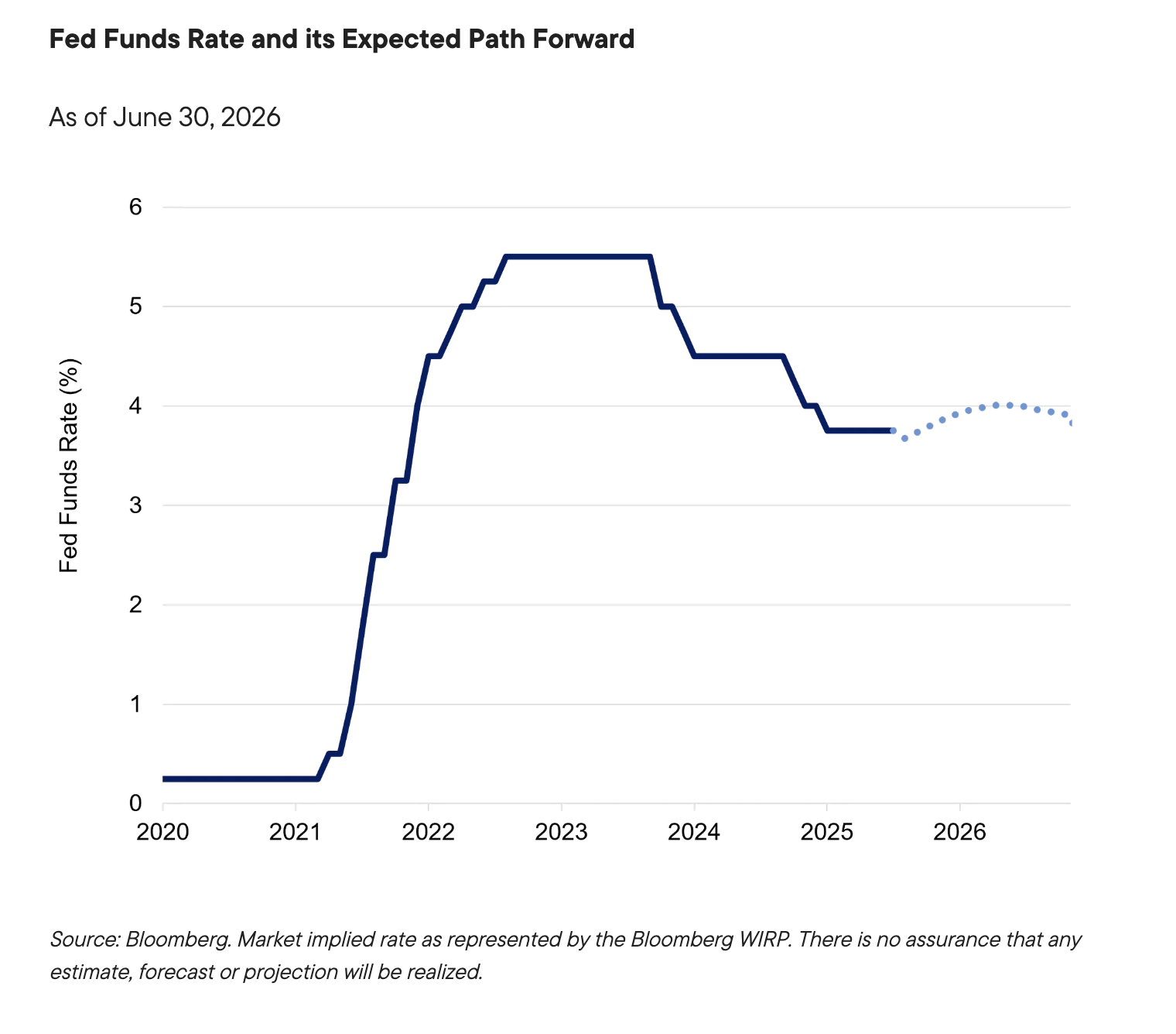
The policy backdrop has been an important driver of sentiment, and Federal Reserve (Fed) expectations have moved meaningfully during the year. Markets at times have shifted from expectations for rate cuts to concerns that policy may remain restrictive for longer. In our view, some of these swings reflected short-term market reactions rather than durable changes in the economic outlook.
New Fed Chair Kevin Warsh signaled a move toward a more data-dependent policy framework and reduced forward guidance. With markets accustomed to central-bank signposts for over two decades, this shift may amplify sensitivity across risk assets as investors recalibrate.
Higher Yields Support Income, but Spreads Demand Selectivity
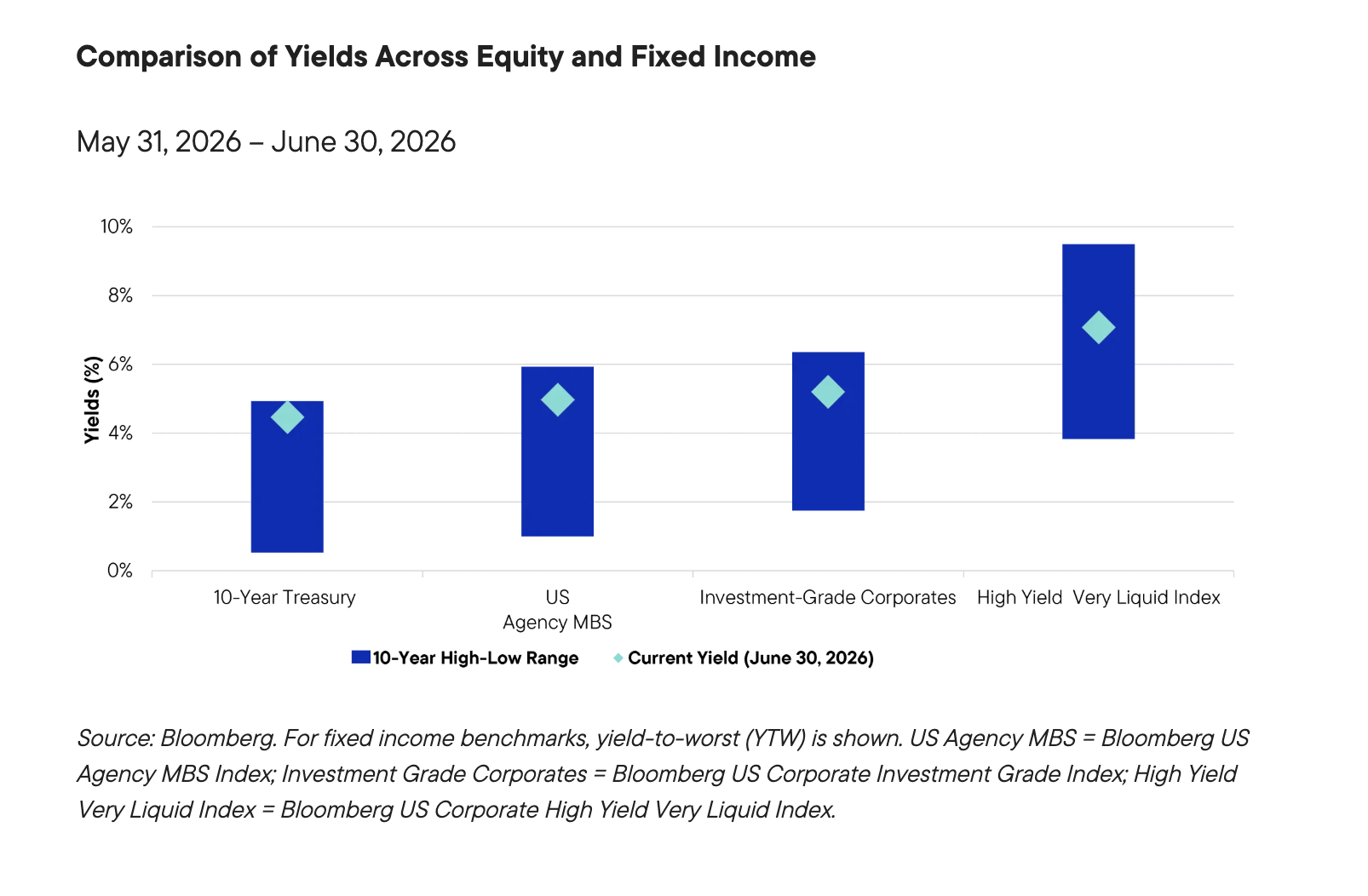
In fixed income, we continue to view the opportunity primarily through the lens of carry and income return rather than broad-based total return. Yields remain attractive relative to history, but tight credit spreads leave less room for error, making selectivity important.
We have maintained a relatively short-duration posture and continued to emphasize income, quality and careful security selection. Within high yield, we continue to favor bonds of public companies where we believe there is the potential for better visibility for leverage and interest coverage ratio, while benefiting from public equity market capitalization.
A steeper yield curve and a somewhat higher 10-year Treasury yield could create more attractive opportunities for income investors, but for now we expect rates to remain relatively range-bound.
See more: Understanding Client Fear — How Advisors Can Foster Confidence in Uncertain Times
Looking Beyond Narrow Equity Leadership
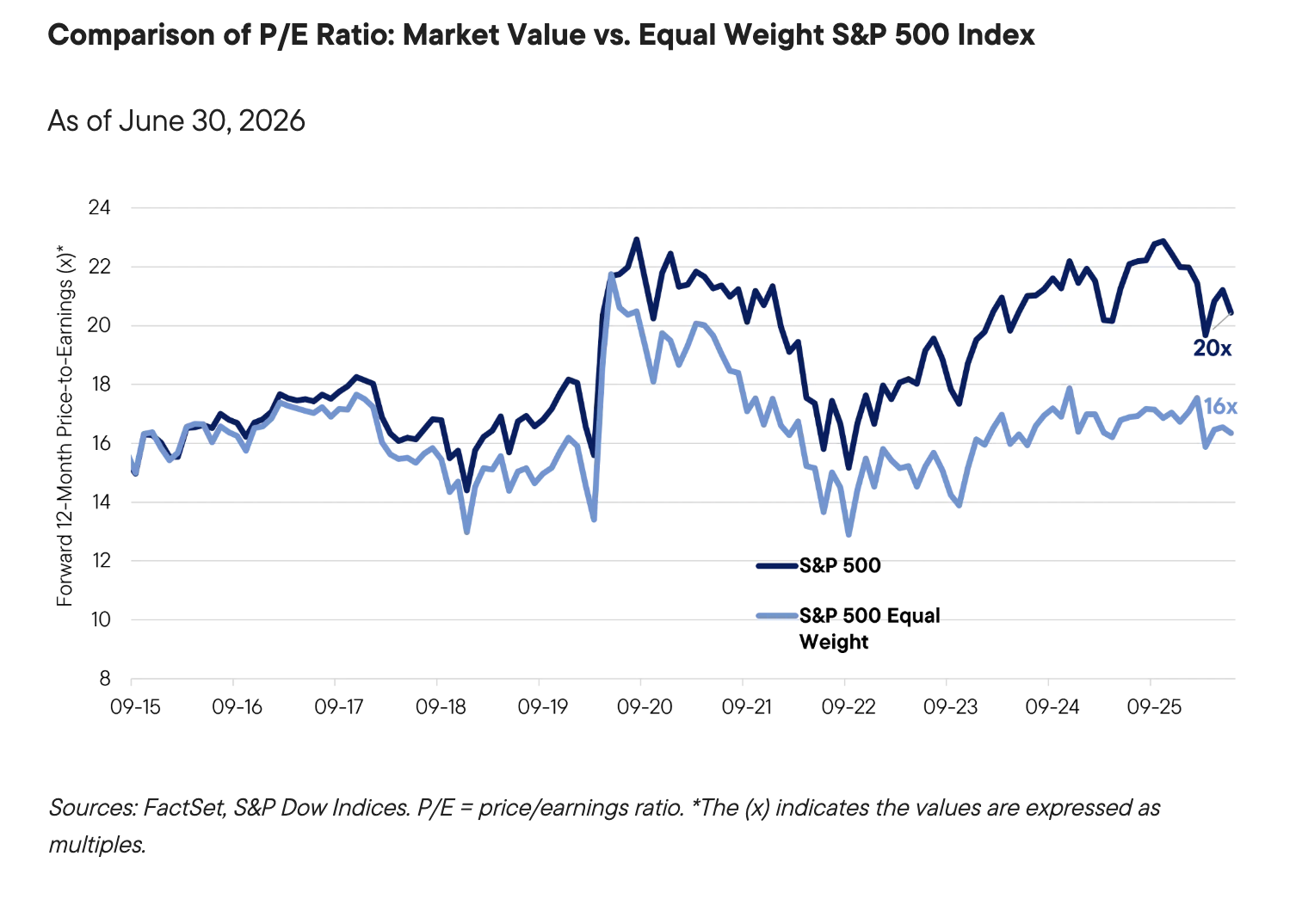
US equities entered the second half of 2026 on constructive footing after a strong start to the year. Earnings growth has been a key driver of returns, helping offset some valuation compression even as parts of the market appear fairly full-valued. Broadening participation, continued earnings momentum and a resilient macro backdrop suggest the overall health of the equity market remains sound, though selectivity is increasingly important.
Artificial intelligence (AI) remains a powerful theme, but the implications of the AI investment cycle extend beyond technology. The historic semiconductor rally has been a major driver of market leadership, and any shift in expectations around AI infrastructure spending could have meaningful implications for broader equity performance.
At the same time, we are also finding opportunities in more traditional areas, including utilities, financials and energy. The second-quarter earnings season will be an important test. We will be watching to see whether earnings strength broadens across sectors or begins to stall in areas where expectations have moved meaningfully higher.
Turning Volatility into Opportunity
The March equity market selloff and subsequent recovery demonstrated that dislocations created by geopolitical shocks can create attractive entry points. This highlights how our ability to stay nimble with asset allocation allows us to respond when parts of the market dislocate.
In our view, elevated implied volatility can create opportunities through equity-linked notes and other structured investments, where we may be able to capitalize on attractive income, improved terms or better upside participation.
Key Risks to Be Aware of
A key risk we are watching in the second half of 2026 is the scale and pace of capital expenditures (capex), particularly around AI infrastructure. Data center and large infrastructure projects are drawing on similar resources and competing for capital at the same time, creating the potential for bottlenecks as companies pursue massive buildouts.
The key questions are where capex goes from here, when it peaks and how much financing the market will need to absorb. Material delays in AI infrastructure projects, or a slowdown in spending plans, could create volatility risk for markets.
These investment plans may have important implications beyond the current cycle, which is why we believe it is important to assess the risks before they become more visible in market pricing.
Looking Forward
In our view, today’s uncertain market environment reinforces the importance of maintaining a long-term perspective. As companies seek significant financing for AI infrastructure and other large-scale projects, we believe providers of capital can remain patient. The competition for capital may create opportunities, but discipline will be important as investors evaluate the durability of cash flows, the timing of returns and the risks tied to execution.
Staying nimble with asset allocation and diversified across sectors remains important, particularly in an environment shaped by policy uncertainty, range-bound rates, AI-related investment and periodic market dislocations.
Indexes and Terms
Bloomberg US Agency MBS Index: Tracks fixed‑rate agency mortgage‑backed pass‑through securities guaranteed by the U.S. government agencies Ginnie Mae, Fannie Mae and Freddie Mac.
Bloomberg US Corporate High Yield Very Liquid Index: Tracks a more liquid segment of the US-dollar denominated, below-investment-grade, fixed-rate corporate bond market.
Bloomberg US Corporate Investment Grade Index: Tracks the performance of the investment-grade, fixed-rate, taxable corporate bond market in US dollars.
Capital expenditure (capex): Funds that companies spend to acquire, upgrade or maintain physical assets, such as buildings, technology or equipment, with the purpose of maintaining or growing future operations.
Carry: Refers to a differential in interest rates across sectors, such that tactical profits could be generated by trading between them.
Duration: A measure of how much a bond’s price changes relative to changes in interest rates.
Equity-linked notes combine fixed-income investments with potential returns linked to the performance of equities.
Fed funds (FF) rate: The interest rate that depository institutions such as banks charge other institutions for holding overnight reserves.
Price/earnings (PE) ratio: The P/E ratio is a stock's (or index’s) price divided by its earnings per share (or index earnings). The forward P/E ratio is a stock’s (or index’s) current price divided by its estimated earnings per share (or estimated index earnings), usually one year ahead.
S&P 500® Index (SPX): A market capitalization-weighted index of 500 stocks, a measure of broad US equity market performance.
S&P 500 Equal Weight Index (EWI): The equal-weight version of the S&P 500 Index. The index includes the same constituents as the capitalization weighted S&P 500, but each company is allocated a fixed weight, or 0.2% of the index total, at each quarterly rebalance.
Yield spreads/tights: Spreads are the difference between yields on differing debt instruments of varying maturities, credit ratings, issuers or risk levels. “Tights” in reference to spreads indicates small differences in yields.
Yield-to-worst: The lowest potential yield that can be received on a bond without the issuer actually defaulting.
WHAT ARE THE RISKS?
All investments involve risks, including possible loss of principal. Indexes are unmanaged and one cannot directly invest in them. They do not include fees, expenses or sales charges.
The allocation of assets among different strategies, asset classes and investments may not prove beneficial or produce desired results.
Diversification does not guarantee a profit or protect against a loss.
Equity securities are subject to price fluctuation and possible loss of principal. Investments in equity-linked notes often have risks similar to their underlying securities, which could include management risk, market risk and, as applicable, foreign securities and currency risks.
Fixed income securities involve interest rate, credit, inflation and reinvestment risks, and possible loss of principal. As interest rates rise, the value of fixed income securities falls. Low-rated, high-yield bonds are subject to greater price volatility, illiquidity and possibility of default.
WF: 11562911
IMPORTANT LEGAL INFORMATION
This material is intended to be of general interest only and should not be construed as individual investment advice or a recommendation or solicitation to buy, sell or hold any security or to adopt any investment strategy. It does not constitute legal or tax advice. This material may not be reproduced, distributed or published without prior written permission from Franklin Templeton.
The views expressed are those of the investment manager and the comments, opinions and analyses are rendered as at publication date and may change without notice. The underlying assumptions and these views are subject to change based on market and other conditions and may differ from other portfolio managers or of the firm as a whole. The information provided in this material is not intended as a complete analysis of every material fact regarding any country, region or market. There is no assurance that any prediction, projection or forecast on the economy, stock market, bond market or the economic trends of the markets will be realized. The value of investments and the income from them can go down as well as up and you may not get back the full amount that you invested. Past performance is not necessarily indicative nor a guarantee of future performance. All investments involve risks, including possible loss of principal.
Any research and analysis contained in this material has been procured by Franklin Templeton for its own purposes and may be acted upon in that connection and, as such, is provided to you incidentally. Data from third party sources may have been used in the preparation of this material and Franklin Templeton ("FT") has not independently verified, validated or audited such data. Although information has been obtained from sources that Franklin Templeton believes to be reliable, no guarantee can be given as to its accuracy and such information may be incomplete or condensed and may be subject to change at any time without notice. The mention of any individual securities should neither constitute nor be construed as a recommendation to purchase, hold or sell any securities, and the information provided regarding such individual securities (if any) is not a sufficient basis upon which to make an investment decision. FT accepts no liability whatsoever for any loss arising from use of this information and reliance upon the comments, opinions and analyses in the material is at the sole discretion of the user.
Franklin Templeton has environmental, social and governance (ESG) capabilities; however, not all strategies or products for a strategy consider “ESG” as part of their investment process.
Products, services and information may not be available in all jurisdictions and are offered outside the U.S. by other FT affiliates and/or their distributors as local laws and regulation permits. Please consult your own financial professional or Franklin Templeton institutional contact for further information on availability of products and services in your jurisdiction.
Issued in the U.S. by Franklin Templeton, One Franklin Parkway, San Mateo, California 94403-1906, (800) DIAL BEN/342-5236, franklintempleton.com. Investments are not FDIC insured; may lose value; and are not bank guaranteed.
You need Adobe Acrobat Reader to view and print PDF documents. Download a free version from Adobe's website.
CFA® and Chartered Financial Analyst® are trademarks owned by CFA Institute.
Membership required
Membership is now required to use this feature. To learn more:
View Membership Benefits