Key Takeaways
-
All eyes turn to the first two Magnificent 7 earnings reports this week: Alphabet and Tesla, as well as IBM results
-
The latest LERI reading shows corporations are feeling confident with growth prospects as we head into the back half of the year
-
Potential earnings surprises this week: Charles Schwab, AvalonBay Communities, Norfolk Southern and more
Big Banks Ignite Q2
The second-quarter earnings season kicked off last week with a resounding statement from Wall Street, led by stellar results across the nation's six largest banking institutions. Leading better-than-expected bottom-line results was the massive spike in investment banking fees and equity trading revenues. After a prolonged and quiet period in corporate dealmaking, the floodgates have officially reopened with corporate debt issuance, secondary offerings, and IPOs completely reigniting capital markets.
Goldman Sachs1, Bank of America2, and JPMorgan Chase3 led the charge, capitalizing on a sharp revival in corporate debt issuance and secondary offerings alongside blockbuster quarters for their trading desks. This momentum carried over to Citigroup4, which benefited heavily from major debt and equity underwriting on high-profile public debuts like SpaceX and Cerebras, and Morgan Stanley5, which comfortably beat expectations across both revenue and earnings. Collectively, these results signal a powerful reopening of the global capital markets after a prolonged period of muted dealmaking.
Heading into the quarter, investors braced for a wave of credit deterioration that never broke, as widely feared spikes in loan loss provisions failed to materialize. Instead, credit quality remained remarkably resilient, with both Citigroup and Bank of America actually lowering their provisions for credit losses. Consumer credit also showed strength, as JPMorgan Chase beat expectations by lowering its credit card net charge-offs and full-year outlook. However, this recovery carried a minor caveat: JPMorgan reported that revolving credit card balances crept higher, signaling that while defaults remain low, some consumers are carrying more month-to-month debt to navigate persistent inflation.
Underpinning these financial results was a chorus of optimistic commentary from Wall Street's C-suite, painting a picture of an economy that remains surprisingly robust. JPMorgan Chase CEO Jamie Dimon highlighted the "notable resiliency" of the U.S. economy, pointing to a strong labor market and fiscal stimulus as key drivers keeping business investment active and the broader markets booming. CFOs echoed this confidence regarding consumer health; Citigroup CFO Gonzalo Luchetti noted that the U.S. consumer remains highly resilient, with card performance and delinquencies tracking in line with or better than expectations. However, this optimism was met with a note of caution from the retail-heavy perspective of Wells Fargo. While acknowledging that consumer credit remains fundamentally strong, CFO Mike Santomassimo warned that persistent inflation and elevated everyday expenses could eventually squeeze household budgets and dampen future spending.6
With those bank reports, and results from 25 other S&P 500 constituents, the blended EPS growth rate moved higher to 24.7% last week, from 23.6% the week prior. Revenue growth also saw a bump to 12.8% from 12.3% in the week prior.7
See more: Q2 2026 Equity Markets
CEOs Signaling Confidence as Q2 Earnings Begin
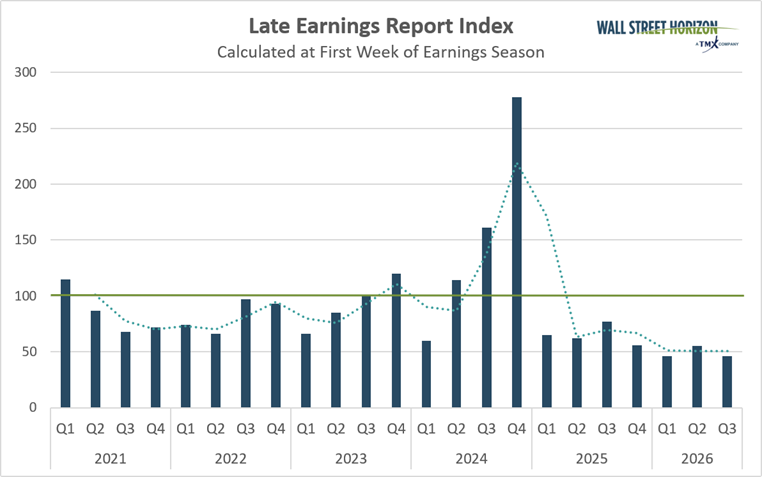
CEO uncertainty seems to be back down heading into Q2 reports after finishing the Q1 season with the highest reading in three quarters (although still well below the benchmark reading at 73). The Late Earnings Report Index, our proprietary measure of CEO uncertainty, has now recorded seven consecutive quarterly readings below the historical benchmark as companies prepare to report their Q2 results.
The LERI tracks outlier earnings date changes among publicly traded companies with market capitalizations of $250M and higher. The LERI has a baseline reading of 100, and anything above that indicates that companies are feeling uncertain about their current and short-term prospects. A LERI reading under 100 suggests that companies feel they have a pretty good handle on the near-term.
The official pre-peak season LERI reading for Q2 earnings (reported in Q3) stands at 46, tying for the lowest LERI ever recorded in our eight years of data. This is well below the baseline reading, suggesting when companies announced their earnings dates they were feeling more certain about economic conditions. As of July 14, there were 39 late outliers and 77 early outliers.
Source: Wall Street Horizon
The Macro Reality Check
But it wasn't just earnings data investors were watching last week; a slew of macro data was out and gave some clues on the state of inflation and the consumer. June's Consumer Price Index (CPI) dropped 0.4% month-over-month, cooling annual inflation to 3.5%8, while the Producer Price Index (PPI) unexpectedly fell 0.3%.9 However, market analysts quick to celebrate this softer inflation print noted that the light reading was heavily driven by June's temporary Iran ceasefire, which briefly relieved energy pressures and allowed global oil prices to drift back down. That relief was short-lived as the ceasefire fell apart on July 8, leading to the resumption of fighting between the US and Iran, as well as the blockade in the Strait of Hormuz, meaning energy costs and broader inflation are highly likely to turn back upward for July.
Retail sales for June also ticked up a modest 0.2%, representing the weakest monthly retail growth in five months, with the sluggishness heavily driven by those temporarily falling gas station receipts rather than an outright collapse in spending.10
Looking past the volatile energy numbers reveals a consumer base that is under undeniable pressure and actively changing its behavior. A new report from Bain & Company and NielsenIQ highlighted a deepening slowdown in the grocery aisle, noting that U.S. grocery prices have surged a cumulative 33% since 2019. In response to this massive price hike, grocery unit sales fell 1.8% year-over-year in June.11 Stretched household budgets are forcing shoppers to actively buy fewer items, seek out heavy promotions, and trade down to cheaper private-label alternatives. Even higher income cohorts are struggling with sticker shock.
Earnings On Deck: Tesla, Alphabet, and IBM
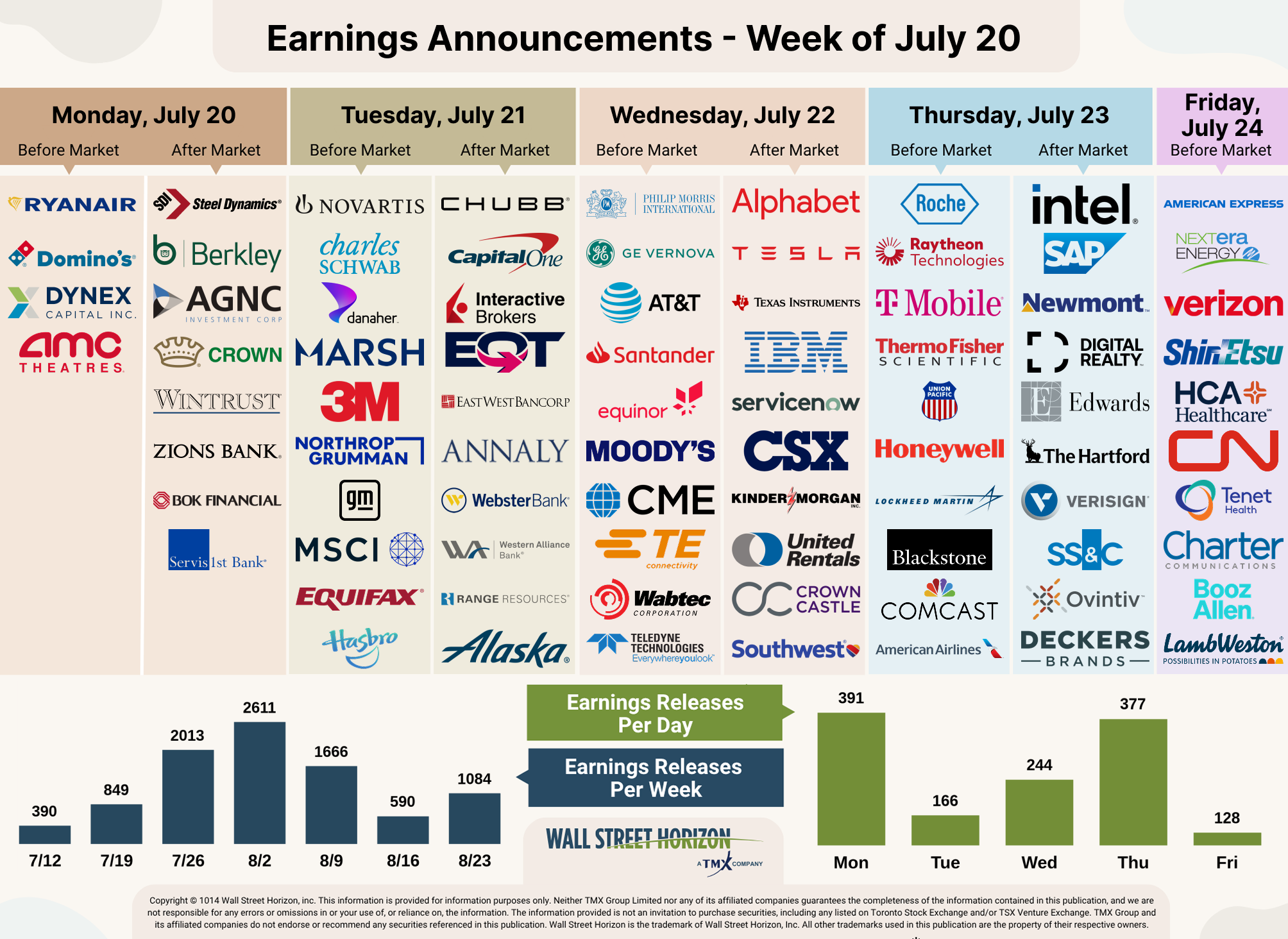
This week the market narrative pivots from the banking sector to high-growth tech. Investors will be focused on results from the first two Magnificent 7 heavyweights, Tesla and Alphabet. Additionally, IBM is slated to release its finalized second-quarter figures, a report that carries extra weight after a dismal preliminary update last week left market participants on edge. All three of these names are scheduled to report on Wednesday, July 22.
Source: Wall Street Horizon
Outlier Earnings Dates This Week
Academic research shows that when a company confirms a quarterly earnings date that is later than when they have historically reported, it’s typically a sign that the company will share bad news on their upcoming call, while moving a release date earlier suggests the opposite.12
This week we get results from a number of large companies on major indexes that have pushed their Q2 2026 earnings dates outside of their historical norms. Six companies within the S&P 500 confirmed outlier earnings dates for this week. Five of those companies, AvalonBay Communities (AVB), Equity Residential (EQR), Norfolk Southern (NSC), Hartford Insurance Group (HIG) and PG&E Corp (PCG) are earlier than usual and therefore have positive DateBreaks Factors*. Only Charles Schwab (SCHW) has a negative DateBreaks Factor for this week.
* Wall Street Horizon DateBreaks Factor: statistical measurement of how an earnings date (confirmed or revised) compares to the reporting company's 5-year trend for the same quarter. Negative means the earnings date is confirmed to be later than historical average while Positive is earlier.
Q2 2026 Earnings Wave
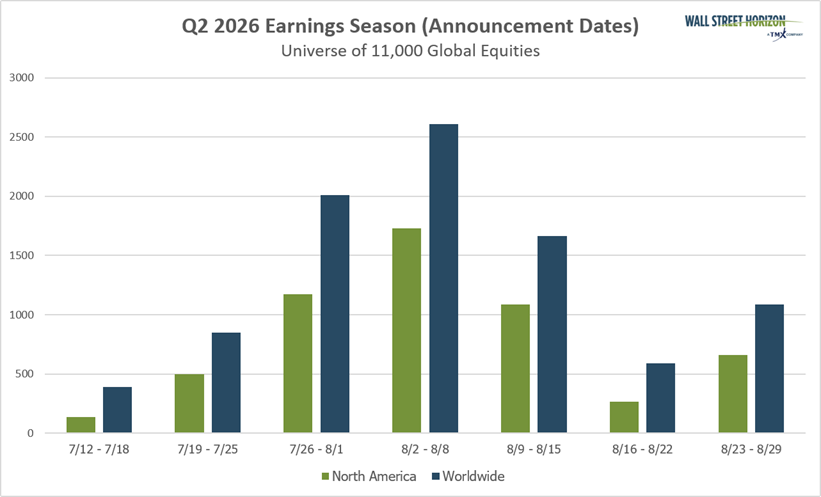
The peak weeks of the Q2 earnings season are expected to fall between July 27 - August 14, with each week expected to see over 2,000 reports. Currently, August 6 is predicted to be the most active day with 1,240 companies anticipated to report. Thus far, only 58% of companies have confirmed their earnings date (out of our universe of 11,000+ global names). The remaining dates are estimated based on historical reporting data.
Source: Wall Street Horizon
1 Goldman Sachs Second Quarter 2026 Earnings Results, July 14, 2026, https://www.goldmansachs.com
2 Bank of America Second Quarter 2026 Earnings Results, July 14, 2026, https://d1io3yog0oux5.cloudfront.net
3 JPMorgan Chase Second Quarter 2026 Earnings Results, July 14, 2026, https://www.jpmorganchase.com
4 Citigroup Second Quarter 2026 Earnings Results, July 14, 2026, https://www.citigroup.com
5 Morgan Stanley Second Quarter 2026 Earnings Results, July 15, 2026, https://www.morganstanley.com
6 “Bank earnings takeaways: From Goldman Sachs’ SpaceX IPO fees to JPMorgan’s AI job cuts,” CNBC July 14, 2026, https://www.cnbc.com
7 FactSet Earnings Insight, John Butters, July 17, 2026, https://advantage.factset.com
8 CONSUMER PRICE INDEX – JUNE 2026, Bureau of Labor Statistics, July 14, 2026, https://www.bls.gov
9 PRODUCER PRICE INDEXES – JUNE 2026, Bureau of Labor Statistics, July 15, 2026, https://www.bls.gov
10 Advance Monthly Sales for Retail and Food Services, US Census Bureau, July 16, 2026, https://www.census.gov
11 “U.S. grocery slowdown deepens as shoppers buy fewer items, raising pressure on food companies,” CNBC, Brandon Gomez, July 16, 2026, https://www.cnbc.com
12 Time Will Tell: Information in the Timing of Scheduled Earnings News, Journal of Financial and Quantitative Analysis, Eric C. So, Travis L. Johnson, Dec, 2018, https://papers.ssrn.com
Copyright © 2026 Wall Street Horizon, Inc. All rights reserved. Do not copy, distribute, sell or modify this document without Wall Street Horizon's prior written consent. This information is provided for information purposes only. Neither TMX Group Limited nor any of its affiliated companies guarantees the completeness of the information contained in this publication, and we are not responsible for any errors or omissions in or your use of, or reliance on, the information. This publication is not intended to provide legal, accounting, tax, investment, financial or other advice and should not be relied upon for such advice. The information provided is not an invitation to purchase securities, including any listed on Toronto Stock Exchange and/or TSX Venture Exchange. TMX Group and its affiliated companies do not endorse or recommend any securities referenced in this publication. This publication shall not constitute an offer to sell or the solicitation of an offer to buy, nor may there be any sale of any securities in any state or jurisdiction in which such offer, solicitation or sale would be unlawful prior to registration or qualification under the securities laws of any such state or jurisdiction. TMX, the TMX design, TMX Group, Toronto Stock Exchange, TSX, and TSX Venture Exchange are the trademarks of TSX Inc. and are used under license. Wall Street Horizon is the trademark of Wall Street Horizon, Inc. All other trademarks used in this publication are the property of their respective owners.
A message from Advisor Perspectives and VettaFi: Discover something new! Click here to register for our upcoming webcasts.
© Wall Street Horizon
More ETF Topics >