Fixed income can serve several important purposes within an investment portfolio, including income generation, capital preservation, diversification, and supporting future cash flow needs. Unlike growth assets, an individual bond generally provides a defined schedule of interest payments and a stated maturity date. Assuming the issuer remains able to meet its obligations and the bond is not redeemed early, an investor who holds the bond to maturity can expect to receive the contracted interest payments and the return of principal.
That predictability can be particularly valuable during periods of economic and market uncertainty. Geopolitical developments, monetary-policy changes, shifting supply and demand, and movements in interest rates may affect a bond’s market value. However, for an investor who does not need to sell before maturity, those interim price movements may be less important than the bond’s underlying cash flow and ultimate repayment.
Today’s interest rate environment has made income a more meaningful component of fixed income portfolio returns. For much of the period following the 2008–2009 financial crisis, Treasury yields remained historically low. The 10-year Treasury yield averaged approximately 2.45% from July 2007 through December 2022. By comparison, it averaged approximately 4.28% from July 2023 through June 2026. As of July 23, 2026, the yield was approximately 4.70%.
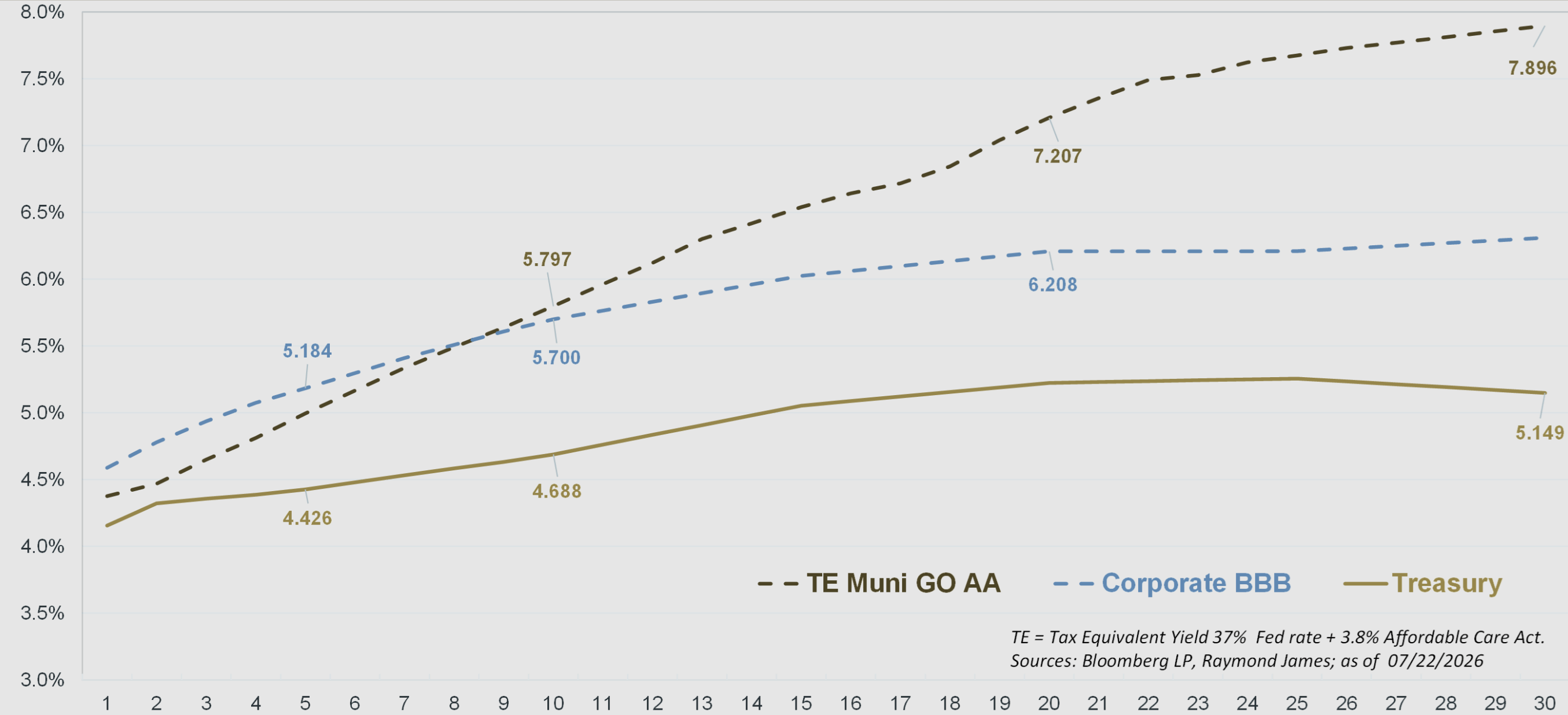
Higher yields allow fixed income allocations to serve two purposes more effectively: helping preserve capital over an investor’s intended holding period and producing a more substantial stream of portfolio income. The shape of the yield curve also matters. In portions of the municipal and corporate markets, investors are currently being compensated with additional yield for extending beyond short maturities. This creates a potential opportunity to exchange short maturing bonds for longer maturities through an extension swap.
See more: Interest Rate Swaps: The Plumbing of the Financial System
Investing in short maturity bonds is often described as conservative because shorter bonds generally experience less price volatility when interest rates change. That description is accurate from an interest rate risk perspective, but it does not address reinvestment risk. Shorter bonds mature sooner, requiring investors to reinvest their principal at whatever yields are available at that time. If rates decline, future income may also decline.
Extending maturity involves the opposite tradeoff. Longer bonds ordinarily have greater duration or sensitivity to changing interest rates. In exchange, investors may be able to lock in today’s yields for a longer period and reduce the frequency with which principal must be reinvested. For investors who intend to hold their bonds to maturity and whose liquidity needs are appropriately funded elsewhere, this can improve the predictability of long term income.
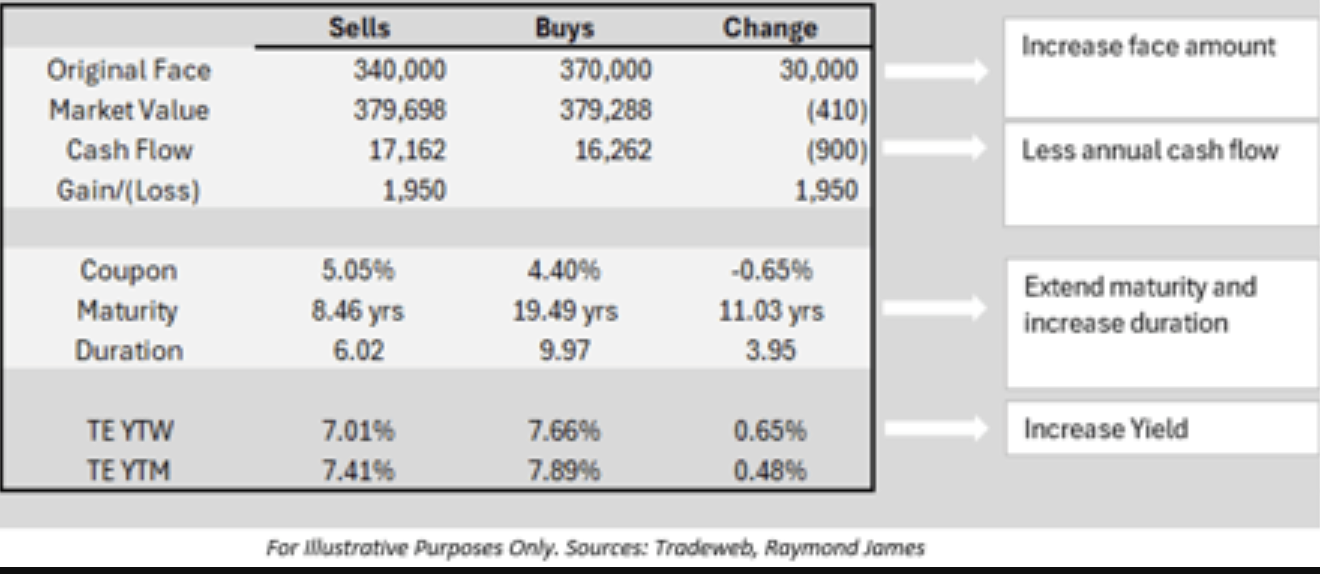
The accompanying illustration below demonstrates a municipal bond extension swap that increases the portfolio’s average maturity from 8.46 years to 19.49 years. The proposed extension moves the portfolio farther along the municipal yield curve, generating additional income while producing a moderate increase in duration.
The swap also uses lower coupon bonds that may provide better protection against an early call than higher-coupon alternatives. This does not eliminate but reduces call risk. The structure may reduce the likelihood that the portfolio’s higher yields will be taken away prematurely if market rates decline. An extension strategy should not be evaluated on yield alone. Investors should also consider the change in duration, credit quality, call exposure, liquidity, realized gains or losses, transaction costs, tax consequences, and the amount of additional annual income generated by the swap.
There is considerable flexibility in structuring an extension. Coupon, maturity, credit quality, product type, and call structure can all be tailored to an investor’s liquidity needs, tax situation, risk tolerance, and long-term objectives. Elevated yields will not necessarily remain available indefinitely. For investors with bonds dedicated to income generation and long-term wealth preservation, the current environment may provide an opportunity to extend selected maturities, reduce reinvestment risk, and lock in attractive income for a longer period.
The author of this material is a Trader in the Fixed Income Department of Raymond James & Associates (RJA), and is not an Analyst. Any opinions expressed may differ from opinions expressed by other departments of RJA, including our Equity Research Department, and are subject to change without notice. The data and information contained herein was obtained from sources considered to be reliable, but RJA does not guarantee its accuracy and/or completeness. Neither the information nor any opinions expressed constitute a solicitation for the purchase or sale of any security referred to herein. This material may include analysis of sectors, securities and/or derivatives that RJA may have positions, long or short, held proprietarily. RJA or its affiliates may execute transactions which may not be consistent with the report’s conclusions. RJA may also have performed investment banking services for the issuers of such securities. Investors should discuss the risks inherent in bonds with their Raymond James Financial Advisor. Risks include, but are not limited to, changes in interest rates, liquidity, credit quality, volatility, and duration. Past performance is no assurance of future results.
Investment products are: not deposits, not FDIC/NCUA insured, not insured by any government agency, not bank guaranteed, subject to risk and may lose value.
Links are being provided for information purposes only. Raymond James is not affiliated with and does not endorse, authorize or sponsor any of the listed websites or their respective sponsors. Raymond James is not responsible for the content of any website or the collection or use of information regarding any website's users and/or members.
Raymond James & Associates, Inc., member New York Stock Exchange / SIPC, and Raymond James Financial Services, Inc., member FINRA / SIPC, are subsidiaries of Raymond James Financial, Inc.
Raymond James® and Raymond James Financial® and power of personal® are registered trademarks of Raymond James Financial, Inc.
A message from Advisor Perspectives and VettaFi: Discover something new! Click here to register for our upcoming webcasts.
© Raymond James
Read more commentaries by Raymond James