Demand continues to outpace record supply. Municipal bonds remain an attractive income opportunity in a market where the Federal Reserve (Fed) is likely to remain on hold and carry is driving returns. Despite record issuance of roughly $50 billion per month, demand has remained strong, supported by a reinvestment wave that is running approximately 40% above last year and favorable summer technicals.
The yield curve favors intermediate maturities. Within the market, the yield curve presents the clearest opportunity, with nearly 100 basis points of steepness from 1 to 30 years, making the intermediate maturities particularly compelling due to their combination of attractive yield, roll-down potential, and lower long-end volatility.
Credit quality warrants closer attention. At the same time, the exceptionally strong municipal credit environment of recent years is beginning to fade as pandemic-era fiscal support dissipates, downgrades increase, and performance dispersion widens across issuers.
Active management remains essential. As a result, investors should focus on high-quality bonds in the intermediate portion of the curve and rely on active management to identify opportunities and navigate a more differentiated credit landscape.
The Setup: A Market Built for Patience
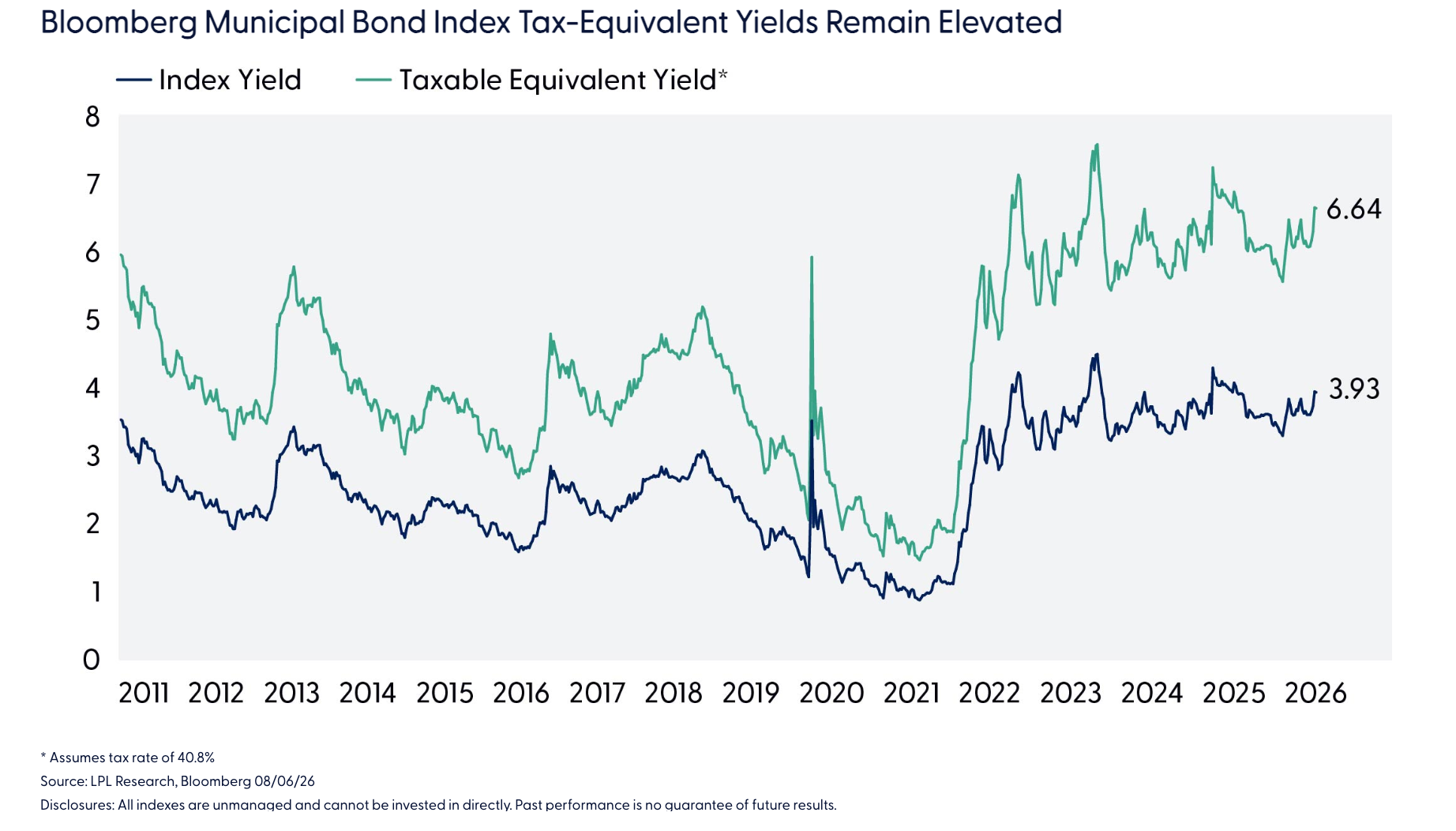
The municipal bond market enters the second half of 2026 in a familiar but underappreciated position: absorbing record supply, supported by resilient demand, and operating under a Fed that we expect to remain on hold for the balance of the year. That combination doesn't produce dramatic price returns, and it doesn't need to. With tax-equivalent yields for investment-grade municipals still sitting in the top quartile of their 10-year history, this is a market where the coupon does the heavy lifting. For investors who have spent the last several years waiting for a "better entry point," the second half of 2026 is a reminder that in fixed income, the entry point is the yield. And the yield remains generous.
The first half wasn't a straight line. Munis posted solid gains in January and February before a rate-driven sell-off in March, triggered by escalating geopolitical tensions and an inflation repricing, pushing returns temporarily negative. As well, despite July’s negative returns, the market has been resilient, with the Bloomberg Municipal Bond Index remaining in positive territory (through July 31) as strong investor demand kept tax-exempt yields anchored even as Treasury yields backed up. That relative resilience, with munis outperforming Treasuries during a rate scare, is itself a signal worth noting. It reflects a demand base that has become structurally deeper, steadier, and more retail-driven than at any point in recent memory.
See more: Muni Bonds Look Cheapest Since March After Rough Week of Returns
The Fed: On Hold, and That's Fine
As noted in our recently released 2026 Midyear Outlook: Policy, Buildouts, & Bottlenecks, we expect the Fed to be a central theme in markets over the remainder of the year, and that theme impacts the muni market as well. Our base case is that the Fed remains on hold through the remainder of 2026. Under Chair Kevin Warsh, the committee faces an uncomfortable mix: headline inflation that reaccelerated on energy pass-through from the Middle East conflict, core inflation that remains above target, and a labor market that has cooled without cracking. That configuration argues for patience in both directions. The bar for additional cuts is high as long as inflation prints stay sticky; the bar for hikes is equally high given that policy remains generally restrictive and the growth impulse is fading at the margin.
For municipal investors, a Fed on hold is a better environment than it sounds. First, it anchors the front end of the curve, which reduces reinvestment-rate uncertainty for laddered portfolios and short-duration strategies. Second, it keeps money market yields elevated but no longer rising. Trillions remain parked in money market funds earning after-tax yields that, for investors in the top brackets, no longer clear inflation by a meaningful margin. Every month the Fed sits still is another month that comparison gets harder to ignore. Third, and most importantly, a static policy rate shifts the return driver from price to income. Income is precisely what the municipal market is currently handsomely paying investors to collect, at least by the standards of the past 15 years.
Supply: Another Record Year, and Why That's Not a Problem
Stop me if you’ve heard this before, but municipal bond issuance is on pace for a third consecutive record year, with full-year gross supply estimates centered around $600 billion. Through July, new issuance was running roughly 10% ahead of last year's record clip, led by outsized growth in hospital and electric power borrowing. The drivers are durable rather than episodic: construction and labor costs remain well above pre-pandemic levels, pandemic-era federal support has fully faded, and issuers have a decade-plus backlog of deferred infrastructure investment that can no longer wait for cheaper financing. Notably, issuers keep coming to market at these yields, a sign that underlying financing needs are genuine rather than opportunistic.
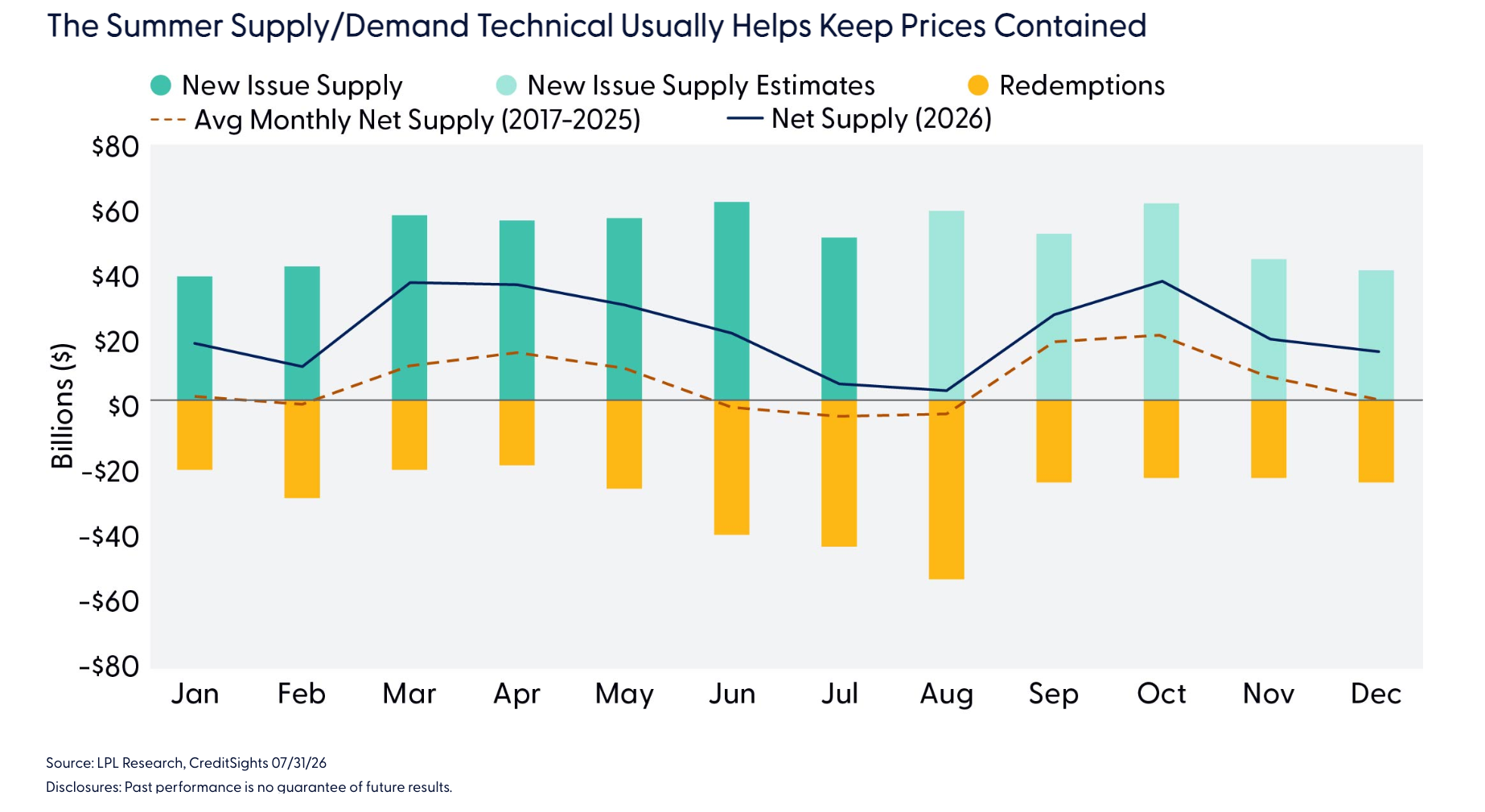
Here's the nuance that headline supply figures miss: gross supply is not net supply. Once maturities, calls, and coupon payments are netted out, the supply is much more manageable but is calendar dependent. June through August are historically the most favorable months for the supply/demand technical with redemptions largely offsetting supply. However, once the calendar flips to September, the supply/demand technical becomes a meaningful headwind with supply outpacing organic demand (past performance does not guarantee future results).
One other consideration. While supply concerns have become a lingering concern in the muni market of late, borrowings have been relatively constrained. Over the past decade, the stock of outstanding municipal debt has grown by roughly 13%, while outstanding Treasury debt has grown by more than 130%. In relative terms, the tax-exempt market is shrinking against the broader fixed income universe. Scarcity is a slow-moving technical, but it is a real one, and it is a structural reason why municipal credit spreads and ratios have stayed firm through three consecutive record supply years.
Elevated gross supply does have one practical implication: it makes total returns more sensitive to demand technicals month to month, and it periodically cheapens valuations when the calendar gets heavy. For active buyers and ladder builders, that's a feature, not a bug. Heavy issuance weeks are when concessions appear.
Relative Value: A Historically Steep Curve Favors the Intermediate Sweet Spot
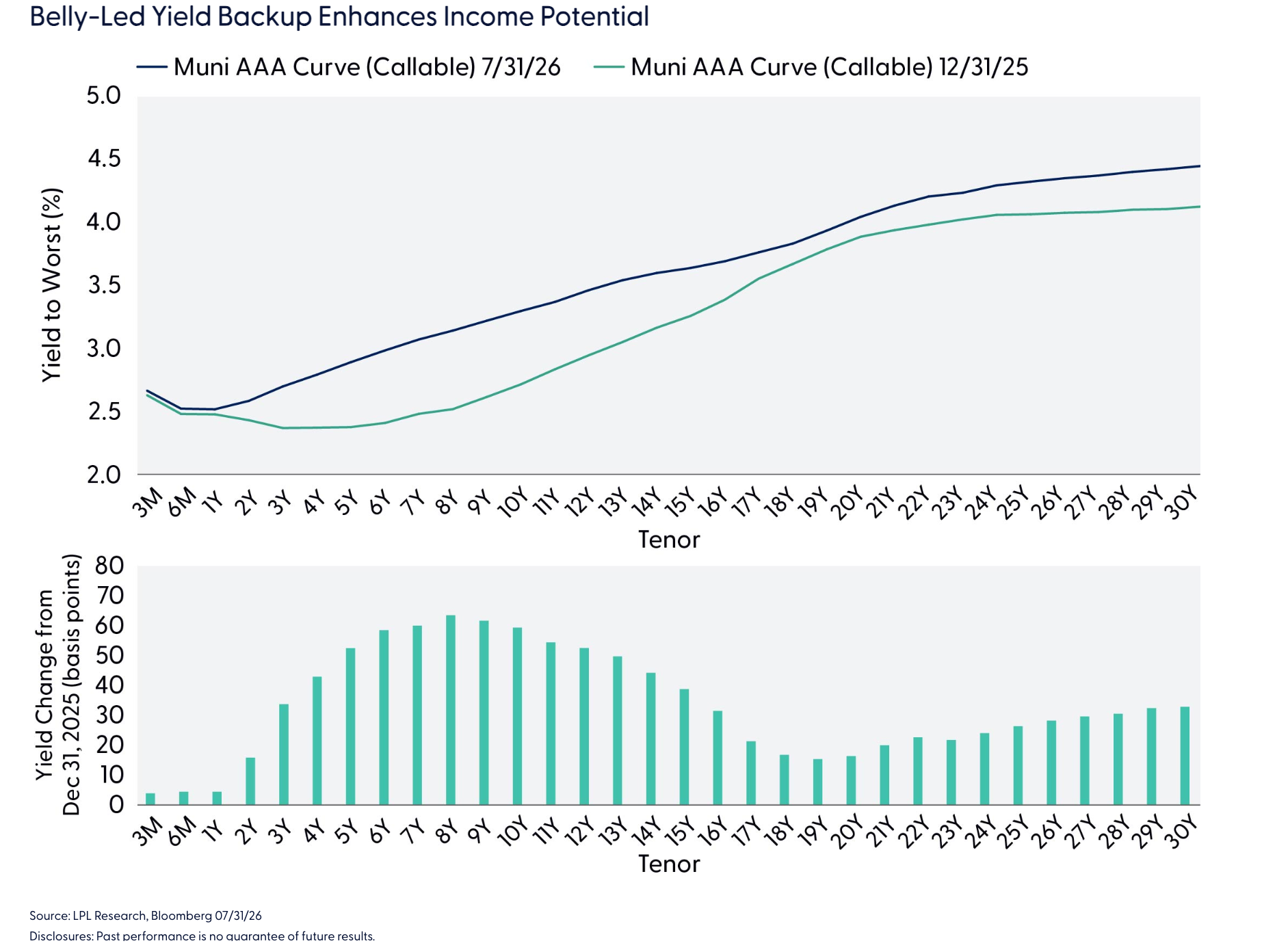
After years of inversion, the municipal yield curve has repriced into one of its steepest configurations of the past decade, with nearly 100 basis points separating 1-year and 30-year AAA yields. In our view, that steepness makes the intermediate part of the curve, roughly the 5- to 20-year range, the most attractive place to invest.
The logic is straightforward. A historically steep curve means investors capture the majority of available tax-exempt yield well before reaching the long end, without taking on the full duration risk of 25- and 30-year paper. Just as importantly, steepness supercharges roll-down: as an intermediate bond ages down a steep curve, its yield declines and its price appreciates, adding a source of return on top of the coupon that simply isn't available when curves are flat or inverted. In a Fed-on-hold environment where rates are likely rangebound, that roll-down return is one of the few free lunches left in fixed income. With money market yields drifting lower in after-tax terms, the intermediate range also offers cash-heavy investors a natural landing spot: a meaningful yield pickup over bills, manageable rate sensitivity, and the ability to lock in today's elevated tax-equivalent yields for a decade rather than a quarter.
Municipal-to-Treasury ratios round out the picture. Ratios in the mid-60s percent range at five years and low-70s at 10 years reflect persistent SMA and ETF demand concentrated inside 10 years, while 30-year ratios near the mid-80s screen cheaper on a relative basis. We recognize the long end offers absolute yields above 4.00% on AAA paper, and for investors with genuine long horizons and tolerance for volatility, a modest allocation there can make sense. But the incremental yield beyond 20 years comes with disproportionate duration risk in a market still capable of the kind of rate scare we saw in March. The intermediate range offers the better risk/reward in our view: most of the yield, most of the roll, potential for lower volatility.
Credit: The Golden Age Is Behind Us, and That's an Opportunity
Municipal credit remains fundamentally sound, with nearly 95% of the Bloomberg Municipal Index rated A-/A3 or better, a historically high figure. But investors should be clear-eyed about the direction of travel. The golden age of municipal credit, the post-pandemic stretch when unprecedented federal fiscal support flooded state and local balance sheets, drove reserves to record highs, and produced years of upgrades outpacing downgrades, is likely behind us. That federal support has run off. Revenue growth has slowed while spending pressures have not, and downgrade activity has picked up, concentrated in K-12 school districts facing enrollment declines, hospitals and higher education institutions under operating pressure, and local governments confronting a growing property tax backlash that limits revenue flexibility.
None of this signals a credit crisis. Reserves remain elevated relative to history, default rates are low, and pension funding is in solid shape. What it does signal is dispersion: a widening gap between issuers that built durable financial cushions and those that used temporary money to fund permanent commitments. With credit spreads still near the tight end of their post-crisis range, the market is not yet paying investors to take that dispersion risk indiscriminately. This is precisely the environment where active management and rigorous security selection should earn their keep. When the tide of federal support was lifting every credit, owning the index was enough. As that tide recedes, knowing which issuers you own, and why, becomes the difference between collecting tax-exempt income and explaining a downgrade. We'd stay up in quality as a core position and treat lower-rated exposure as a bond-by-bond decision rather than a beta trade.
AI Meets the Muni Market: A Public Finance Story in the Making
It wouldn’t be an Outlook publication in 2026 without talking about artificial intelligence (AI). The AI buildout has bled in the taxable markets built on hyperscaler bond issuance, data center securitizations, and private credit. Increasingly, it's a municipal story too, and it cuts both ways.
On the opportunity side, unprecedented electricity load growth is flowing directly into public power balance sheets and bond calendars. Electric power issuance is up more than 25% year to date as public utilities finance generation, transmission, and grid upgrades to serve data center demand. The gas prepayment sector, long a niche, has grown to more than 5% of the municipal index with roughly $100 billion outstanding, offering incremental yield with structural complexity that demands genuine analysis rather than index-level exposure. And for host communities, hyperscale facilities can create a substantial new tax base: capital-intensive, property-tax-rich projects landing in jurisdictions that finance schools and services off assessed value.
The risks are equally real and more political than financial. Data centers generate enormous investment but comparatively few permanent jobs, straining the traditional economic development calculus. More importantly, ratepayer backlash over data-center-driven electricity costs has become a live electoral issue. Moratorium legislation has surfaced in numerous statehouses, and utility commission races are being won and lost on the question of who pays for grid expansion. For municipal credit analysts, the questions are practical: Is load growth contracted or speculative? Are hyperscalers bearing interconnection and generation costs, or are they socialized across the rate base? Does the local tax arrangement survive a change in political leadership? Utilities and municipalities that answer those questions well will see genuine credit improvement. Those that don't will discover that concentrated counterparty exposure and angry ratepayers are a poor combination. Here again, selectivity and active oversight, not sector avoidance, is the right posture.
The Midterms: Low Legislative Risk, Local Noise
November's midterm elections matter less for the municipal market than the headlines suggest, and that's the point. Unlike the 2025 reconciliation fight, when elimination of the tax exemption was genuinely on the table, there is little appetite or legislative bandwidth in Congress to reopen municipal tax treatment in an election year. The realistic federal agenda is modest and, if anything, muni-friendly: industry advocates continue pushing to restore advance refundings and raise the bank-qualified cap, most plausibly attached to must-pass surface transportation legislation. Neither is priced in; either would be a pleasant surprise.
The more tangible election effects are timing and local. Some rate-sensitive and policy-exposed issuers, hospitals and higher education in particular, may defer borrowing until post-election policy clarity, which could modestly thin the fall calendar. At the state and local level, affordability politics are the theme to watch: property tax backlash is constraining local government revenue flexibility in several states, and ballot initiatives targeting wealth and property taxation bear monitoring in the handful of large states where the muni market is unavoidably concentrated. None of these rise to actionable credit calls today, but they reinforce the case for issuer-level research over index complacency. A divided-government outcome in November, the historical base case for the midterms, would likely extend the current policy stalemate. For municipal investors, that amounts to the status quo: no threat to the exemption, no new fiscal support, and a market left to trade on its own technicals.
What Does This Mean for Investors?
The second half of 2026 favors the patient. A Fed on hold anchors the front end and makes cash progressively less compelling. Record gross supply is being neutralized by even stronger reinvestment demand, with the summer months offering the year's best technical backdrop. A historically steep curve makes the intermediate range the sweet spot, delivering most of the available yield plus roll-down return without long-end volatility. The golden age of fiscally supercharged municipal credit is likely behind us, downgrades are picking up, and widening dispersion is exactly the environment where active management and disciplined security selection should outperform (no guarantees of course). Stay up in quality, favor the intermediate part of the curve, and let historically elevated tax-equivalent yields do what they were designed to do: compound.
Asset Allocation Insights
LPL’s Strategic and Tactical Asset Allocation Committee (STAAC) maintains its recommendation for a tactical equity overweight and fixed income underweight. This reflects an expectation of further easing of geopolitical and commodity supply concerns as a result of the U.S.-Iran conflict, alongside a more cautious outlook for select areas of core fixed income. Overall, our tactical views emphasize a modest equity overweight expressed via a defensive factor tilt, a continued focus on quality bond sectors, caution in rate‑sensitive fixed income sectors, and an ongoing allocation to diversifying strategies and alternatives. Within fixed income sectors, we remain underweight investment grade corporates and mortgage-backed securities (MBS) as spreads remain tight relative to historical standards, diminishing the risk/reward profile of the sectors.
Lawrence Gillum, Chief Fixed Income Strategist, LPL Financial
Brian Booe, Associate Analyst, Research, LPL Financial
Disclosures
This material is for general information only and is not intended to provide specific advice or recommendations for any individual. There is no assurance that the views or strategies discussed are suitable for all investors or will yield positive outcomes. Investing involves risks including possible loss of principal. Any economic forecasts set forth may not develop as predicted and are subject to change.
References to markets, asset classes, and sectors are generally regarding the corresponding market index. Indexes are unmanaged statistical composites and cannot be invested into directly. Index performance is not indicative of the performance of any investment and do not reflect fees, expenses, or sales charges. All performance referenced is historical and is no guarantee of future results.
Any company names noted herein are for educational purposes only and not an indication of trading intent or a solicitation of their products or services. LPL Financial doesn’t provide research on individual equities.
All information is believed to be from reliable sources; however, LPL Financial makes no representation as to its completeness or accuracy.
All investing involves risk, including possible loss of principal.
US Treasuries may be considered “safe haven” investments but do carry some degree of risk including interest rate, credit, and market risk. Bonds are subject to market and interest rate risk if sold prior to maturity. Bond values will decline as interest rates rise and bonds are subject to availability and change in price.
The Standard & Poor’s 500 Index (S&P500) is a capitalization-weighted index of 500 stocks designed to measure performance of the broad domestic economy through changes in the aggregate market value of 500 stocks representing all major industries.
The PE ratio (price-to-earnings ratio) is a measure of the price paid for a share relative to the annual net income or profit earned by the firm per share. It is a financial ratio used for valuation: a higher PE ratio means that investors are paying more for each unit of net income, so the stock is more expensive compared to one with lower PE ratio.
Earnings per share (EPS) is the portion of a company’s profit allocated to each outstanding share of common stock. EPS serves as an indicator of a company’s profitability. Earnings per share is generally considered to be the single most important variable in determining a share’s price. It is also a major component used to calculate the price-to-earnings valuation ratio.
The Bloomberg US Municipal Index is a flagship measure of the US municipal tax-exempt investment grade bond market. It includes general obligation and revenue bonds, which both can be pre-refunded years later and get reclassified as such.
All index data from FactSet or Bloomberg.
This research material has been prepared by LPL Financial LLC.
A message from Advisor Perspectives and VettaFi: Discover something new! Click here to register for our upcoming webcasts.
More Alternative Investments Topics >