Additional content provided by Brian Booe, Associate Analyst, Research.
The S&P 500 towed an anchor for much of the summer as a historic momentum and leverage unwind under the surface dragged on the equity benchmark before breaking out to fresh records last week. While these mechanical drivers received most of the blame for the mid-year consolidation, higher Treasury yields were also a large part of the headwind. The 10-year yield has remained uncomfortably high as sporadic flare-ups in kinetic activity and unanswered questions around energy production and shipping disruptions in the Middle East have led markets to increase their expectations of a Federal Reserve (Fed) rate hike. And while the 10-year yield is viewed as one of the most important rates to monitor — due to its use as an economic indicator, a baseline rate for consumer and business loans, and the standard “risk-free” rate in financial models — the Treasury curve has made headlines for broadly shifting higher as well. Among highlights, the 30-year yield reached its highest level since 2007 in late July, and the two-year yield has traded above the fed funds rate — suggesting that fixed income markets expect policymakers to at least stick to “higher for longer.”
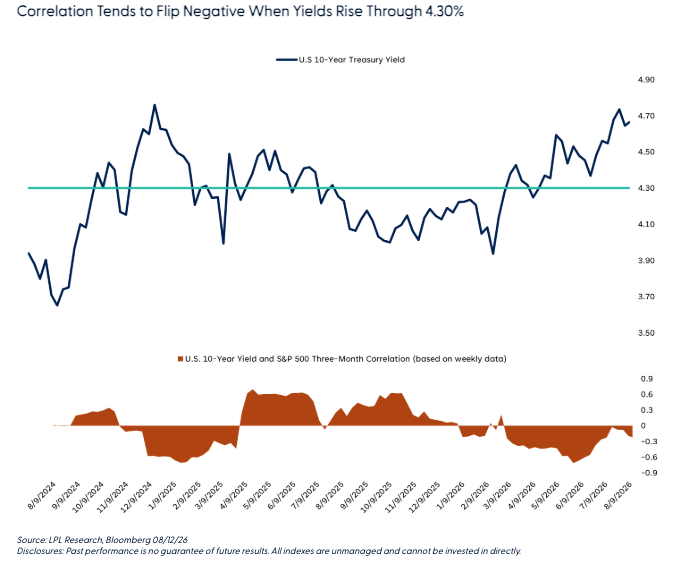
Fixed income investors have welcomed the more attractive yields, but do higher rates mean anything for equity markets? Historically, a rise in yields driven by economic growth is fine for stocks, but elevated yields caused by inflation worries can reach a threshold that spills into equity market selling pressure. Especially when the rise in rates is rapid as we’ve seen this summer. These factors have led stocks and rates to move in opposite directions in the past, and we’ve seen that dynamic come back into play at times again this year. As shown below, when the 10-year Treasury yield rises in a sustained move above the 4.3% range, the three-month weekly correlation with the S&P 500 flips negative, suggesting that stocks have struggled above this level. When the 10-year yield has entered this range, market concerns of higher rates potentially hurting the economy and the equity market via higher borrowing costs impairing demand for big-ticket purchases, weighing on stock valuations, and increasing the cost of capital (especially for the more debt-laden small cap space) begin to dampen risk appetite until upward pressure on yields ebbs. And, of course, higher rates drag down bond values (though the return prospects of future bond investments are lifted by those higher yields).
See more: Long TIPS Yield 3%. Time to Buy?
Where Do Stocks and Yields Go from Here?
Negotiations in the Middle East are ongoing, and all parties still seem interested in eventually reaching a diplomatic resolution. While global economic impacts may change depending on how long that takes, once a deal is reached crude prices and Treasury yields are likely to come off recent highs, and we continue to expect the 10-year yield to finish the year between 4.00% and 4.50% (as discussed in Midyear Outlook 2026). With yields currently trading near 4.69% (as of Wednesday afternoon) and correlation leaning negatively, we would expect stocks to feel some support if upward pressure on Treasury yields eases — aligning with our expectations for modest equity market gains over the second half. However, our technical analysis work suggests a breakout higher cannot be ruled out, nor can the possibility that positive economic surprises spur Fed rate hikes.
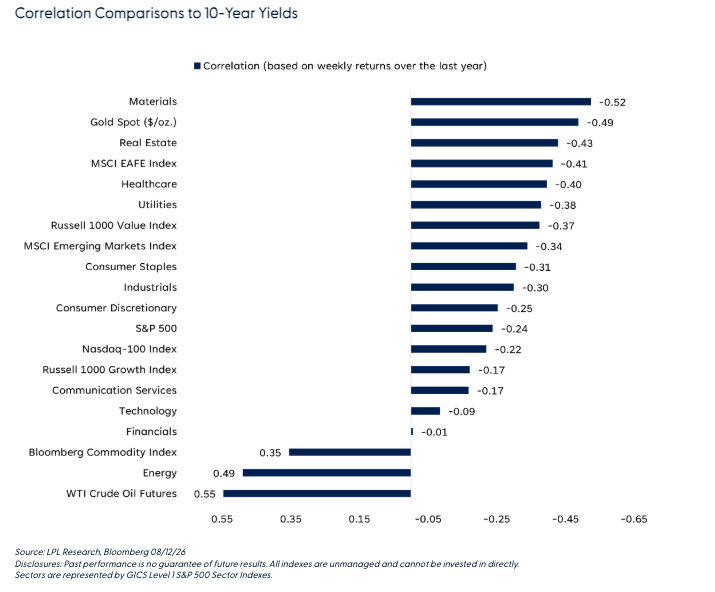
Digging in one level deeper, moves in interest rates have different effects on S&P 500 sectors and asset classes. As the correlation comparison data highlights below, higher yields could weigh more on materials, real estate, and developed market stocks, as they have been the most negatively correlated assets to 10-year Treasury yields over the last year (of course, a pullback in yields could be a tailwind to these areas as well). On the other side of the coin, and to little surprise, energy companies and crude oil futures could be relative outperformers in the event of a breakout higher in yields, as they have displayed the highest correlation to yields.
Conclusion
At lower yield levels, rising rates signal growth, historically benefiting equities. However, as the 10-year Treasury yield moves further above 4.30%, rising rates increasingly represent a valuation and liquidity constraint, making equities more sensitive to further rate increases. The current environment, with 10-year yields trading at 4.69%, sits squarely in a near-term negative-correlation regime. We continue to expect yields will ease as markets gain more clarity on oil flows and production in the Persian Gulf, helping alleviate pressure on bond prices and ease the negative correlation with stocks.
Important Disclosures
This material is for general information only and is not intended to provide specific advice or recommendations for any individual. There is no assurance that the views or strategies discussed are suitable for all investors. To determine which investment(s) may be appropriate for you, please consult your financial professional prior to investing.
Investing involves risks including possible loss of principal. No investment strategy or risk management technique can guarantee return or eliminate risk.
Indexes are unmanaged and cannot be invested into directly. Index performance is not indicative of the performance of any investment and does not reflect fees, expenses, or sales charges. All performance referenced is historical and is no guarantee of future results.
This material was prepared by LPL Financial, LLC. All information is believed to be from reliable sources; however LPL Financial makes no representation as to its completeness or accuracy.
Unless otherwise stated LPL Financial and the third party persons and firms mentioned are not affiliates of each other and make no representation with respect to each other. Any company names noted herein are for educational purposes only and not an indication of trading intent or a solicitation of their products or services.
Asset Class Disclosures –
International investing involves special risks such as currency fluctuation and political instability and may not be suitable for all investors. These risks are often heightened for investments in emerging markets.
Bonds are subject to market and interest rate risk if sold prior to maturity.
Municipal bonds are subject and market and interest rate risk and potentially capital gains tax if sold prior to maturity. Interest income may be subject to the alternative minimum tax. Municipal bonds are federally tax-free but other state and local taxes may apply.
Preferred stock dividends are paid at the discretion of the issuing company. Preferred stocks are subject to interest rate and credit risk. They may be subject to a call features.
Alternative investments may not be suitable for all investors and involve special risks such as leveraging the investment, potential adverse market forces, regulatory changes and potentially illiquidity. The strategies employed in the management of alternative investments may accelerate the velocity of potential losses.
Mortgage backed securities are subject to credit, default, prepayment, extension, market and interest rate risk.
High yield/junk bonds (grade BB or below) are below investment grade securities, and are subject to higher interest rate, credit, and liquidity risks than those graded BBB and above. They generally should be part of a diversified portfolio for sophisticated investors.
Precious metal investing involves greater fluctuation and potential for losses.
The fast price swings of commodities will result in significant volatility in an investor's holdings.
This research material has been prepared by LPL Financial LLC.
Not Insured by FDIC/NCUA or Any Other Government Agency | Not Bank/Credit Union Deposits or Obligations | Not Bank/Credit Union Guaranteed | May Lose Value
For Public Use – Tracking: #1158982
A message from Advisor Perspectives and VettaFi: Discover something new! Click here to register for our upcoming webcasts.
More Mutual Funds Topics >