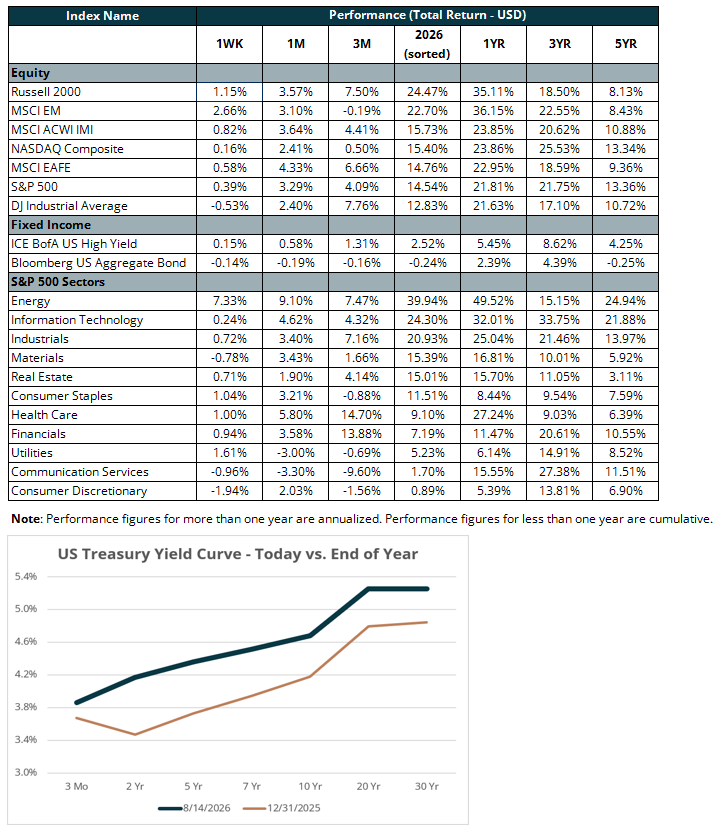
U.S. equities were mostly higher last week, though gains were modest and trading was quiet. The S&P 500, an index of the largest U.S. companies, rose 0.4 per cent and closed on Thursday at a new record high. The NASDAQ Composite added 0.2 per cent for the week, and the small-cap Russell 2000 gained 1.1 per cent. Energy was the strongest sector by a wide margin, rising 7.3 per cent as WTI crude advanced 5.4 per cent. The Bloomberg U.S. Aggregate Bond Index (the “Agg”), a broad measure of investment-grade fixed income, declined 0.1 per cent.
Two inflation reports landed during the week, and both gave the Federal Reserve some room to stay patient. The July Consumer Price Index rose 0.1 per cent on the month, bringing the annual rate down to 3.4 per cent from 3.5 per cent in June. Core prices, which exclude food and energy, rose 0.2 per cent and eased to 2.5 per cent year over year. Producer prices were flat on the month, below the 0.2 per cent increase that had been forecast.
With the unemployment rate trending sideways, the inflation data eased pressure on the Fed to act at its September meeting. Fed funds futures ended the week pricing a 33 per cent chance of a 25bps hike, down from 44 per cent a week earlier. Treasury yields moved in the other direction, with the 30-year closing at 5.25 per cent, its highest level since 2007, as oil supply concerns and questions about the sustainability of federal deficits and spending weighed on the long end.
See more: Economic Momentum Flips From Blessing to Curse for S&P 500 Bulls
Artificial intelligence (AI) remained an active trade, though developments were company-specific rather than signaling a broad shift in sentiment. Neoclouds – providers that rent out specialized computing capacity for AI workloads – drew much of the attention. CoreWeave (CRWV) and Nebius (NBIS) rose 16.1 per cent and 47.7 per cent, respectively, after both reported quarterly results and raised prices in response to strong demand. Nvidia (NVDA) is now expected to provide a $120 billion backstop for OpenAI’s Ohio data center project, down from the $250 billion originally discussed, easing investor concerns about the scale of the commitment. Anthropic, the creator of the AI chatbot Claude, is expected to go public later this year. Recent reports suggest the company could command a valuation near $2 trillion, which would surpass SpaceX’s June listing as the largest IPO on record. Taken together, the week’s developments point to a healthy underlying AI trade.
The conflict with Iran has settled into a standoff with both sides turning to economic pressure in place of military escalation. The U.S. is enforcing a blockade of Iranian ports intended to cut off the regime’s oil revenue, and on Tuesday American forces fired on a Panama-flagged cargo ship that attempted to evade it. Iran continues to restrict traffic through the Strait of Hormuz, through which roughly one-fifth of the world’s oil passes. Control of the waterway remains the central sticking point in negotiations, which remained stalled last week.
The views expressed represent the opinion of Sequoia Financial Group. The views are subject to change and are not intended as a forecast or guarantee of future results. This material is for informational purposes only. It does not constitute investment advice and is not intended as an endorsement of any specific investment. Stated information is derived from proprietary and nonproprietary sources that have not been independently verified for accuracy or completeness. While Sequoia believes the information to be accurate and reliable, we do not claim or have responsibility for its completeness, accuracy, or reliability. Statements of future expectations, estimates, projections, and other forward-looking statements are based on available information and Sequoia’s view as of the time of these statements. Accordingly, such statements are inherently speculative as they are based on assumptions that may involve known and unknown risks and uncertainties. Actual results, performance or events may differ materially from those expressed or implied in such statements. Investing in equity securities involves risks, including the potential loss of principal. While equities may offer the potential for greater long-term growth than most debt securities, they generally have higher volatility. Past performance is not an indication of future results. Investment advisory services offered through Sequoia Financial Advisors, LLC, an SEC Registered Investment Advisor. Registration as an investment advisor does not imply a certain level of skill or training.
A message from Advisor Perspectives and VettaFi: Discover something new! Click here to register for our upcoming webcasts.
© Sequoia Financial Group
More Capital Growth Topics >