Key Takeaway
Margin of safety has nearly vanished from today’s market, as heavy AI debt, off-balance-sheet financing, and a stressed bond market leave stocks little room for error.
Benjamin Graham was a professor at Columbia University in the early part of the twentieth century. He taught that it was important to have a margin of safety when purchasing common stocks, a cushion between the price you paid and what the business was actually worth. His most famous student, Warren Buffett, absorbed that lesson and built a career on it.
See more: Mountain, Cliff, or Ocean
Today, we do not have much margin for error, at least not by our reading of where things stand. We have a very small number of companies driving the economy and the market, a concentration we have written about before, and one that already appears to be rotating underneath investors’ feet. As so often happens, the bond market appears to be flagging concerns well before the equity market has caught up.
What the Treasury Market Is Telling Us
Start with the Treasury market itself. The thirty-year US Treasury bond was auctioned off on August 13 at a yield of 5.216%, the highest yield (lowest price) in twenty-five years, on softer demand than the prior month’s auction. In my experience, that combination raises real questions about the sustainability of our country’s fiscal situation, and frankly about the state of its governance, though reasonable people can debate how much weight to put on a single auction.
Credit default swaps, which price the cost of insuring a company’s bonds against default, have begun to rise as well. Nvidia’s five-year swap spread hit a record 82 basis points in a single day this month, a move that is not typical when credit investors are comfortable.
The AI Debt Question
What is adding to the bond stress, in my view, is the sheer volume of debt issuance by the major players in artificial intelligence, along with the off-balance sheet contingent liabilities that come with it. When I hear a term like special vehicle used to describe where these liabilities actually sit, it reminds me, rightly or wrongly, of past speculative bubbles.
These vehicles are financing not only long-lived assets like data centers, but semiconductor chips as well. One can make a reasonable argument for intermediate to longer-term debt on an asset like a data center. That same argument is harder to make for a chip. The problem with semiconductors is that the rate of technological obsolescence is high, a cutting-edge chip may hold its edge for two years or less, and debt financing stretched out much longer than that starts to look, at least to us, like it is asking for trouble.
A Couple of Accounting Concerns
There are also a couple of accounting questions worth flagging among the AI companies, though we want to be careful not to overstate them. The first is depreciation schedules, closely related to the obsolescence point above. If a chip is depreciated over five years instead of its effective life of two, earnings and cash flow may not be reported as conservatively as we would like, whatever the footnotes say.
The second is that some of these firms’ earnings appear to be boosted by gains on investments in each other, the same circular financing dynamic behind Nvidia’s swap spread widening this month (its financing arrangements with customers like OpenAI and CoreWeave have drawn exactly this kind of scrutiny). That non-operating source of profit could continue to grow relative to what these companies report as earnings, and in our opinion it deserves more skepticism than it is currently getting.
What This Means for Stocks
What does this have to do with stocks, you ask?
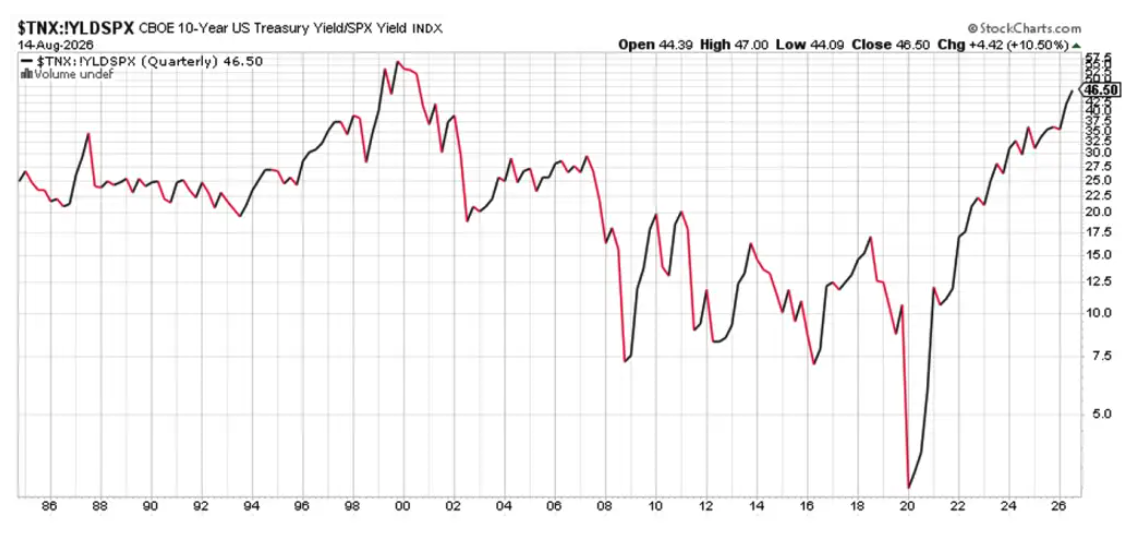
When we compare the yield on the ten-year Treasury note to the earnings yield the S&P 500 effectively pays investors, we get a read on their relative value, though it is only one input among many. The chart above tracks that ratio back to 1986, and as of this month it sits near levels last seen around 2000 and again in 2007, both moments when stocks were later found, in hindsight, to have been priced for more perfection than the earnings could support.
To be clear, that is not a prediction that history repeats on the same schedule, only an observation that with the ten-year sitting close to 4.6%, bonds are paying more relative income than they have in years, and stocks do not appear to have fully adjusted to reflect it.
A Bit of Market History
In closing, a bit of historical perspective may be in order. After the Great Depression, investors would not buy a stock unless its dividend yield exceeded the yield on US Treasuries by a couple of percentage points. That was not arbitrary. It came out of a decade of manipulation and a lack of transparency during the Roaring Twenties, after which no one trusted a company’s financial statements at face value. That habit of demanding a premium for trust lasted for decades after the Depression ended.
We are not suggesting we are back in that environment. But concentrated leadership, financing structures that do not always match the life of the assets they fund, and earnings quality that can be harder to pin down than it first appears, strike us as ingredients Graham would have recognized, and worth keeping in mind rather than a reason on their own to make any specific change to a portfolio.
Please read important disclosures here.
A message from Advisor Perspectives and VettaFi: Discover something new! Click here to register for our upcoming webcasts.
© Defiant Capital Group
More Fixed Income Topics >