The headline U.S. unemployment rate has been falling for several months, but a closer look at who is leaving the workforce – and who isn’t entering or returning to it – reveals why average wages are stagnating, and why labor markets aren’t a source of inflationary pressure.
In last week’s edition of Macro Signposts, we discussed some counterintuitive trends in the U.S. labor market. Since the beginning of the year, we’ve seen tandem declines in both the unemployment rate and the employment-to-population ratio – a concurrence without historical precedent (see Macro Signposts, “As Older Workers Retire, Labor Costs Ease”).
We argued that this trend is symptomatic of structural changes in the labor market related to demographics, AI, and immigration policy that are all colliding. The result is a labor market that isn’t as tight as the headline unemployment rate alone (4.1% as of July 2026, according to the U.S. Bureau of Labor Statistics (BLS)) would suggest. The fact that the unemployment rate is falling while reported wage inflation is also falling confirms this: A tighter labor market theoretically is supposed to firm wage growth, not soften it.
See more: Employment Report: 23K Jobs Shed in July, Worse Than Expected
This week, we dig deeper into the BLS household survey data to better understand what is happening beneath the surface of those moderating headline wage trends. We find that a compositional shift in who is leaving employment – and who isn’t returning – is pulling measured U.S. wage growth lower even as the jobless rate declines. This shift, combined with rising labor force exits and a declining job-finding rate, paints a picture of a labor market that is not generating a sustained source of inflationary pressure.
Given that labor costs are a large portion of the input costs for the goods and services produced across the U.S. economy, consumer price inflation, which is now elevated, should converge to labor cost trends over time. These labor market trends also argue for central bankers not to be overly reliant on the unemployment rate as a measure of the state of the U.S. labor market.
Why falling unemployment and slowing wage growth don’t typically coincide
Standard economic theory argues that wage growth slows when unemployment rises and firms when it falls: In good economic times, stronger hiring rates reduce the available number of individuals searching for jobs and force employers to compete harder for scarcer workers by bidding up pay. On the flip side, recessionary conditions with rising unemployment rates and unutilized labor supply tend to be associated with falling wage inflation.
The recent decline in the U.S. unemployment rate paired with falling labor supply and decelerating wage inflation challenges this traditional logic and adds to the confusing signals coming from the labor market.
The key to understanding why this is happening lies in the way aggregate wage measures are actually constructed. Average wage growth compares the mean wage (or median wage, depending on the measure) across the workforce in one time period to a later period. That number blends two very different things: the raw pay changes of people employed in both periods, and the compositional effect of who moved into versus out of employment in between. Because these two activities tend to behave differently over the cycle, the aggregate wage numbers can diverge sharply from what’s happening to any individual worker’s paycheck.
The household survey’s gross-flows (transitions) data let us see this directly. Each month, workers move between three states relative to full-time employment – unemployment, part-time work, and out of the labor force – and the wage level of those movers matters enormously. Historically, entrants – those who secured full-time work – from formerly being part-time employed, unemployed, or outside the labor market entirely (think of a recent college graduate who secured his or her first job outside of school) overwhelmingly come in below the average and median wage: Roughly 70%–80% do, according to research by Daly, Hobijn, and PyleFootnote1. and our own calculations based on household survey data.
This is why “hot” labor markets that pull people back after a period of not working or not looking for a job still tend to have moderate wage growth. The wages of people who remain employed grow faster than the aggregate wage measures, which are being pulled down by a shift in marginal hiring wages that are below the median wage.
Exits from employment work in a similar way. Individuals transitioning out of full-time work tend to be at wages below the median and average levels. This is why, in a typical recession, aggregate wages hold up better than you might expect: The workers exiting employment are disproportionately lower-paid, service sector employees, so their departure lifts the average wage of those who remain in the workforce, while collapsing hiring removes the low-wage entrants who usually would also weigh on the mean wage.
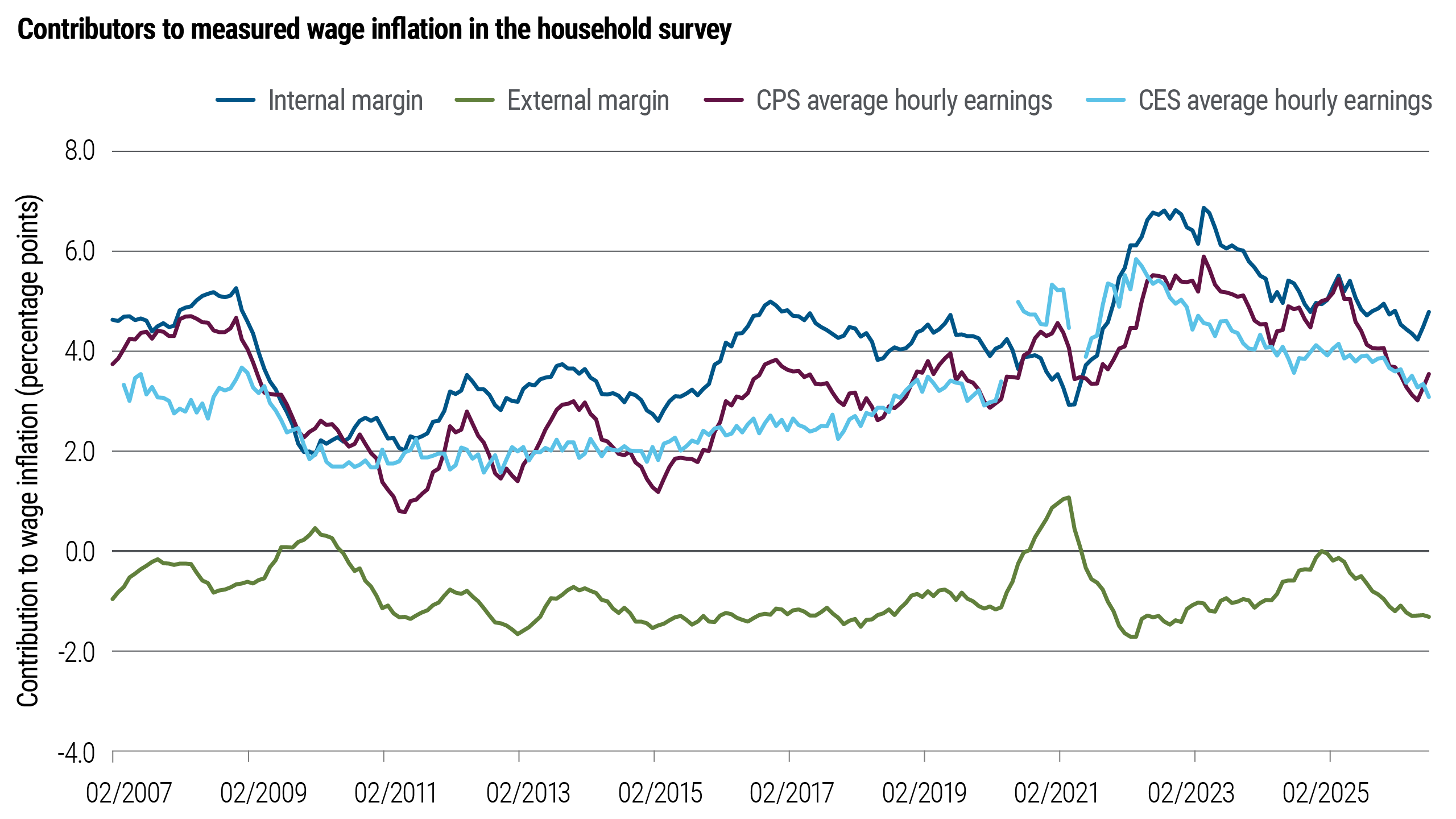
Figure 1 charts the decomposition of average wage inflation as measured by the BLS household survey. The average hourly earnings measure is regularly reported, whereas the household survey measure must be calculated from the individual survey responses recorded each month. Both measures tend to track each other, but the benefit of the household survey is that aggregate average wages can be decomposed further to understand how compositional shifts are affecting measured wage inflation.
Figure 1: Changes in the U.S. labor force affect wage inflation
What economists call the “external margin” in Figure 1 is the net effect of compositional shifts in the makeup of employed people – the difference in wage levels between those entering versus those exiting the labor market. The “internal margin” is the change in the average wage of people who were employed and remained employed. As the chart suggests, a higher rate of people entering employment at lower wages when the economy is doing well tends to put downward pressure on the average wage. During recessions (e.g., the global financial crisis and the COVID pandemic), a greater share of lower-wage workers leaving the workforce tends to put countercyclical upward pressure on wages.
Why the data are telling a very different story today
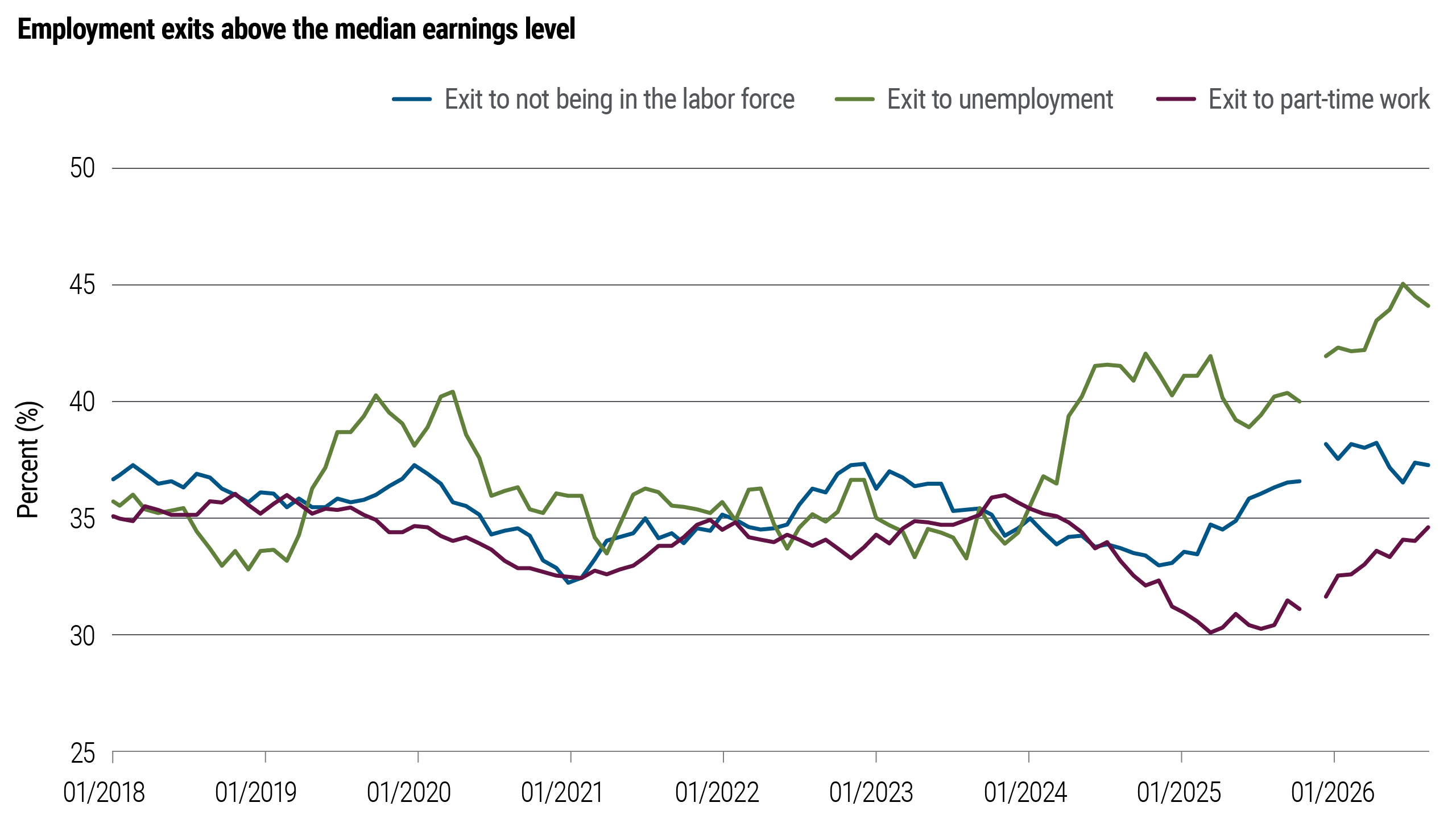
Similar to the recent behavior of other labor market indicators, this year’s patterns in transitions into and out of employment and the compositional impact on wages are working in the opposite direction of what we’ve grown to expect. Rather than low-wage workers being pushed out, as is normally the case when labor market exits pick up, it is disproportionately higher-wage workers moving out of full-time employment – into part-time roles, into unemployment, and, most importantly, out of the labor force altogether – who are dragging down wage measures now. Indeed, because a larger percentage of these exits are occurring above the median wage, they are subtracting from average wage growth rather than propping it up (see Figure 2).
Figure 2: More workers at above the median wage level are exiting employment
Source: BLS data and PIMCO calculations as of 31 July 2026
At the same time, the lower job-finding rates from both unemployment and outside the labor market imply we’re not experiencing a wave of below-median entrants shifting the wage level distribution toward lower-paying jobs, although a greater portion of the entrants that we have seen are below the average and median wage levels.
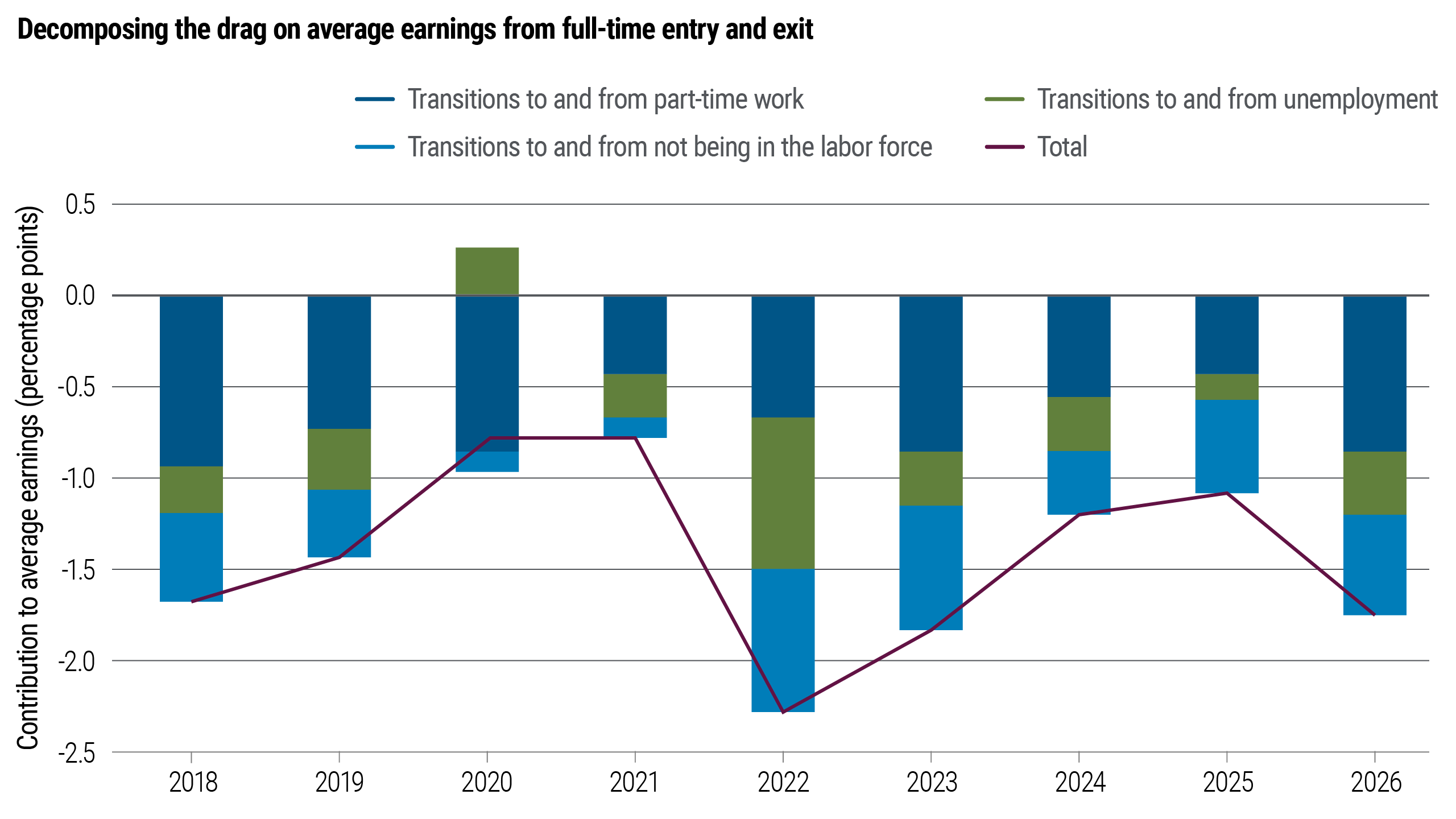
In other words, it’s complicated – and the net result is a compositional drag on measured wages that is occurring alongside falling labor supply. Figure 3 shows that through July of this year, workers transitioning from full-time to part-time employment have been the greatest drag on average earnings – formerly above-average-wage workers are leaving full-time employment and transitioning to part-time. However, a rising share of individuals transitioning from employment to unemployment are people leaving what were relatively high-paying jobs.
Figure 3: Compositional shifts tend to be a net drag on average earnings
Signs of structural shifts in the labor market
All of these trends suggest that important structural shifts are affecting the U.S. labor market. Demographics and an aging workforce are colliding with changing immigration policy, broader economic uncertainty, and very likely the early effects of labor-displacing technologies, including AI. This has ushered in a wave of retirements among older, higher-income workers, which – coupled with increased transitions from full-time to part-time work at lower pay – is putting downward pressure on reported wage inflation.
In addition, with prime-age and college-educated individuals’ job-finding rates also deteriorating, any waves of these individuals returning to employment that would normally pull up average wages also aren’t materializing.
Overall, the household survey’s transitions data suggest that shifts in the labor market are weighing on aggregate labor income for households and costs for businesses. A disproportionate number of higher-paid individuals are leaving employment, and even transitioning out of the labor market altogether. This has meant that the net effect of a labor market characterized by subdued hiring and firing rates is more moderate wage pressures.
Policy implications
As we concluded last week, the takeaway for central bankers is to avoid overreliance on any single labor market indicator. The unemployment rate is signaling tightness that the wage, unit-labor-cost, and workforce flows data flatly contradict. Labor is not a source of inflationary pressure in the U.S. Monetary policy rules (data-based guidelines for setting interest rates) that are traditionally anchored to unemployment as a measure of economic slack will prescribe monetary policy that is tighter than what a broader set of labor market data suggests is necessary.
A message from Advisor Perspectives and VettaFi: Discover something new! Click here to register for our upcoming webcasts.
Footnotes:
1 Mary C. Daly, Bart Hobijn, and Benjamin Pyle. “What’s Up with Wage Growth?” Federal Reserve Bank of San Francisco Economic Letter (March 2016) Return to content↩
Disclosures
Statements concerning financial market trends or portfolio strategies are based on current market conditions, which will fluctuate. There is no guarantee that these investment strategies will work under all market conditions or are appropriate for all investors and each investor should evaluate their ability to invest for the long term, especially during periods of downturn in the market. Outlook and strategies are subject to change without notice.
This material contains the current opinions of the manager and such opinions are subject to change without notice. This material is distributed for informational purposes only and should not be considered as investment advice or a recommendation of any particular security, strategy or investment product. Information contained herein has been obtained from sources believed to be reliable, but not guaranteed.
PIMCO as a general matter provides services to qualified institutions, financial intermediaries and institutional investors. Individual investors should contact their own financial professional to determine the most appropriate investment options for their financial situation. This material contains the opinions of the: manager and such opinions are subject to change without notice. This material has been distributed for informational purposes only and should not be considered as investment advice or a recommendation of any particular security, strategy or investment product. Information contained herein has been obtained from sources believed to be reliable, but not guaranteed. No part of this material may be reproduced in any form, or referred to in any other publication, without express written permission. PIMCO is a trademark of Allianz Asset Management of America LLC in the United States and throughout the world.
© PIMCO
More Income Topics >