The Unexpected Russell Shift
For years, Russell index reconstitutions have been treated as a routine maintenance event. Thousands of stocks are ranked, memberships are adjusted, and markets move on. But the June 2026 Russell reconstitution revealed something far more interesting: artificial intelligence (AI) wasn't simply influencing stock returns. It was quietly rewriting the architecture of the market itself.
Many investors spent the past two years focused on the remarkable rise of AI, the surge in semiconductor stocks, and the growing dominance of mega cap technology companies. Yet the June 2026 reconstitution exposed an even deeper reality. The market's leadership had become so powerful that it altered the composition, factor exposures, and style characteristics of some of the world's most closely followed benchmarks.
In other words, the benchmark changed because the market changed. And that distinction matters.
The Clue Was Hidden in One Number
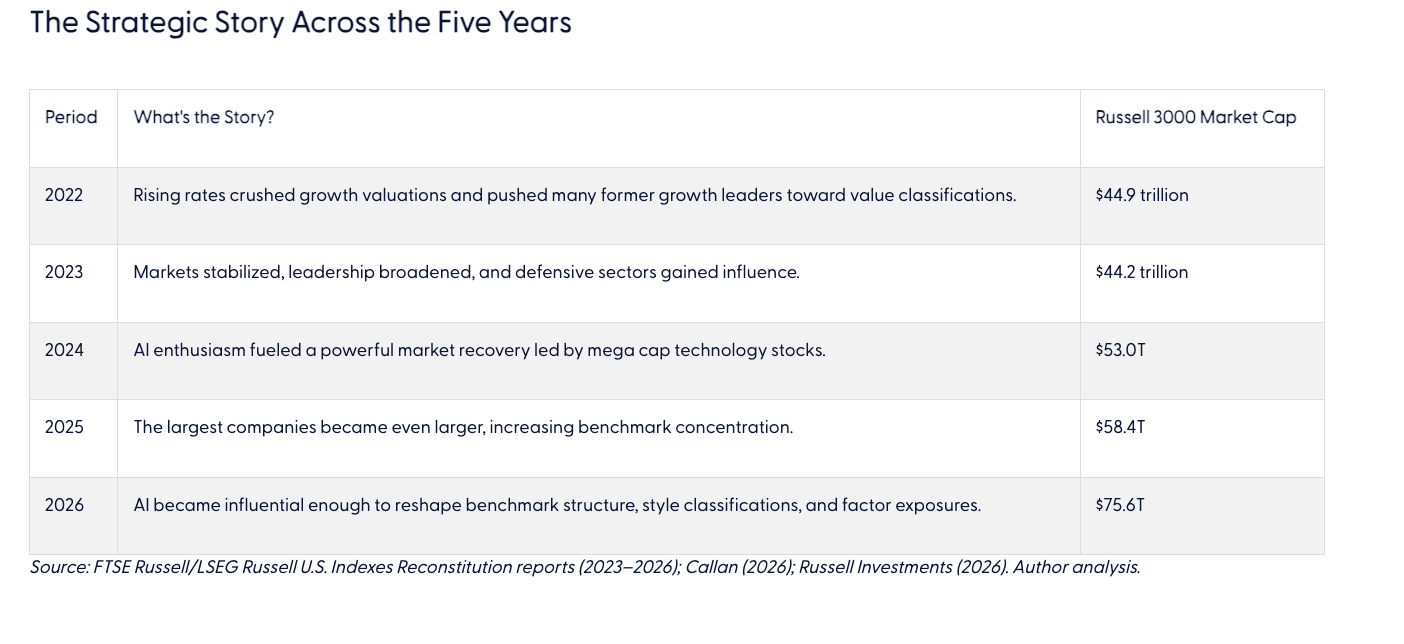
The first hint came from the size of the U.S. equity market. The Russell 3000's total market capitalization grew from approximately $58.4 trillion in 2025 to $75.6 trillion in 2026, a striking 29% increase. At the same time, the breakpoint separating the Russell 1000 from the Russell 2000 climbed from roughly $4.6 billion to $5.7 billion. This wasn't simply a story about a handful of giant companies getting bigger. The entire market moved higher.
Then came the second clue. The companies at the top were growing even faster.
NVIDIA became the largest company in the Russell rankings, while the combined value of the Magnificent Seven reached approximately $22.4 trillion, up nearly 49% from the prior reconstitution. According to analysis from Callan, the top 10 companies in the Russell universe approached $26 trillion in market value.
The market wasn't just getting larger. It was becoming increasingly concentrated.
See more: Is the U.S. Dollar Back? Three Perspectives
When Growth Didn't Look Like Growth Anymore
Historically, the distinction between growth and value investing seemed relatively straightforward.
Growth indexes tended to be dominated by technology and companies with rapidly expanding earnings. Value indexes generally leaned toward financials, industrials, energy companies, and businesses trading at lower valuations. Yet 2026 challenged those assumptions.
Apple and Microsoft were no longer exclusively growth stocks. Both received allocations in value and growth benchmarks. Amazon underwent one of the most dramatic style shifts, moving to approximately 92% value and only 8% growth. Meanwhile, semiconductor companies such as AMD and Micron, migrated in the opposite direction, shifting toward growth classifications as expectations for AI-related earnings accelerated.
That creates an intriguing question:
If Apple, Microsoft, and Amazon are appearing in value benchmarks, and AI-focused semiconductor companies are becoming increasingly dominant in growth benchmarks, are growth and value really as different as they once were?
The answer appears to be "less than before."
The Great Benchmark Migration
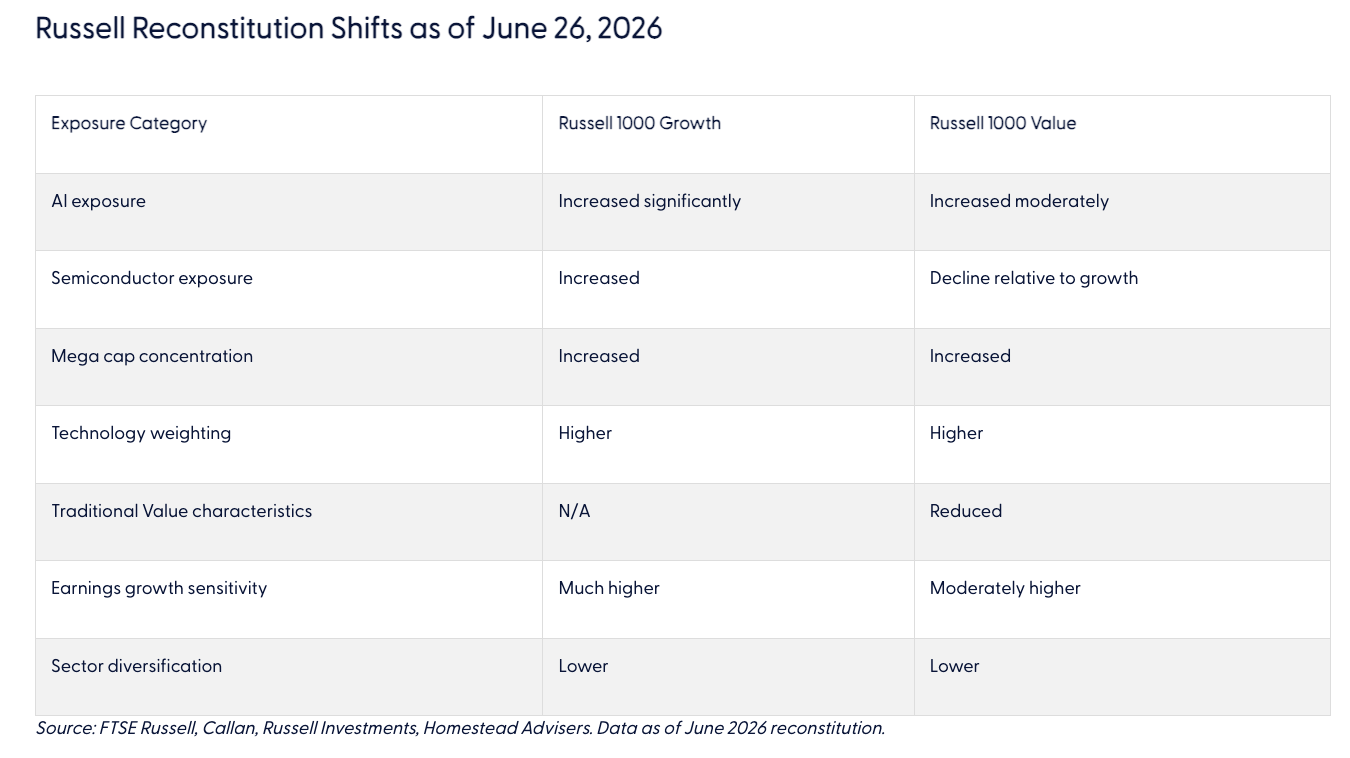
What makes the 2026 reconstitution particularly noteworthy is that it altered factor exposure, sector exposure, and style exposure simultaneously. The Russell 1000 Growth Index became even more concentrated around AI beneficiaries.
Technology and communication services approached 70% of the benchmark. Semiconductor exposure increased significantly as AI infrastructure spending drove stronger earnings expectations. NVIDIA's rise reinforced the benchmark's dependence on a relatively small group of companies.
At the same time, the Russell 1000 Value Index gained additional technology exposure.
Technology giants traditionally associated with growth became meaningful contributors to value benchmarks. The result was a value index that relied less on traditional financials and cyclical sectors and more on large platform businesses with substantial cash flow and durable competitive advantages.
A Healthier Market Beneath the Headlines
Another surprise emerged beneath the mega cap narrative. While headlines focused on NVIDIA and AI leaders, the reconstitution revealed improving breadth across the market.
Approximately 43 companies graduated from the Russell 2000 into the Russell 1000. Technology and industrial firms represented many of those promotions. Meanwhile, approximately 237 companies joined the Russell 2000, with healthcare accounting for the largest share of new entrants.
That's important because strong markets are generally healthier when leadership extends beyond a handful of dominant companies.
The data suggested that while mega caps were driving much of the attention, market participation was broadening underneath the surface.
The Bigger Discovery
Perhaps the most important lesson from the 2026 Russell reconstitution is that benchmark construction is becoming a source of market insight rather than simply a measurement tool. For decades, reconstitution events largely reflected the market. In 2026, they revealed something deeper.
AI has become large enough to influence not only stock prices but also style classifications, sector composition, factor exposures, and benchmark concentration. Technology now plays an increasingly important role in both growth and value indexes. The traditional boundaries separating investment styles are beginning to blur.
That may be the most remarkable discovery of all. The June 2026 Russell reconstitution was not simply a refresh of index memberships. It was evidence that the market's center of gravity had shifted.
And once a benchmark changes, it is often because the future already has.
Scott Froidl is the leader of the equity product research team and covers U.S. large cap equity managers, derivative income managers, and is a key contributor to the LPL Research centrally managed portfolios.
Important Disclosures
This material is for general information only and is not intended to provide specific advice or recommendations for any individual. There is no assurance that the views or strategies discussed are suitable for all investors. To determine which investment(s) may be appropriate for you, please consult your financial professional prior to investing.
Investing involves risks including possible loss of principal. No investment strategy or risk management technique can guarantee return or eliminate risk.
Indexes are unmanaged and cannot be invested into directly. Index performance is not indicative of the performance of any investment and does not reflect fees, expenses, or sales charges. All performance referenced is historical and is no guarantee of future results.
This material was prepared by LPL Financial, LLC. All information is believed to be from reliable sources; however LPL Financial makes no representation as to its completeness or accuracy.
Unless otherwise stated LPL Financial and the third party persons and firms mentioned are not affiliates of each other and make no representation with respect to each other. Any company names noted herein are for educational purposes only and not an indication of trading intent or a solicitation of their products or services.
Asset Class Disclosures –
International investing involves special risks such as currency fluctuation and political instability and may not be suitable for all investors. These risks are often heightened for investments in emerging markets.
Bonds are subject to market and interest rate risk if sold prior to maturity.
Municipal bonds are subject and market and interest rate risk and potentially capital gains tax if sold prior to maturity. Interest income may be subject to the alternative minimum tax. Municipal bonds are federally tax-free but other state and local taxes may apply.
Preferred stock dividends are paid at the discretion of the issuing company. Preferred stocks are subject to interest rate and credit risk. They may be subject to a call features.
Alternative investments may not be suitable for all investors and involve special risks such as leveraging the investment, potential adverse market forces, regulatory changes and potentially illiquidity. The strategies employed in the management of alternative investments may accelerate the velocity of potential losses.
Mortgage backed securities are subject to credit, default, prepayment, extension, market and interest rate risk.
High yield/junk bonds (grade BB or below) are below investment grade securities, and are subject to higher interest rate, credit, and liquidity risks than those graded BBB and above. They generally should be part of a diversified portfolio for sophisticated investors.
Precious metal investing involves greater fluctuation and potential for losses.
The fast price swings of commodities will result in significant volatility in an investor's holdings.
This research material has been prepared by LPL Financial LLC.
Not Insured by FDIC/NCUA or Any Other Government Agency | Not Bank/Credit Union Deposits or Obligations | Not Bank/Credit Union Guaranteed | May Lose Value
For Public Use – Tracking: #1161792
A message from Advisor Perspectives and VettaFi: Discover something new! Click here to register for our upcoming webcasts.
Read more commentaries by LPL Financial