Key takeaways
- Trade talks between Canada and the U.S. fell apart on Saturday, resulting in the Section 338 tariffs on a subset of Canadian goods taking effect. In response, Canada has pledged to implement retaliatory tariffs on a subset of U.S. goods, effective September 8, 2026.
- While a 50% tariff rate may sound high, the tariff only applies to around 5% of U.S. imports from Canada. Therefore, the economic impact on the U.S. might be relatively muted.
- For Canada, the tariffs pose an additional headwind to an economy already under pressure. The lack of progress on USMCA/CUSMA negotiations will also add to economic uncertainty.
- The situation remains fluid, and we have seen in past trade shocks that negotiations can shift at a moment’s notice.
The bottom line: We believe that in these challenging times, investors would benefit from staying disciplined and maintaining a long-term focus, while taking advantage of any tactical opportunities that might arise due to market over-reactions.
See more: Market Signals: Why Real Assets, Why Multi-Fund
New chapter, old story
Trade talks broke down between Canada and the U.S., and the three-day pause on the Section 338 tariffs has now expired. As of Saturday, the U.S. has implemented 50% tariffs on a subset of Canadian goods entering the country. Although the tariffs only target around 5% of Canadian exports to the U.S., they also apply to some items that had previously been exempt from duty under the terms of USMCA/CUSMA. In response, President Trump announced on Monday that he would raise double the sector-specific tariff rate on Canadian automobiles to 50%, though with a delayed implementation date of January 1, 2027.
Meanwhile, Canada has announced that it will implement “dollar-for-dollar” retaliatory tariffs on a subset of American goods. These retaliatory tariffs would not go into effect until September 8, potentially providing the two countries with an opportunity to resume negotiations.
While these tariffs may be a new chapter, they are part of a familiar story. Over the past year and a half, the U.S. has been implementing tighter trade policy, raising tariffs on a broad range of goods. However, the journey has been far from linear, with a litany of escalations and deals along the way.
Multiple paths ahead
Several paths are possible from this point forward. In the optimistic direction, the two countries could agree to resume negotiations, and potentially find enough compromises to result in a reduction or reversal in these Section 338 tariffs. Such an agreement could even accelerate progress towards an outright renewal of USMCA/CUSMA, which is currently in a period of annual reviews after the initial renewal timeline lapsed.
Adverse outcomes are also possible. If Canada’s retaliatory tariffs take effect, there is a possibility that the U.S. could escalate with new tariffs in response, intensifying the trade tensions. It is also possible that the U.S. could declare its intention to withdraw from USMCA/CUSMA outright by giving a formal six-month notice.
Different countries, different impacts
As a reminder, tariffs have the effect of temporarily boosting inflation rates in the importing country, while also temporarily reducing growth in both the importing and exporting countries. The magnitude of the impact depends on both the economic starting conditions and the trade flows between the two countries.
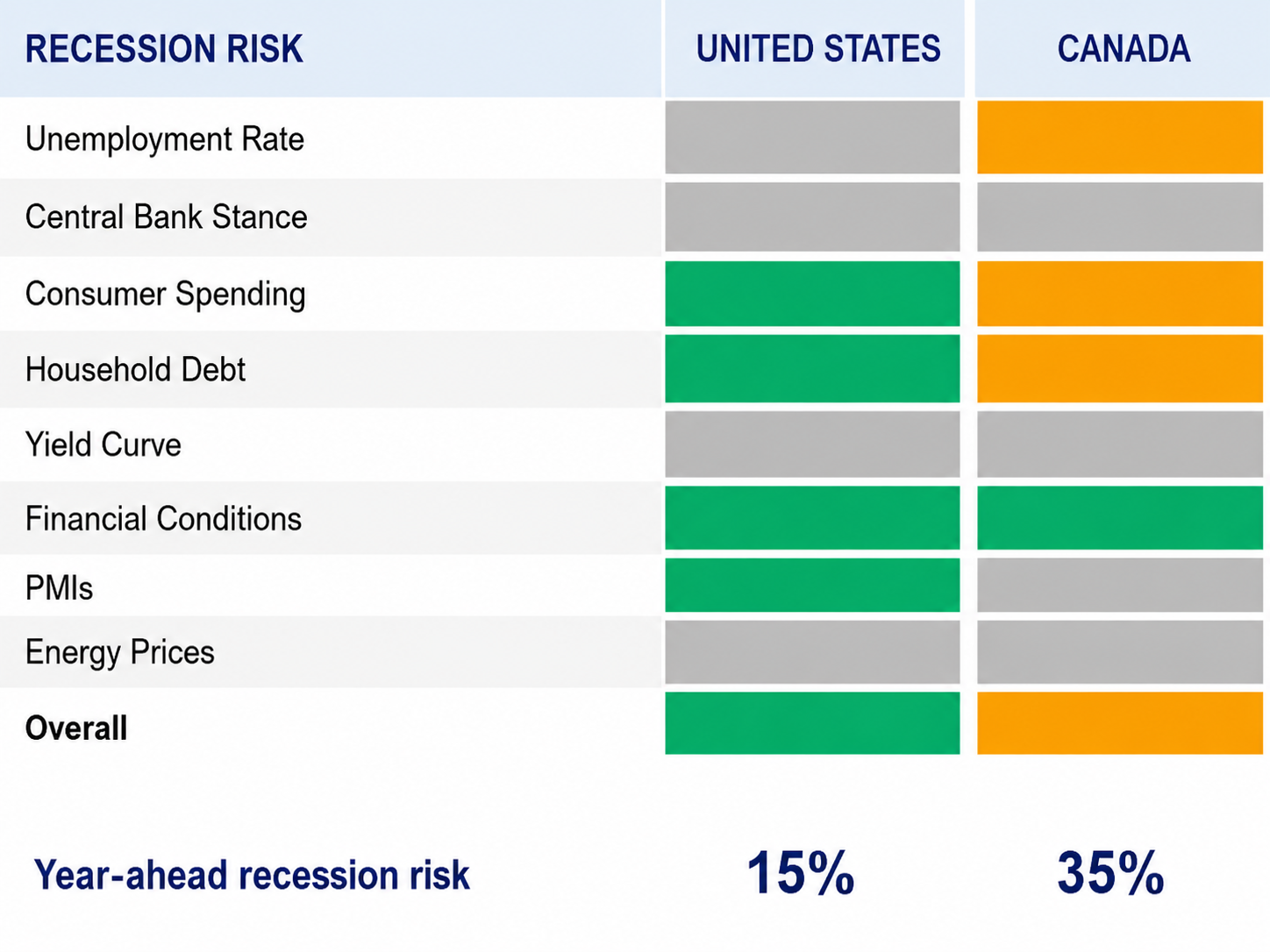
The U.S. is starting from a point of economic resilience. Although the conflict in the Middle East has not yet been fully resolved, the U.S. labor market has remained relatively robust, with the unemployment rate hovering near a normal level of around 4%. Meanwhile, U.S. aggregate consumer spending has remained intact, while U.S. companies are generating exceptionally strong earnings growth.
In contrast, Canada’s economy remains under pressure. Although job creation has improved in recent months, the unemployment rate still remains above our estimate of unemployment. In addition, economic growth in Canada has been volatile, and the economy is running in a state of excess supply (weaker than longer-term potential).
Figure 1: Recession risk dashboard for U.S. and Canada
From a trade flows perspective, because these tariffs (and proposed retaliatory counter-tariffs) only impact a small portion of trade between the two countries, the inflationary impact should be relatively modest and manageable. Meanwhile, when it comes to economic growth, exports play a far greater role for Canada’s economy than for America’s economy. Moreover, the vast majority of Canada’s exports are bound for the U.S., whereas the U.S. has a more diversified base of export locations.
Consequently, given the totality of the circumstances, we expect that the hit to the Canadian economy from the new tariff developments will be greater than the hit to the U.S. economy. In fact, we continue to expect strong economic growth for the U.S. in spite of these tariffs.
Market implications
These new tariffs are likely to add to an already challenging situation for Canada’s economy. In addition, until USMCA/CUSMA gets renewed, hiring activity and business investment in Canada may remain subdued. With the inflationary impact likely to be relatively modest, and with core inflation in Canada running close to the Bank of Canada’s target, we expect that the BoC will continue to prioritize supporting economic activity. Although markets are toying with the idea of a rate hike by the BoC this year, we think a rate cut is the more likely outcome. Accordingly, we see good value in Canadian government bonds.
Meanwhile, from an equity market perspective, we think it’s important for investors to remember that Canada’s economy looks quite different from its stock market. For instance, the financial sector makes up less than 10% of Canada’s GDP, but around 30% of the TSX. In addition, many of the largest companies on the TSX derive a substantial portion of their revenues from outside of Canada. This means that a Canada-specific economic slowdown could still be navigable for Canadian equity markets.
Although we expect that these tariffs will have a relatively minimal impact on the U.S. economy and equity markets, if the U.S. were to announce an outright withdrawal from USMCA/CUSMA at any point, even if just as a bargaining tool, that could cause some near-term volatility for the U.S. markets.
Tariffs can be a challenging subject for investors to navigate, but we believe that amid these difficult times, investors would be best served by continuing to stay disciplined.
Any opinion expressed is that of Russell Investments, is not a statement of fact, is subject to change and does not constitute investment advice.
A message from Advisor Perspectives and VettaFi: Discover something new! Click here to register for our upcoming webcasts.
The information, analyses and opinions set forth herein are intended to serve as general information only and should not be relied upon by any individual or entity as advice or recommendations specific to that individual entity. Anyone using this material should consult with their own attorney, accountant, financial or tax adviser or consultants on whom they rely for investment advice specific to their own circumstances.
Products and services described on this website are intended for United States residents only. Nothing contained in this material is intended to constitute legal, tax, securities, or investment advice, nor an opinion regarding the appropriateness of any investment, nor a solicitation of any type. The general information contained on this website should not be acted upon without obtaining specific legal, tax, and investment advice from a licensed professional. Persons outside the United States may find more information about products and services available within their jurisdictions by going to Russell Investments' Worldwide site.
Russell Investments is committed to ensuring digital accessibility for people with disabilities. We are continually improving the user experience for everyone, and applying the relevant accessibility standards.
Russell Investments' ownership is composed of a majority stake held by funds managed by TA Associates Management, L.P., with a significant minority stake held by funds managed by Reverence Capital Partners, L.P. Certain of Russell Investments' employees and Hamilton Lane Advisors, LLC also hold minority, non-controlling, ownership stakes.
On July 2, 2026, Russell Investments Group, Ltd. (“Russell Investments”) entered into a definitive agreement and plan of merger (the “Transaction”) pursuant to which Russell Investments will be acquired by a consortium led by B Capital Group Management, L.P. that includes California Public Employees Retirement System. The Transaction is expected to close by the end of Q1 2027, subject to the receipt of regulatory approvals and other customary closing conditions.
Frank Russell Company is the owner of the Russell trademarks contained in this material and all trademark rights related to the Russell trademarks, which the members of the Russell Investments group of companies are permitted to use under license from Frank Russell Company. The members of the Russell Investments group of companies are not affiliated in any manner with Frank Russell Company or any entity operating under the "FTSE RUSSELL" brand.
© Russell Investments Group, LLC. 1995-2026. All rights reserved. This material is proprietary and may not be reproduced, transferred, or distributed in any form without prior written permission from Russell Investments. It is delivered on an "as is" basis without warranty.
© Russell Investments
Read more commentaries by Russell Investments