For an asset often designated as a store of value, gold volatility has been especially apparent this year. After starting off the year with a high-paced record-setting run that lifted the metal to nearly $5,600 an ounce, including a 13% rally in January alone, momentum quickly faded as tensions with Iran ratcheted higher.
The correction appeared counterintuitive because it unfolded alongside rising geopolitical risk. Gold ultimately fell more than 20% from its January peak, as rising interest rates, a shift from rate-cut expectations toward potential rate hikes, a stronger U.S. dollar, and liquidity-driven selling outweighed traditional flight-to-safety demand. Some holders also appeared to monetize gold reserves to raise cash or obtain dollars, highlighting the important distinction between owning a safe-haven asset and needing immediate liquidity.
As LPL Research’s Head of Macro Strategy Kristian Kerr wrote in May, gold’s weakness following the escalation with Iran was “not a failure of the safe-haven thesis; it is a reminder that funding needs often temporarily take precedence over fear-driven positioning.” For more insight into why gold did not initially behave like a traditional safe-haven asset during this period, check out "Gold is Doing its Job, Just Not the One Investors May Expect".
Fast forward to today, and many of the underlying risks remain in place. The Strait of Hormuz remains effectively closed, geopolitical uncertainty is elevated, and long-term interest rates have risen to levels that are creating discomfort across financial markets. The Treasury has responded by taking steps intended to improve liquidity in the long end of the government bond market. Last week, the Treasury announced that it would at least double the maximum size of its liquidity support buybacks for 10- to 30-year Treasuries, increasing the limit from $2 billion to at least $4 billion per operation beginning next month. The announcement sent an important signal that policymakers are increasingly sensitive to long-term borrowing costs and Treasury market liquidity. Long-term yields fell sharply following the announcement, although most of that move was subsequently retraced.
While Treasury intervention may help cap upside pressure in rates, several other tailwinds for gold have more recently emerged. Investor positioning appears considerably cleaner than it was in January, when enthusiasm for the metal had become crowded. The dollar has also retreated into its prior trading range, helping reduce a key headwind for dollar-denominated gold.
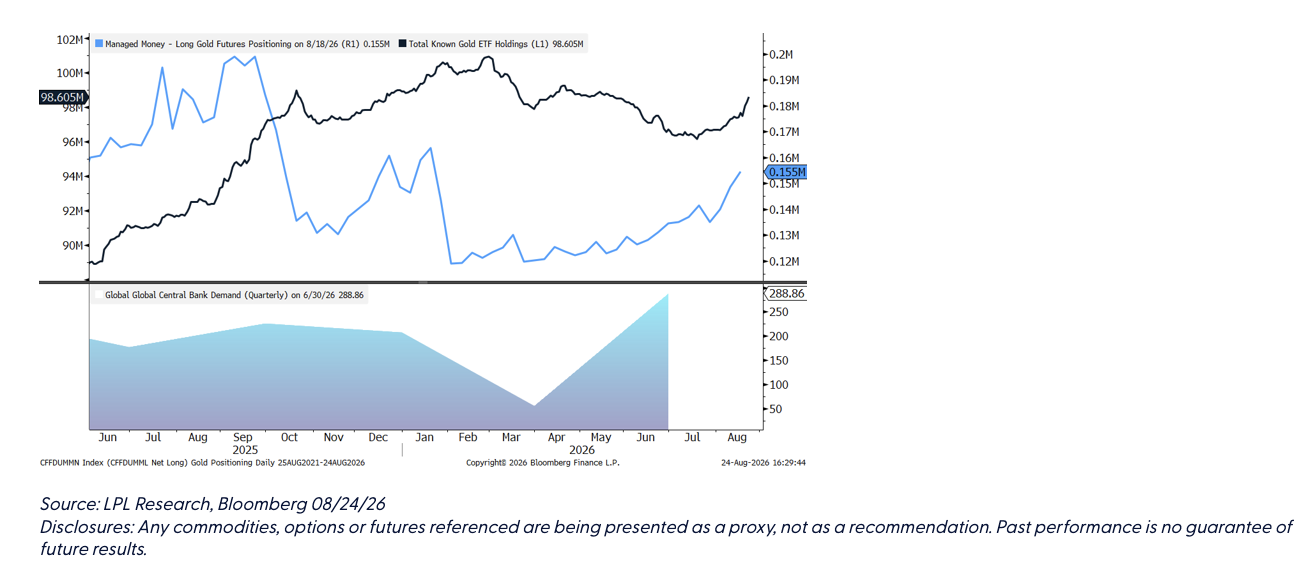
As highlighted in the “Gold Demand Returns” chart, physical gold exchange-traded fund holdings have risen steadily since reaching year-to-date lows in July. Speculative positioning has improved as well, with managed money long positions in the futures market continuing to climb. Together, these trends suggest that investor demand is rebuilding after the second-quarter liquidation.
Central bank demand also strengthened considerably during the second quarter. According to the World Gold Council, central banks purchased 289 tonnes of gold, approximately five times first-quarter demand and 62% more than in the second quarter of 2025. Poland led purchases with 51 tonnes, while China added 33 tonnes, its largest quarterly increase since late 2023. South Korea also announced a long-term gold buying program and completed its first purchases since 2013, including exposure through spot gold exchange-traded funds.
Gold Demand Returns
See more: Gold Mining ETFs: Poised to Outshine Gold
Technical Setup
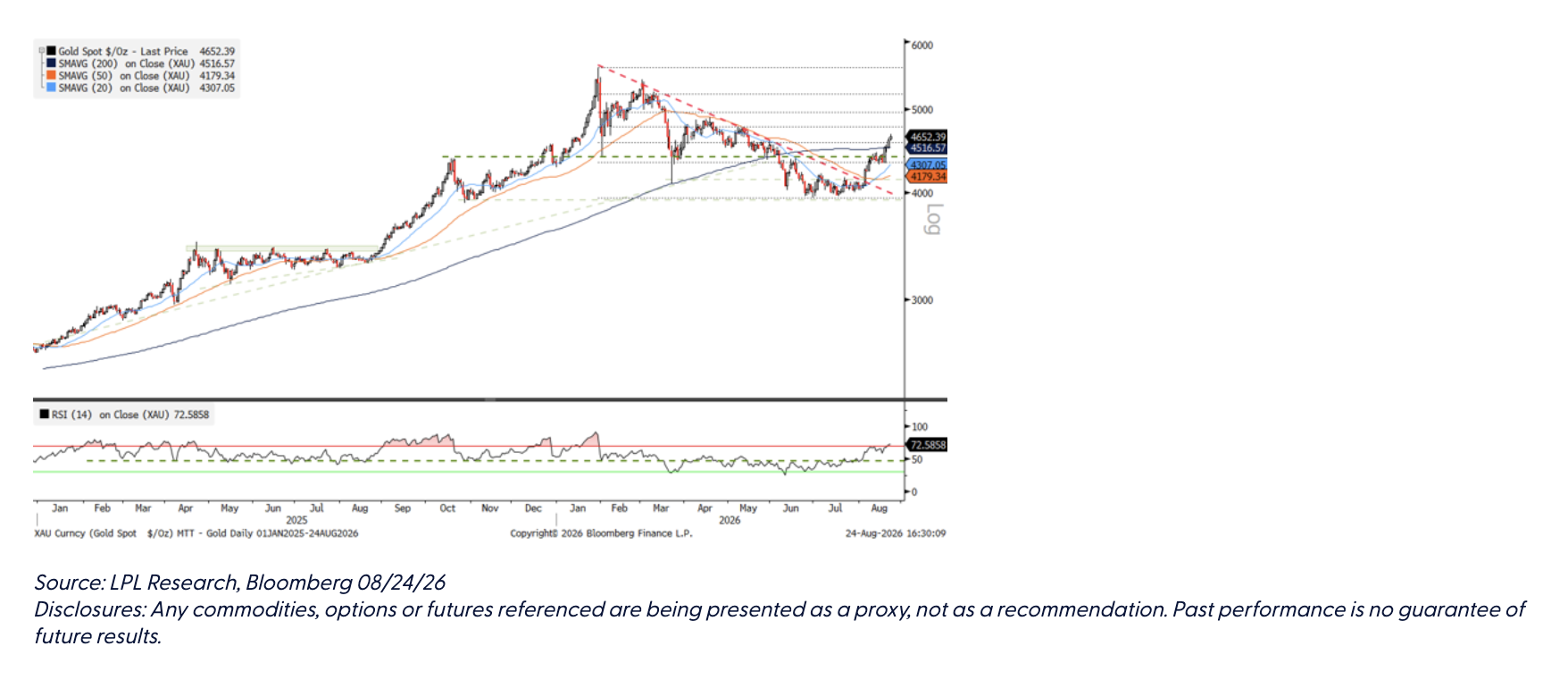
The technical setup for gold appears considerably stronger than it did in early July. The yellow metal has rebounded from oversold levels, reversed the downtrend extending from its January peak, and recaptured its closely watched 200-day moving average.
Momentum indicators are reinforcing the improving price structure. The Relative Strength Index, or RSI, has moved out of bearish territory for the first time in several months and has entered overbought territory on a short-term basis. While an overbought reading increases the likelihood of consolidation or a temporary pullback, it does not mean the rally is over. In this case, the overbought reading provides evidence that buyer enthusiasm has returned after several months of weak momentum. The more important test will be whether gold can hold above its 200-day moving average during the next period of consolidation. Doing so would strengthen the case that the summer decline represented a cyclical correction within a longer-term uptrend rather than the beginning of a sustained bear market.
Gold Reclaims Its Momentum
2006 Analog
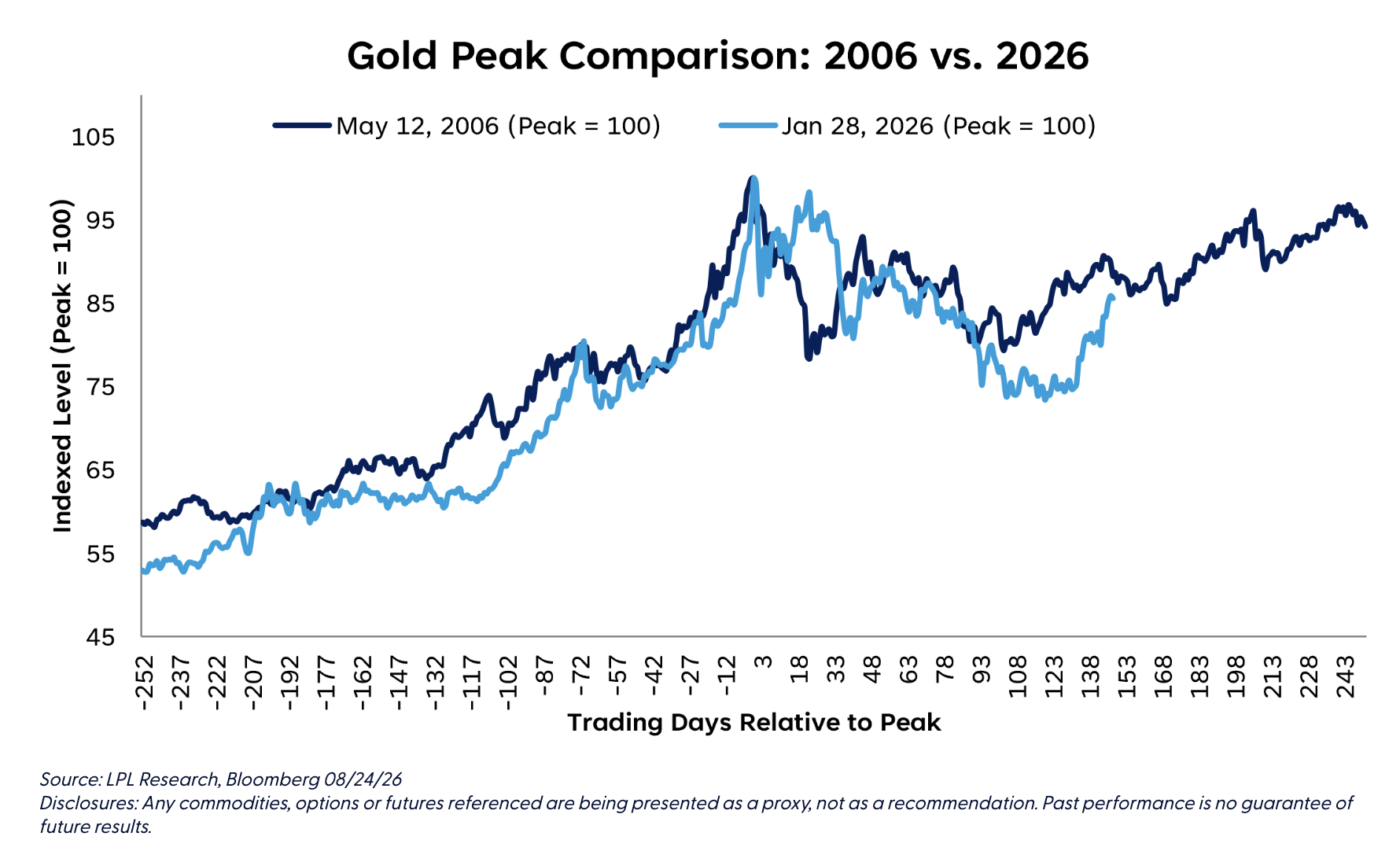
Although the macroeconomic environment is different, gold’s current price progression remains highly correlated with its bull market pattern in 2006. During that period, gold rallied sharply during the spring before undergoing a deep correction toward its 200-day moving average. The metal subsequently stabilized and resumed its longer-term advance, although the path toward its eventual 2011 peak included several significant drawdowns.
Gold’s rally from its late-October 2025 low to the January 2026 high was similar in both magnitude and duration, as was the subsequent correction into the late-June low. The comparison provides a potentially constructive road map, particularly now that gold has recovered its 200-day moving average.
As the familiar market expression goes, history does not repeat, but it often rhymes. Price action in 2006 illustrates that sharp corrections are not uncommon during secular bull markets. However, historical analogs should be treated as context rather than forecasts. Differences in inflation, monetary policy, fiscal conditions, investor positioning, and geopolitical risk could cause the current cycle to diverge considerably from the earlier pattern.
Gold Today Versus 2006
Conclusion
Gold’s corrective phase increasingly appears to have run its course, although the strength of the recent rebound leaves the metal vulnerable to short-term consolidation. The technical picture has improved meaningfully, with gold breaking its post-January downtrend, reclaiming its 200-day moving average, and registering its strongest momentum readings in several months. Cleaner positioning, a softer dollar, renewed investment demand, and a sharp recovery in central-bank purchases add fundamental support to the improving price structure.
LPL Research’s Strategic and Tactical Asset Allocation Committee maintains its positive view on precious metals, while recognizing that elevated volatility and periodic pullbacks are likely to remain features of the broader bullish trend.
Adam Turnquist oversees the management and development of technical research at LPL Financial. His investment career spans over 15 years.
Important Disclosures
This material is for general information only and is not intended to provide specific advice or recommendations for any individual. There is no assurance that the views or strategies discussed are suitable for all investors. To determine which investment(s) may be appropriate for you, please consult your financial professional prior to investing.
Investing involves risks including possible loss of principal. No investment strategy or risk management technique can guarantee return or eliminate risk.
Indexes are unmanaged and cannot be invested into directly. Index performance is not indicative of the performance of any investment and does not reflect fees, expenses, or sales charges. All performance referenced is historical and is no guarantee of future results.
This material was prepared by LPL Financial, LLC. All information is believed to be from reliable sources; however LPL Financial makes no representation as to its completeness or accuracy.
Unless otherwise stated LPL Financial and the third party persons and firms mentioned are not affiliates of each other and make no representation with respect to each other. Any company names noted herein are for educational purposes only and not an indication of trading intent or a solicitation of their products or services.
Asset Class Disclosures –
International investing involves special risks such as currency fluctuation and political instability and may not be suitable for all investors. These risks are often heightened for investments in emerging markets.
Bonds are subject to market and interest rate risk if sold prior to maturity.
Municipal bonds are subject and market and interest rate risk and potentially capital gains tax if sold prior to maturity. Interest income may be subject to the alternative minimum tax. Municipal bonds are federally tax-free but other state and local taxes may apply.
Preferred stock dividends are paid at the discretion of the issuing company. Preferred stocks are subject to interest rate and credit risk. They may be subject to a call features.
Alternative investments may not be suitable for all investors and involve special risks such as leveraging the investment, potential adverse market forces, regulatory changes and potentially illiquidity. The strategies employed in the management of alternative investments may accelerate the velocity of potential losses.
Mortgage backed securities are subject to credit, default, prepayment, extension, market and interest rate risk.
High yield/junk bonds (grade BB or below) are below investment grade securities, and are subject to higher interest rate, credit, and liquidity risks than those graded BBB and above. They generally should be part of a diversified portfolio for sophisticated investors.
Precious metal investing involves greater fluctuation and potential for losses.
The fast price swings of commodities will result in significant volatility in an investor's holdings.
This research material has been prepared by LPL Financial LLC.
Not Insured by FDIC/NCUA or Any Other Government Agency | Not Bank/Credit Union Deposits or Obligations | Not Bank/Credit Union Guaranteed | May Lose Value
For Public Use – Tracking: #1164860
A message from Advisor Perspectives and VettaFi: Discover something new! Click here to register for our upcoming webcasts.
Read more commentaries by LPL Financial