Beyond the AI battleground issues, the rebound in smaller stocks points to broader return potential.
In markets that have faced multiple sources of uncertainty this year, small-cap stocks have quietly moved to the front of the pack. Unlike the S&P 500, where performance has been heavily influenced by changing AI narratives, smaller companies have seen earnings improve across a broader set of sectors that are more closely tied to the overall US economy.
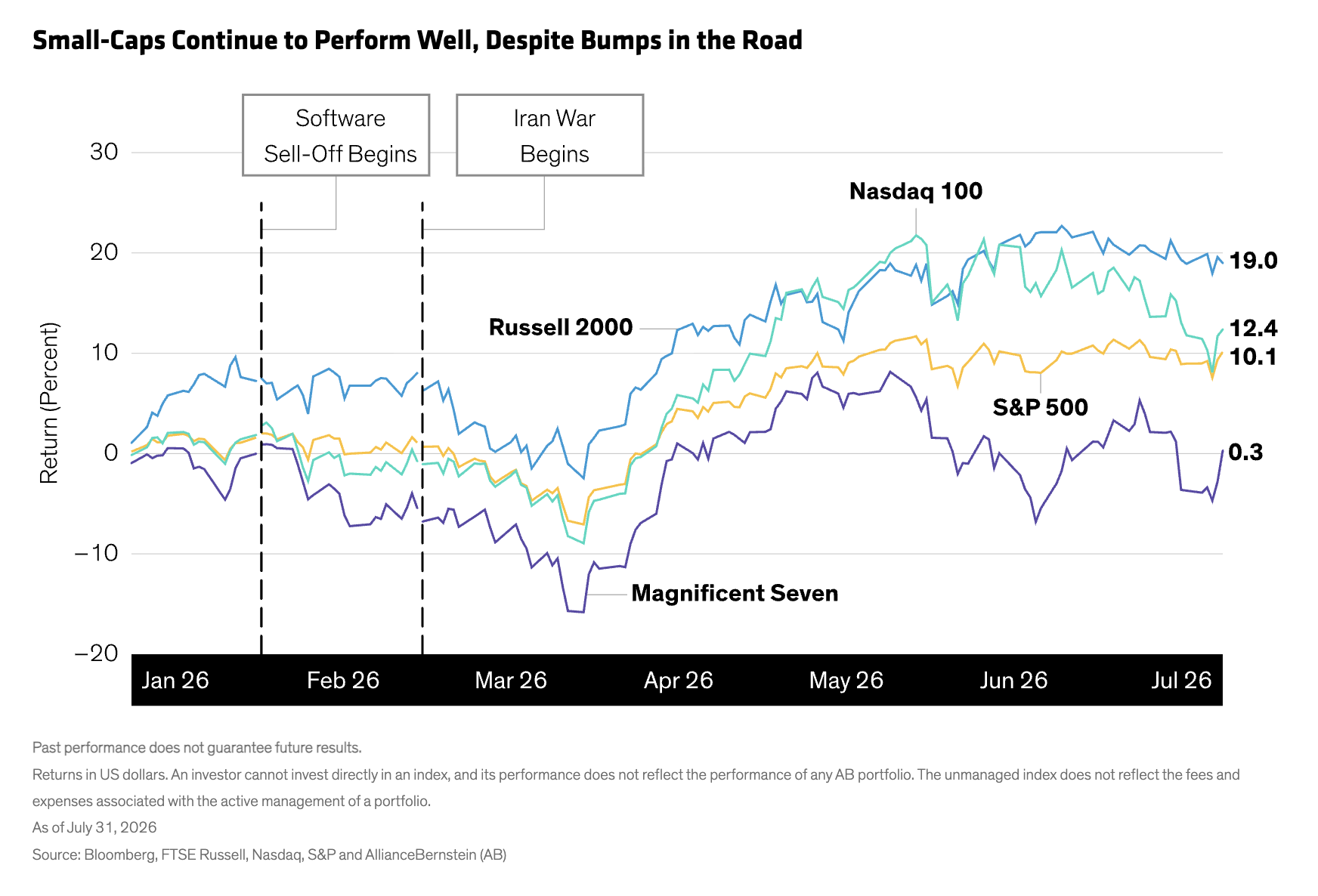
It’s been a big change after five tough years. From 2021 through 2025, the small-cap Russell 2000 Index delivered an annualized return of 6.1%, trailing the large-cap S&P 500, which advanced by 14.4% annualized over the same period. In 2026, small-cap stocks have outpaced both the Magnificent Seven and the S&P 500 by a wide margin through July, while also outperforming the tech-heavy Nasdaq 100 (Display).
See more: We Now Know Who Really Benefited from the Index Revolution
A Sustained Turning Point?
Before the shift, small-caps were burdened by post-pandemic market conditions. Inflation, higher interest rates and sluggish growth suppressed earnings of smaller companies, which are more economically sensitive than larger companies. Then, the AI-driven surge of the Magnificent Seven turbocharged the large-cap market. In our view, the S&P 500 has now effectively become an AI index, because the dominant source of earnings growth—both for the mega-caps and many other companies—comes from the AI build-out.
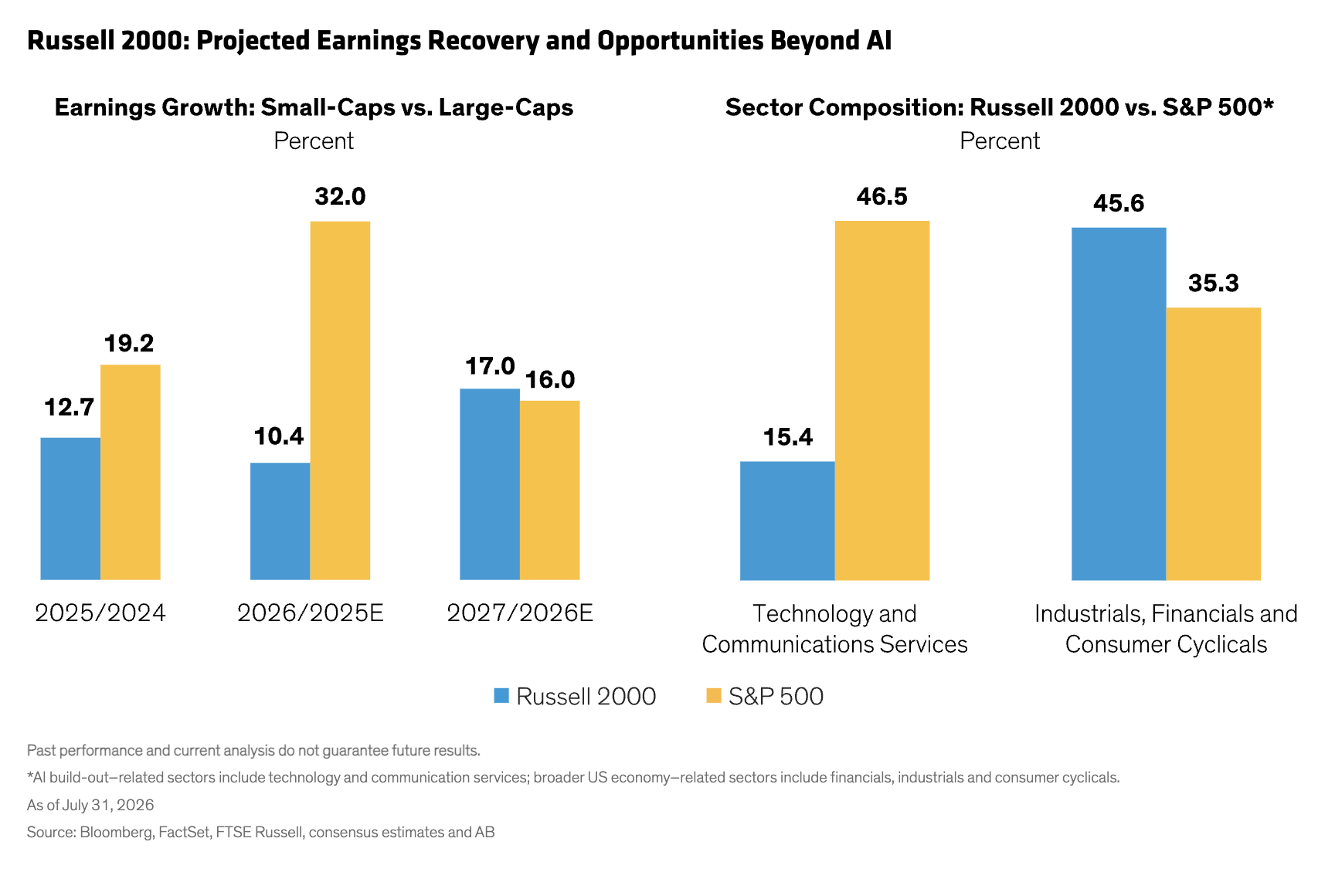
In contrast, this year’s strong returns in smaller-caps has been fueled by an emerging earnings recovery with a broader base. While small-caps earnings growth is expected to trail larger-caps in 2026, forecasts suggest stronger increases later in the year; the Russell 2000 earnings growth is now expected to outpace S&P 500 profits through the second half of 2026 and 2027, according to consensus estimates (Display). And the sector profile of small-caps transcends AI themes, which we believe can help investors tap into broader earnings sources. As seen below, by midyear, almost half the S&P 500’s weight was in technology and communications services companies, sectors that rely heavily on the AI build-out for their profit growth. By comparison, almost half of the Russell 2000’s weight is in industrials, consumer cyclicals and financials, where earnings are driven by broader exposure to the US economy.
In fact, 68% of small-cap companies have significant revenue concentration in the US, versus 39% of large-cap peers, according to our research. Small-caps aren’t an “anti-AI” allocation, but in our view, they offer a viable source of diversification from the AI trade.
More Exposure to the Real Economy
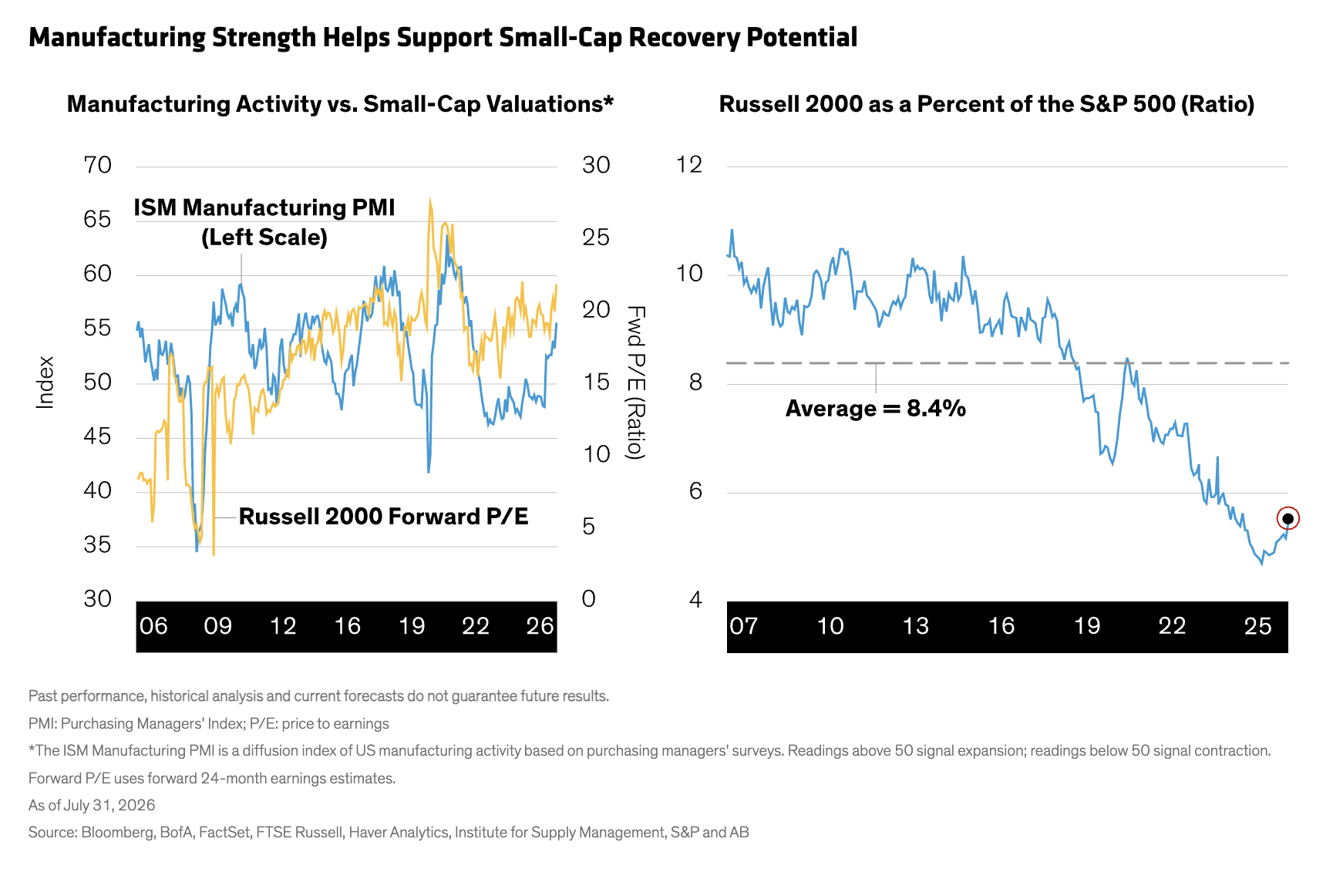
Since the Russell 2000’s composition is more broadly exposed to the US economy, the small-cap market has a more cyclical profile than the AI-focused large-cap market. As a result, price-to-earnings valuations of smaller stocks are generally more correlated with manufacturing activity. We believe smaller stocks have benefited from strong manufacturing, with the ISM Manufacturing Purchasing Managers’ Index reaching 55.6 in July, its seventh consecutive month above 50, indicating economic expansion.
Given resilient manufacturing and the strong small-cap recovery, some investors might be concerned that the rally has run its course. We disagree. In fact, even after this year’s recovery, the Russell 2000 represents only about 5.5% of the S&P 500’s market value (Display), well below its longer-term footprint. In our view, this suggests there is more potential for smaller-caps to rebound further toward levels that are more consistent with their long-term position.
Of course, there are risks to consider. For example, the US economy could face headwinds if elevated energy prices create persistently higher inflation, leading to higher interest rates. A slowdown in the AI build-out could also weigh on broader US economic growth. Negative macro forces would indeed raise the hurdles for small-cap performance.
Quality Underpins Long-Term Potential
But the AI build-out could also be a catalyst for growth by unlocking productivity gains over time via efficiency and margin improvements. Smaller-cap stocks have long suffered a scale disadvantage compared to large-cap peers, keeping them from enjoying some of the productivity and efficiency gains from globalization and advances in technology. We believe AI tools have the potential to level the playing field somewhat, helping smaller companies unlock the same productivity gains as large-caps.
At this juncture, we think small-caps are in a sweet spot to benefit from broadening growth while also being less vulnerable to AI-induced volatility. What’s more, we believe the combination of AI-driven efficiency and a broader base has the potential to close the quality gap between small-caps and large-caps. Active investors who focus on companies with strong return on equity and free cash flow can discover attractive opportunities in both the small-cap value and growth universes.
After years in the shadow of mega-cap tech, small-caps are presenting a more compelling case for inclusion in equity allocations. In today’s market, selectively chosen small-cap stocks can help reduce reliance on AI-linked outcomes. For investors who may have been wary of the asset class, we believe small-caps now provide a valuable source of improving earnings streams that support long-term return potential beyond the market’s dominant growth drivers.
The views expressed herein do not constitute research, investment advice or trade recommendations, do not necessarily represent the views of all AB portfolio-management teams and are subject to change over time.
Samantha S. Lau was named Chief Investment Officer of Small and Mid Cap Growth Equities in October 2023.
James MacGregor was appointed Chief Investment Officer of US Small and Mid Cap Value Equities in 2009.
A message from Advisor Perspectives and VettaFi: Discover something new! Click here to register for our upcoming webcasts.
© AllianceBernstein
Read more commentaries by AllianceBernstein